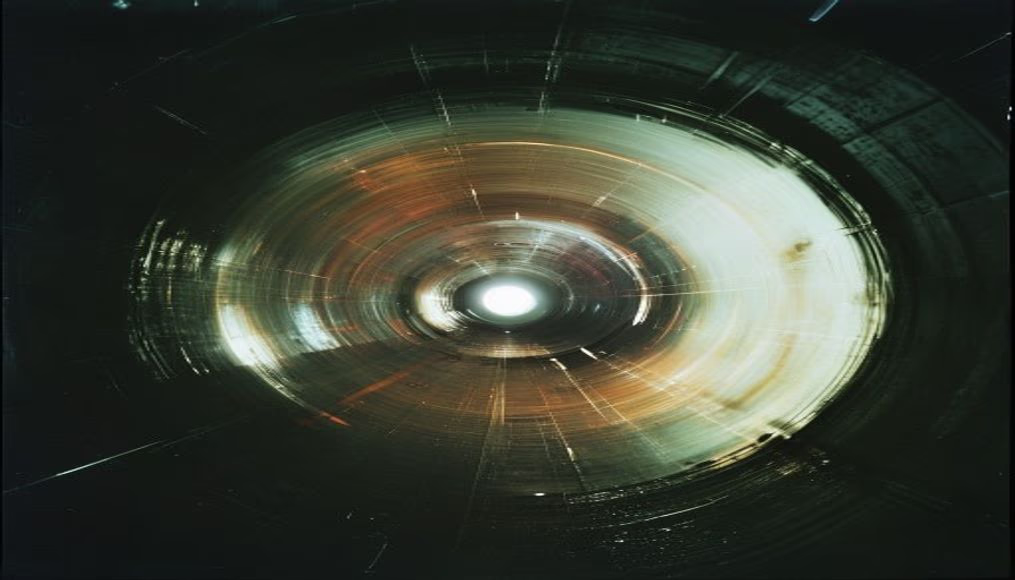
Red giant star expanding
1344×768 · AVIF · CC BY 4.0

Red giant stars are late stages of stellar evolution, when the hydrogen core is depleted and the star expands dramatically.
About this subject
A red giant is a star that has exhausted the hydrogen in its core and begun helium fusion, leading to a colossal expansion and intense brightness. This stage occurs in low to intermediate mass stars, like our Sun, which will become a red giant in about 5 billion years. During this phase, the star's radius can increase hundreds of times, engulfing nearby planets. The surface temperature drops, giving the star a reddish hue.
The expansion process begins when radiation pressure in the core overcomes gravity, causing outer layers to detach. The star then becomes variable, pulsating with periods that can last months. Famous examples include Betelgeuse in Orion and Aldebaran in Taurus. Betelgeuse, about 640 light-years away, is a red supergiant visible to the naked eye and has been studied for its variable brightness and possible future supernova.
Red giants play a crucial role in nucleosynthesis, producing elements like carbon and oxygen via nuclear fusion. These elements are ejected into interstellar space when the star sheds its outer layers, forming planetary nebulae. The central remnant becomes a white dwarf. Without these stars, the universe's chemistry would be poor, and rocky planets like Earth would not exist.
Interestingly, the expansion of a red giant can be observed in real time thanks to modern telescopes. Astronomers monitor changes in angular diameter and luminosity to understand internal dynamics. ESA's Gaia mission has mapped thousands of red giants, providing data on distances and motions. These observations help refine stellar evolution models and predict the Sun's fate.
Frequently Asked Questions
What causes a star to become a red giant?
When a star exhausts hydrogen in its core, nuclear fusion stops and the core contracts under gravity, heating up. This ignites helium fusion in shells around the core, generating pressure that expands the outer layers, turning the star into a red giant.
How long does the red giant phase last?
The duration depends on the star's mass. For the Sun, the red giant phase is estimated to last about 1 billion years, a relatively short period compared to its 10 billion year main sequence life.
Will the Sun swallow Earth when it becomes a red giant?
Yes, it is likely. When the Sun expands, its radius will reach Earth's orbit, vaporizing the planet. However, this will happen billions of years from now, and Earth will already be uninhabitable due to the Sun's gradual increase in luminosity.
Direct URL
https://pub-c7d6a6ea828543ac903a74a341ccb2e1.r2.dev/imagens/red-giant-star-expanding-magazine-editorial-p9.avifHow to credit
Include a visible link back to UtilizAí. Copy one of the snippets below:
<a href="https://xn--utiliza-eza.com/en/midia/imagens/red-giant-star-expanding-magazine-editorial-p9">Red giant star expanding</a> by <a href="https://xn--utiliza-eza.com">UtilizAí</a>, licensed under <a href="https://creativecommons.org/licenses/by/4.0/">CC BY 4.0</a>.
[Red giant star expanding](https://xn--utiliza-eza.com/en/midia/imagens/red-giant-star-expanding-magazine-editorial-p9) by [UtilizAí](https://xn--utiliza-eza.com), CC BY 4.0
License: CC-BY-4.0