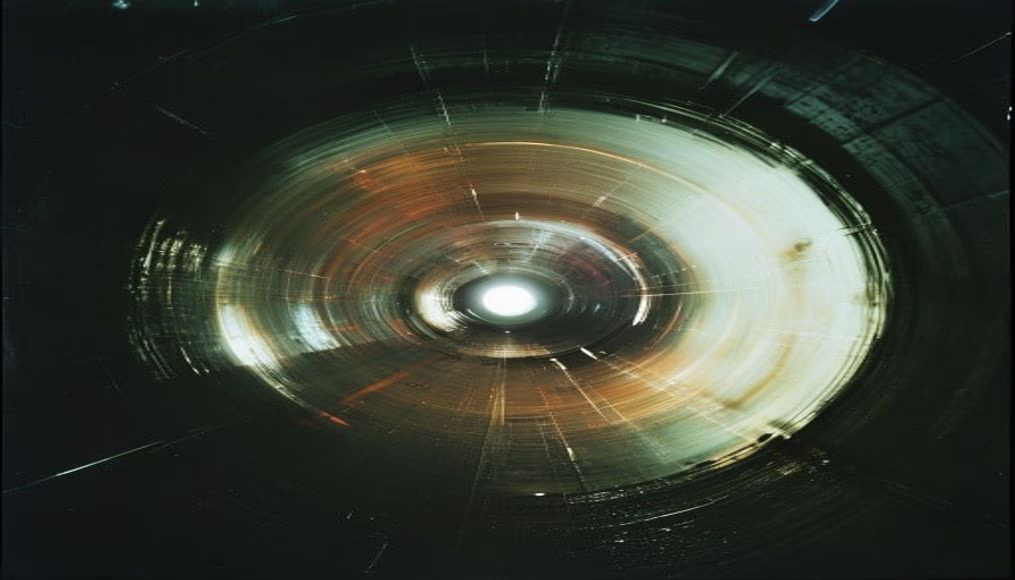
Red giant star expanding
1344×768 · AVIF · CC BY 4.0

A red giant star is an advanced stage of stellar evolution, where the core contracts and the outer layers expand dramatically.
About this subject
A red giant star represents the final stage of life for low to intermediate mass stars, like our Sun. This stage begins when the hydrogen in the stellar core is exhausted, halting the nuclear fusion reactions that generate pressure to counterbalance gravity. The core then contracts under its own weight, heating up to over 100 million degrees Celsius, allowing helium fusion into carbon and oxygen. Meanwhile, the outer layers expand and cool, taking on a reddish hue and a size that can reach tens to hundreds of times the original diameter.
Notable examples include Betelgeuse in the constellation Orion and Aldebaran in Taurus. Betelgeuse is a red supergiant about 700 times the Sun's diameter and 100,000 times more luminous. These stars play a crucial role in stellar nucleosynthesis, producing heavier elements like carbon, nitrogen, and oxygen that are scattered into the interstellar medium through stellar winds or supernova explosions for more massive stars.
The fate of a red giant depends on its mass. For Sun-like stars, after the red giant phase, the star ejects its outer layers forming a planetary nebula, while the remaining core becomes a white dwarf composed mainly of carbon and oxygen. More massive stars may go through multiple nuclear burning phases and eventually explode as a supernova, leaving behind a neutron star or black hole. The red giant phase typically lasts a few hundred million years, a relatively short period on the stellar lifetime scale of billions of years.
Frequently Asked Questions
What causes a star to become a red giant?
The process begins when the hydrogen in the star's core is exhausted. Without the pressure from nuclear fusion to balance gravity, the core contracts and heats up, while the outer layers expand and cool, resulting in the reddish color and enormous size.
How long does the red giant phase last?
The duration varies with the star's mass, but typically lasts a few hundred million years. Less massive stars may remain in this phase longer, while more massive ones evolve more quickly.
What is the end fate of a red giant?
For Sun-like stars, after the red giant phase, the core becomes a white dwarf and the outer layers form a planetary nebula. Much more massive stars may explode as a supernova and become a neutron star or black hole.
Direct URL
https://pub-c7d6a6ea828543ac903a74a341ccb2e1.r2.dev/imagens/red-giant-star-expanding-documentary-photography-p2.avifHow to credit
Include a visible link back to UtilizAí. Copy one of the snippets below:
<a href="https://xn--utiliza-eza.com/en/midia/imagens/red-giant-star-expanding-documentary-photography-p2">Red giant star expanding</a> by <a href="https://xn--utiliza-eza.com">UtilizAí</a>, licensed under <a href="https://creativecommons.org/licenses/by/4.0/">CC BY 4.0</a>.
[Red giant star expanding](https://xn--utiliza-eza.com/en/midia/imagens/red-giant-star-expanding-documentary-photography-p2) by [UtilizAí](https://xn--utiliza-eza.com), CC BY 4.0
License: CC-BY-4.0