Ram memory module ddr5
1344×768 · AVIF · CC BY 4.0
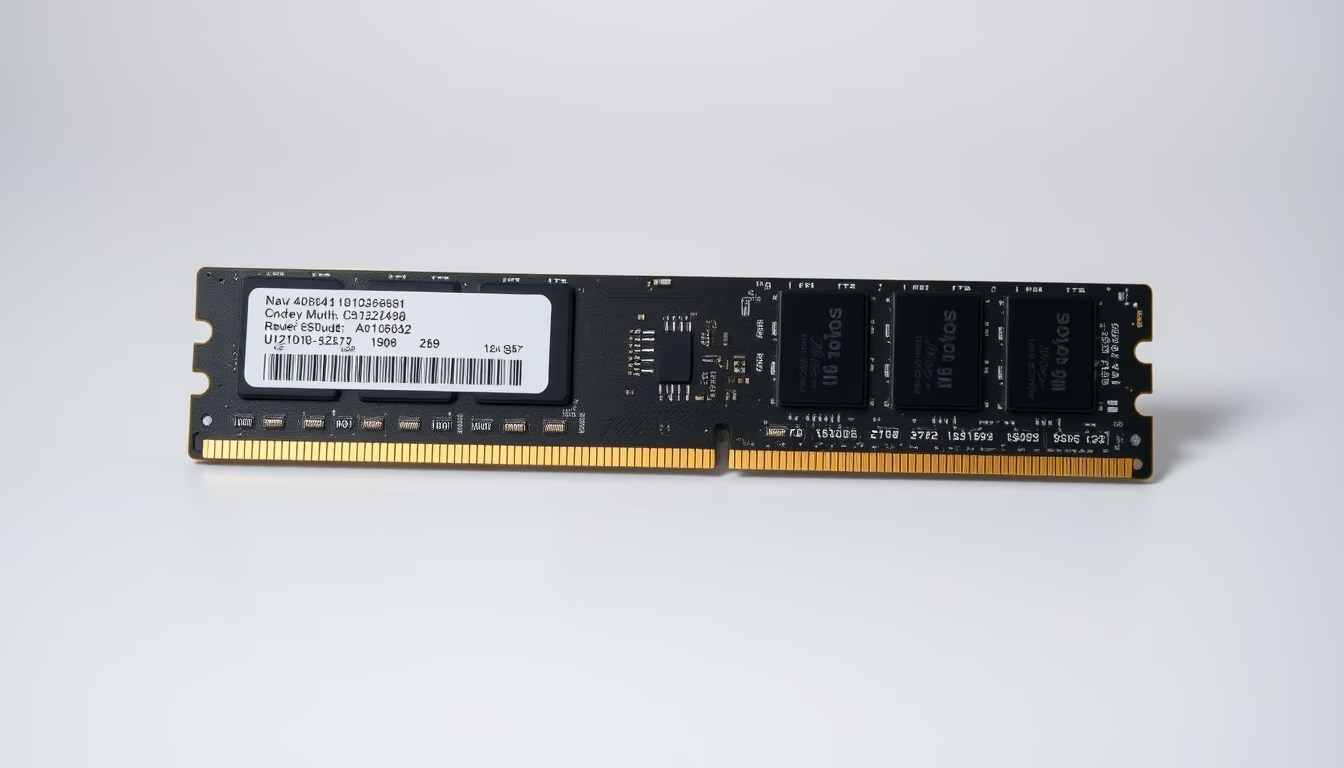
DDR5 RAM memory module, the successor to DDR4, delivers higher bandwidth and energy efficiency for modern computers.
About this subject
DDR5 (Double Data Rate 5) is the latest generation of RAM for computers, succeeding DDR4. Officially launched in 2020 by JEDEC (Joint Electron Device Engineering Council), DDR5 brings significant improvements in speed and capacity. While DDR4 topped at 3200 MT/s, DDR5 starts at 4800 MT/s and can reach 8400 MT/s or more on overclocked modules. Chip density is higher too, allowing modules up to 512 GB per stick, compared to 32 GB for DDR4.
One innovation of DDR5 is the inclusion of two independent 32-bit channels per module instead of a single 64-bit channel. This effectively doubles bandwidth without increasing clock frequency. Another change is the shift of power management to the module itself, with a built-in PMIC (Power Management IC) that improves voltage regulation and reduces noise. Operating voltage dropped from 1.2V (DDR4) to 1.1V, contributing to lower power consumption.
DDR5 is ideal for high-bandwidth applications like 8K video editing, 3D rendering, scientific simulations, and AAA gaming. Consumer adoption began with Intel Alder Lake (12th gen) and AMD Ryzen 7000 (Raphael series) platforms. Latencies (CL) are higher than DDR4, but speed compensates in sequential data access tasks. The technology also supports on-die ECC (Error Correction Code), improving stability for servers and workstations.
A fun fact: DDR5 development took years of collaboration among chip and module manufacturers like Samsung, SK Hynix, Micron, Corsair, and G.Skill. The standard will keep evolving, with speeds above 10,000 MT/s expected in future revisions. For PC builders, checking motherboard and CPU compatibility is crucial, as DDR5 is not interchangeable with DDR4, sockets and controllers differ.
Frequently Asked Questions
Is DDR5 compatible with DDR4 motherboards?
No. DDR5 uses a different physical socket and a distinct memory controller, so it is not compatible with DDR4 motherboards. A motherboard with specific DDR5 support is required.
Is DDR5 worth it for gaming?
Yes, especially in titles that benefit from high bandwidth, like AAA games and simulations. However, the gain is smaller in games that depend more on latency. Still, more games are expected to optimize for DDR5.
What is the expected lifespan of DDR5 modules?
DDR5 modules have a similar lifespan to DDR4, around 5 to 10 years under normal use. However, as technology advances quickly, functional obsolescence may occur before physical wear.
Direct URL
https://pub-c7d6a6ea828543ac903a74a341ccb2e1.r2.dev/imagens/ram-memory-module-ddr5-studio-still-life-p9.avifHow to credit
Include a visible link back to UtilizAí. Copy one of the snippets below:
<a href="https://xn--utiliza-eza.com/en/midia/imagens/ram-memory-module-ddr5-studio-still-life-p9">Ram memory module ddr5</a> by <a href="https://xn--utiliza-eza.com">UtilizAí</a>, licensed under <a href="https://creativecommons.org/licenses/by/4.0/">CC BY 4.0</a>.
[Ram memory module ddr5](https://xn--utiliza-eza.com/en/midia/imagens/ram-memory-module-ddr5-studio-still-life-p9) by [UtilizAí](https://xn--utiliza-eza.com), CC BY 4.0
License: CC-BY-4.0