Ram memory module ddr5
1344×768 · AVIF · CC BY 4.0
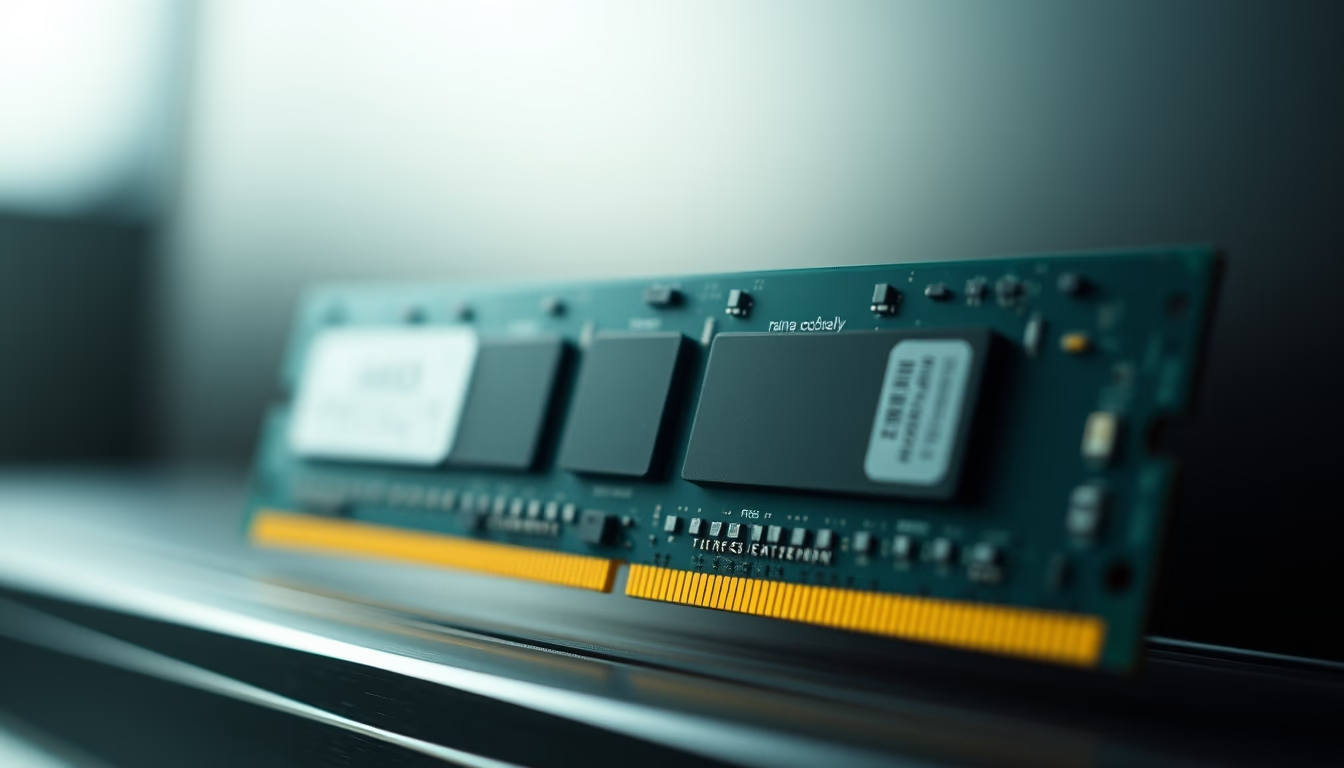
The DDR5 RAM memory module represents the latest evolution in volatile memory technology for computers, offering higher bandwidth and energy efficiency.
About this subject
DDR5 (Double Data Rate 5) memory is the successor standard to DDR4, officially introduced by JEDEC (Joint Electron Device Engineering Council) in 2020. It doubles the maximum transfer rate of DDR4, reaching up to 6400 MT/s (megatransfers per second) on standard modules, with future versions expected to exceed 8000 MT/s. This improvement is crucial for modern processors such as Intel Core 12th to 14th gen and AMD Ryzen 7000 series, which benefit from higher bandwidth for tasks like 8K video editing, 3D rendering, and games with large textures.
One of the most significant innovations in DDR5 is the integration of the voltage regulator (PMIC) directly onto the module, allowing more precise power management and reduced power consumption compared to DDR4. Additionally, capacity per module has increased: while DDR4 supports up to 32 GB per stick, DDR5 can reach 128 GB, with plans for 512 GB in the future. Latency is slightly higher in terms of clock cycles, but the speed gain compensates for this aspect.
In the current market, DDR5 modules are common in high-performance computers, but the cost is still higher than DDR4, though it is gradually decreasing. Mass adoption is expected to accelerate with platforms that exclusively support DDR5, such as LGA1700 and AM5 sockets. For the average user, the practical difference is noticeable in data-intensive applications like data science and artificial intelligence, but for everyday use DDR4 remains sufficient. The durability and reliability of DDR5 modules follow strict industry standards, operating at reduced voltages (1.1V) compared to DDR4 (1.2V).
Frequently Asked Questions
What is the difference between DDR5 and DDR4?
DDR5 offers higher bandwidth (up to 6400 MT/s vs 3200 MT/s for DDR4), greater capacity per module (up to 128 GB vs 32 GB), and improved energy efficiency thanks to the integrated PMIC, operating at 1.1V compared to 1.2V for DDR4.
Are DDR5 modules compatible with DDR4 motherboards?
No, because the slots are physically different (288 pins but with distinct notch positions) and operating voltages differ. A motherboard with a compatible socket (e.g., LGA1700 or AM5) that supports DDR5 is required.
Is it worth investing in DDR5 for gaming?
For current games, the performance gain is small compared to high-frequency DDR4, but future titles optimized for DDR5 may benefit. If budget allows, it is a long-term investment for newer platforms.
Direct URL
https://pub-c7d6a6ea828543ac903a74a341ccb2e1.r2.dev/imagens/ram-memory-module-ddr5-film-grain-authentic-p7.avifHow to credit
Include a visible link back to UtilizAí. Copy one of the snippets below:
<a href="https://xn--utiliza-eza.com/en/midia/imagens/ram-memory-module-ddr5-film-grain-authentic-p7">Ram memory module ddr5</a> by <a href="https://xn--utiliza-eza.com">UtilizAí</a>, licensed under <a href="https://creativecommons.org/licenses/by/4.0/">CC BY 4.0</a>.
[Ram memory module ddr5](https://xn--utiliza-eza.com/en/midia/imagens/ram-memory-module-ddr5-film-grain-authentic-p7) by [UtilizAí](https://xn--utiliza-eza.com), CC BY 4.0
License: CC-BY-4.0