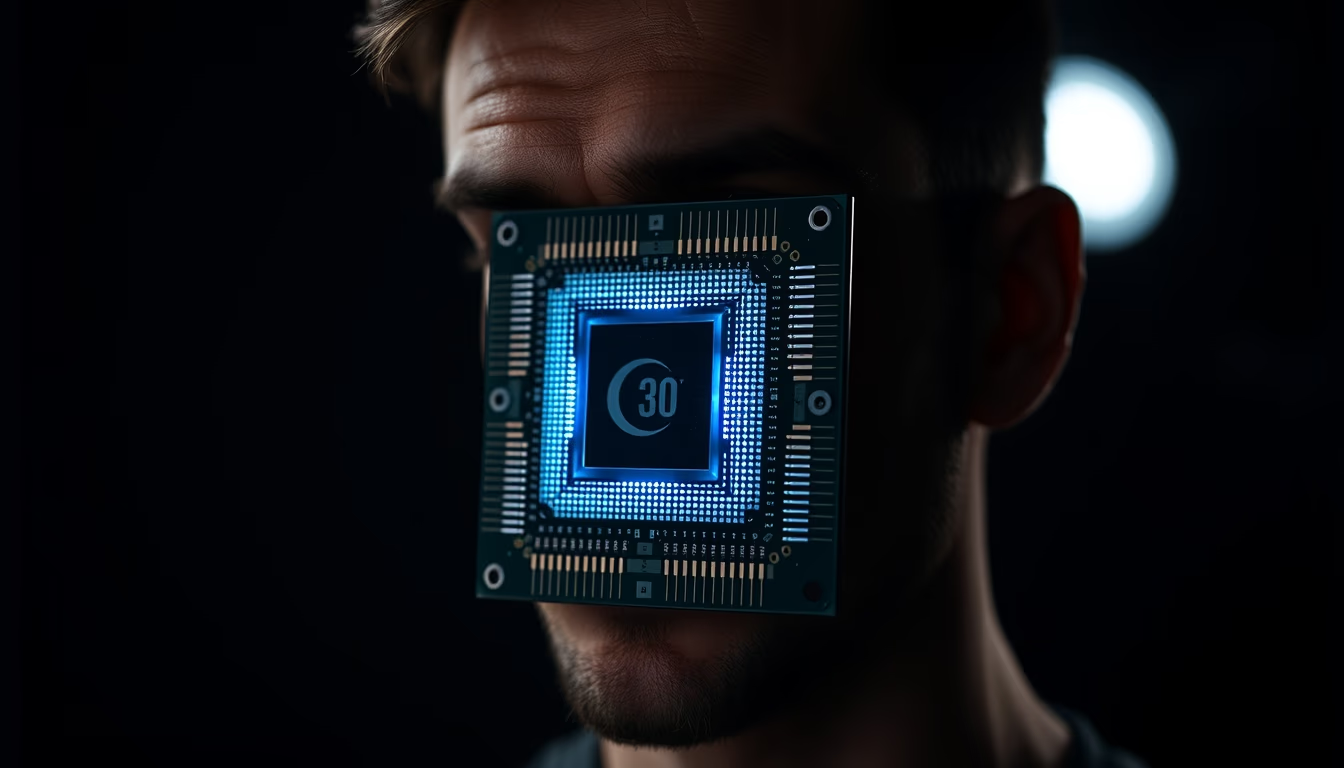
Quantum entanglement visualization
1344×768 · AVIF · CC BY 4.0

Conceptual visualization of quantum entanglement, a phenomenon where particles share a quantum state regardless of distance.
About this subject
Quantum entanglement is a phenomenon in quantum mechanics where two or more particles become interconnected such that the state of one cannot be described independently of the others, even when separated by great distances. The concept was formalized by Erwin Schrödinger in 1935, following the famous EPR (Einstein-Podolsky-Rosen) paper that questioned the completeness of quantum theory. Einstein called it "spooky action at a distance," as it seemed to violate special relativity.
In practice, entanglement underpins technologies such as quantum computing, quantum cryptography, and quantum teleportation. In 2015, a Bell test experiment using diamonds in laboratories separated by 1.3 km confirmed the violation of Bell inequalities, demonstrating quantum nonlocality. Today, satellite experiments like China's Micius can entangle photons over 1,200 km apart.
A key curiosity: entanglement does not enable faster-than-light information transmission because measuring one particle collapses the entangled state, but the outcome is random. To transmit information, an additional classical channel is needed, preserving causality. This intriguing phenomenon remains a cornerstone of the ongoing quantum revolution.
Frequently Asked Questions
Can quantum entanglement be used for instant communication?
No, quantum entanglement does not allow faster-than-light communication. Measuring one particle gives a random result, and transmitting information requires a classical channel, preserving causality.
What is the difference between quantum entanglement and superposition?
Superposition is a particle's ability to exist in multiple states simultaneously. Entanglement is a correlation between multiple particles where their states are non-separably linked.
What are Bell tests and why are they important?
Bell tests are experiments that verify Bell inequalities, proposed by John Bell in 1964. They demonstrate that quantum mechanics is incompatible with local hidden variable theories, confirming quantum nonlocality.
Direct URL
https://pub-c7d6a6ea828543ac903a74a341ccb2e1.r2.dev/imagens/quantum-entanglement-visualization-travel-photography-p5.avifHow to credit
Include a visible link back to UtilizAí. Copy one of the snippets below:
<a href="https://xn--utiliza-eza.com/en/midia/imagens/quantum-entanglement-visualization-travel-photography-p5">Quantum entanglement visualization</a> by <a href="https://xn--utiliza-eza.com">UtilizAí</a>, licensed under <a href="https://creativecommons.org/licenses/by/4.0/">CC BY 4.0</a>.
[Quantum entanglement visualization](https://xn--utiliza-eza.com/en/midia/imagens/quantum-entanglement-visualization-travel-photography-p5) by [UtilizAí](https://xn--utiliza-eza.com), CC BY 4.0
License: CC-BY-4.0