Quantum computer in research lab
1344×768 · AVIF · CC BY 4.0
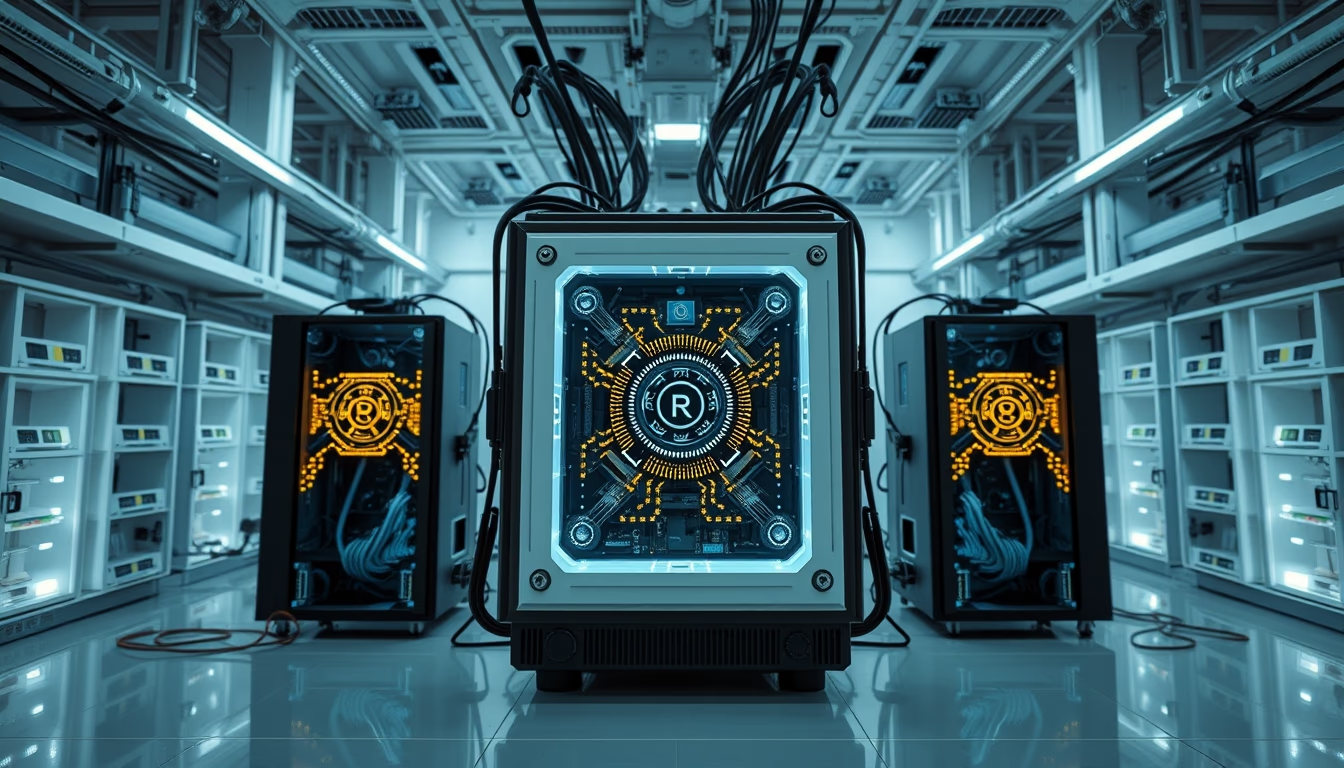
A quantum computer operating in a research lab, representing the frontier of modern computing.
About this subject
Quantum computers are devices that leverage quantum mechanics principles, such as superposition and entanglement, to process information exponentially faster than classical computers for specific problems. Unlike traditional bits (0 or 1), qubits can exist in multiple states simultaneously, enabling complex calculations in fields like cryptography, molecular simulation, and optimization.
Currently, companies like IBM, Google, and D-Wave lead development, with prototypes that have already achieved "quantum supremacy" in restricted tasks. For instance, Google's Sycamore processor in 2019 performed a calculation that would take thousands of years on a classical supercomputer. In Brazil, labs such as those at the National Center for Research in Energy and Materials (CNPEM) and universities like USP and Unicamp investigate applications in materials and chemistry.
The research lab environment shown in the image includes cryogenic cooling systems, as superconducting qubits operate at temperatures near absolute zero (about -273°C). Stability and vibration isolation are crucial to prevent quantum decoherence, which destroys the quantum state. Despite advances, quantum computers remain experimental and require complex infrastructure, but they promise to revolutionize fields such as drug discovery and artificial intelligence.
Frequently Asked Questions
What is a quantum computer and how does it differ from a classical computer?
A quantum computer uses qubits, which can represent 0 and 1 simultaneously (superposition), while classical computers use binary bits. This allows solving certain problems, like factoring large numbers, much faster.
What are the main challenges to making quantum computers practical?
Key challenges include maintaining quantum coherence (preventing qubits from losing their quantum state), scaling the number of qubits without errors, and operating at extremely low temperatures, near absolute zero.
Are there commercially available quantum computers today?
Yes, companies like IBM and D-Wave offer quantum computers via the cloud, but they are limited to specific tasks. They are mainly used for research and experimentation, not for general-purpose use.
Direct URL
https://pub-c7d6a6ea828543ac903a74a341ccb2e1.r2.dev/imagens/quantum-computer-in-research-lab-architectural-photography.avifHow to credit
Include a visible link back to UtilizAí. Copy one of the snippets below:
<a href="https://xn--utiliza-eza.com/en/midia/imagens/quantum-computer-in-research-lab-architectural-photography">Quantum computer in research lab</a> by <a href="https://xn--utiliza-eza.com">UtilizAí</a>, licensed under <a href="https://creativecommons.org/licenses/by/4.0/">CC BY 4.0</a>.
[Quantum computer in research lab](https://xn--utiliza-eza.com/en/midia/imagens/quantum-computer-in-research-lab-architectural-photography) by [UtilizAí](https://xn--utiliza-eza.com), CC BY 4.0
License: CC-BY-4.0