Quantum computer chip detail
1344×768 · AVIF · CC BY 4.0
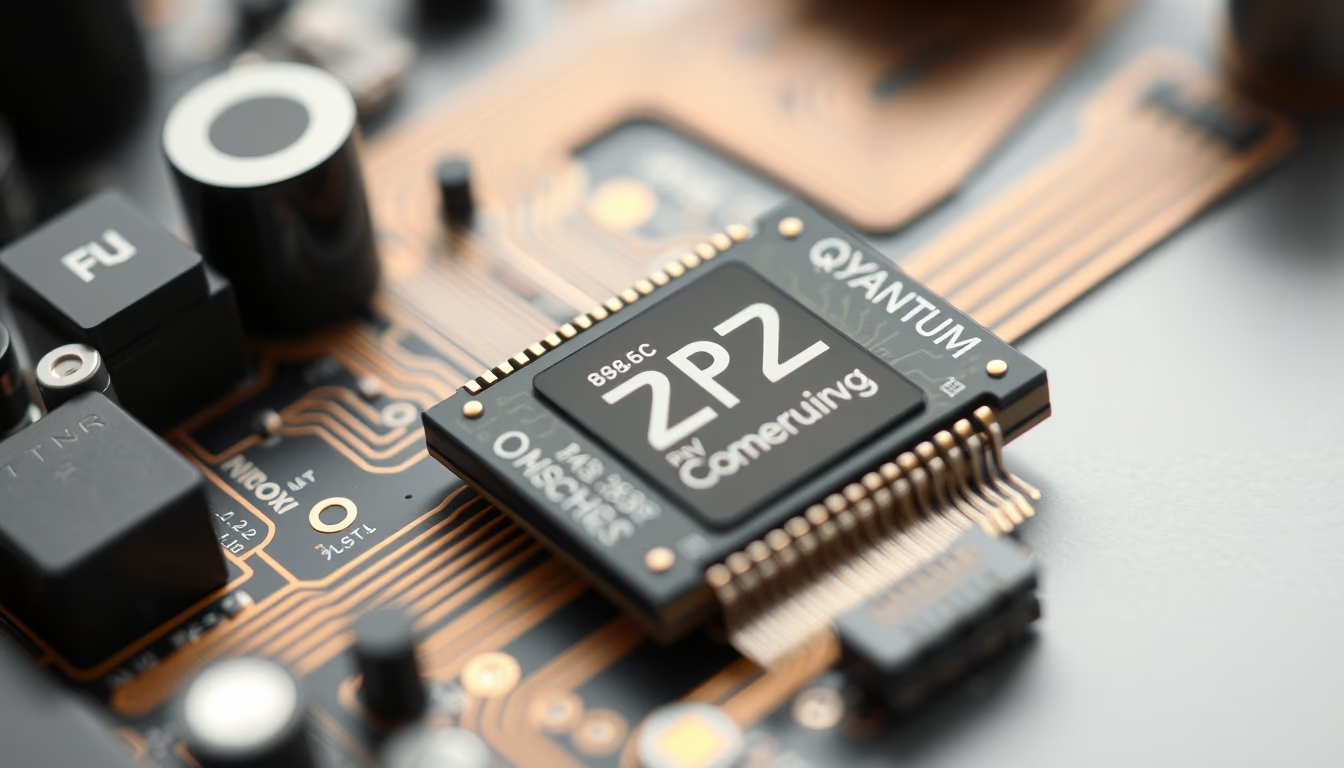
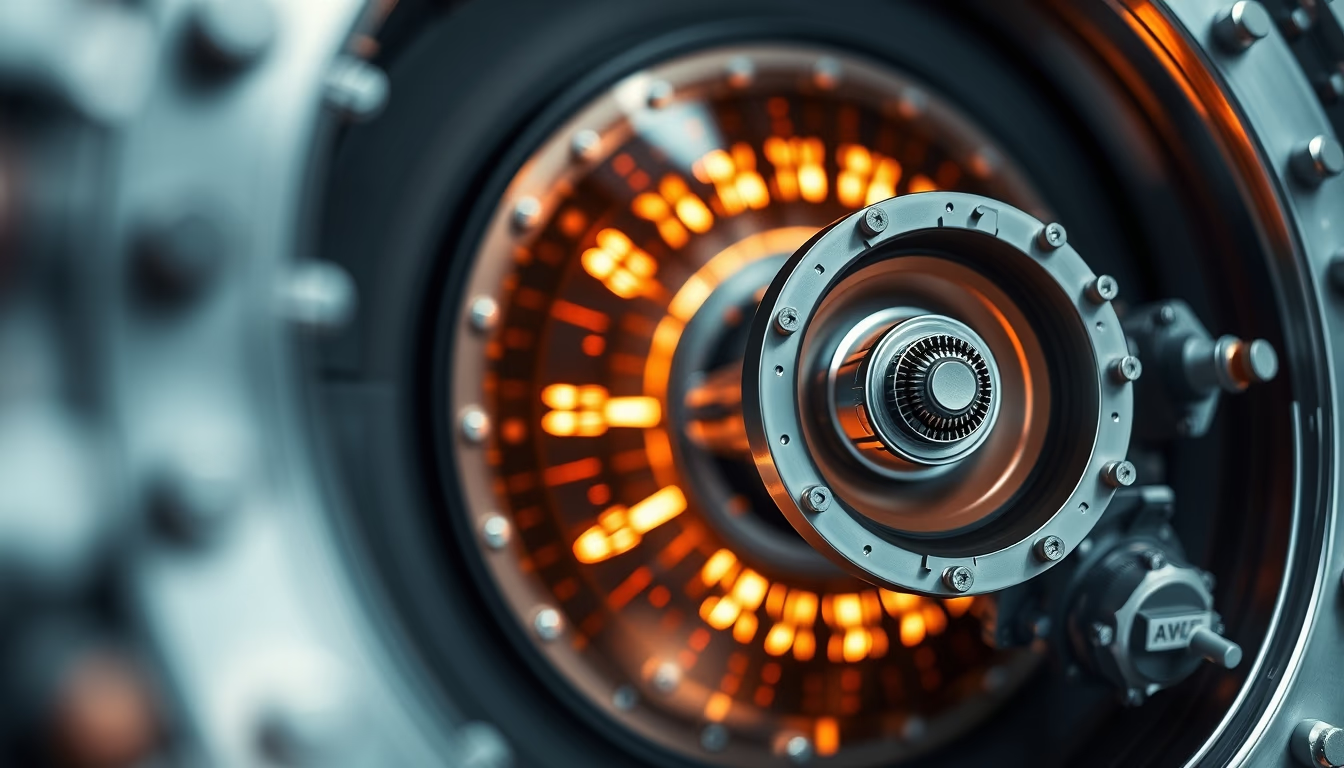
Details of a quantum computer chip, featuring superconducting qubits and cryogenic circuitry for quantum data processing.
About this subject
Quantum computer chips represent a revolution in computing, operating on principles of quantum mechanics such as superposition and entanglement. Unlike classical chips that use bits (0 or 1), quantum chips use qubits, which can exist in multiple states simultaneously. Most current quantum chips, such as those developed by Google, IBM, and Rigetti, are based on superconducting qubits, which operate at temperatures near absolute zero, around 15 millikelvin. These chips are fabricated in cleanrooms using materials like niobium and aluminum deposited on silicon substrates. Cryogenic circuitry includes resonators, amplifiers, and filters to preserve quantum coherence.
Manufacturing quantum chips faces immense challenges: sensitivity to external noise requires magnetic shielding and extreme vacuum. Each qubit has a limited lifetime, called coherence time, which must be maximized for complex calculations. Besides superconductors, other architectures include trapped ions, quantum dots, and topological qubits, each with specific advantages and difficulties. Google's Sycamore chip, for instance, achieved quantum supremacy in 2019 by solving a task in 200 seconds that would take a classical supercomputer thousands of years.
Potential applications are vast: simulating molecules for drug discovery, optimizing logistics systems, cryptography, and artificial intelligence. However, quantum error correction remains a critical bottleneck, requiring thousands of physical qubits to form a reliable logical qubit. Companies and governments invest billions in the quantum race, with predictions that fault-tolerant quantum computers could emerge within the next decade.
Frequently Asked Questions
What is the difference between a quantum chip and a classical chip?
A classical chip uses bits representing 0 or 1, while a quantum chip uses qubits that can be in superposition of states. Additionally, quantum chips operate at cryogenic temperatures and are extremely sensitive to interference.
How are superconducting qubits fabricated?
Superconducting qubits are fabricated in cleanrooms by depositing thin films of niobium or aluminum on silicon substrates. Electrodes and capacitors are lithographed to form circuits that resonate at microwave frequencies.
What is the coherence time of a qubit?
It is the duration during which a qubit maintains its quantum state before losing coherence due to interactions with the environment. The longer the coherence time, the more quantum operations can be performed accurately.
Direct URL
https://pub-c7d6a6ea828543ac903a74a341ccb2e1.r2.dev/imagens/quantum-computer-chip-detail-commercial-product-photography-p12.avifHow to credit
Include a visible link back to UtilizAí. Copy one of the snippets below:
<a href="https://xn--utiliza-eza.com/en/midia/imagens/quantum-computer-chip-detail-commercial-product-photography-p12">Quantum computer chip detail</a> by <a href="https://xn--utiliza-eza.com">UtilizAí</a>, licensed under <a href="https://creativecommons.org/licenses/by/4.0/">CC BY 4.0</a>.
[Quantum computer chip detail](https://xn--utiliza-eza.com/en/midia/imagens/quantum-computer-chip-detail-commercial-product-photography-p12) by [UtilizAí](https://xn--utiliza-eza.com), CC BY 4.0
License: CC-BY-4.0