Pyrite gold cubes
1344×768 · AVIF · CC BY 4.0
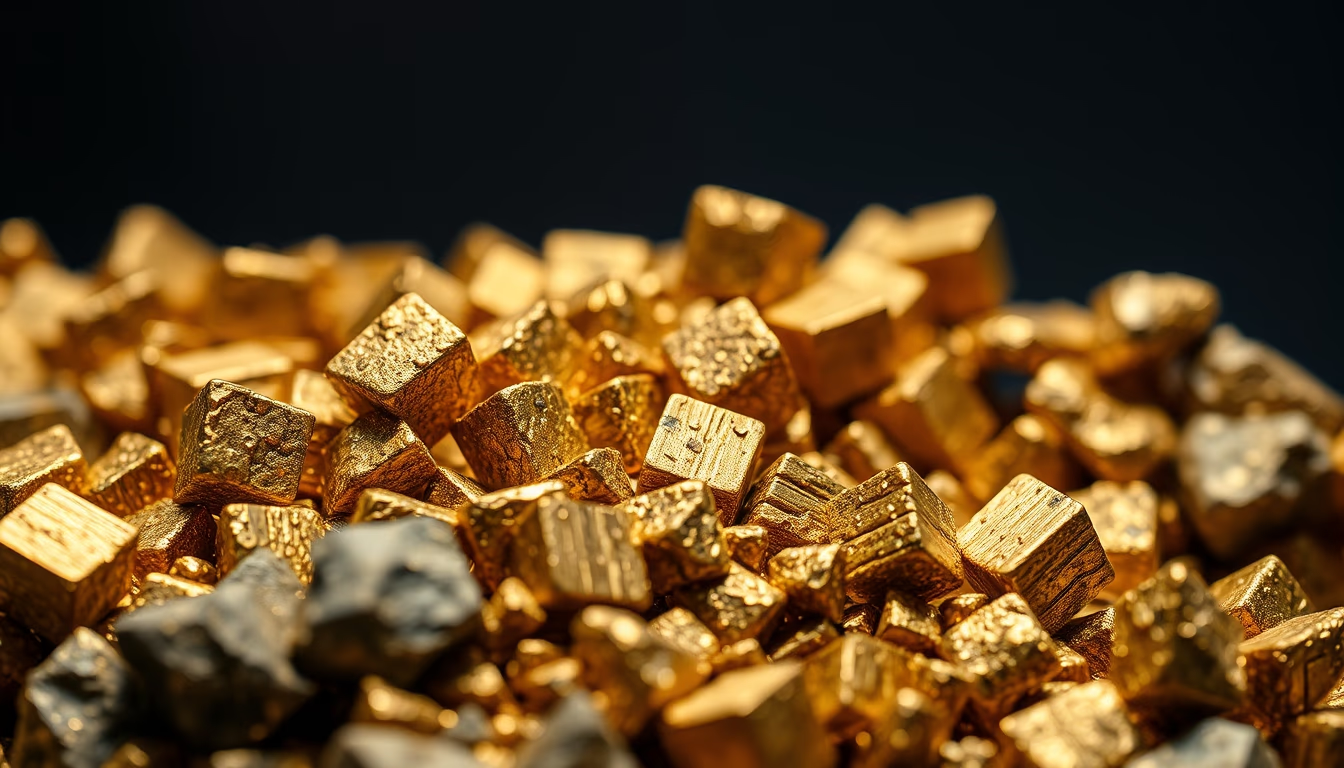
Pyrite, also known as fool's gold, forms golden cubic crystals that have deceived many unwary prospectors.
About this subject
Pyrite (FeS2) is an iron sulfide that crystallizes in the cubic system, often forming perfect cubes with striated faces. Its brass-yellow color and metallic luster make it easily mistaken for gold, but distinct physical properties set them apart: pyrite is harder (6, 6.5 on Mohs scale vs. 2.5, 3 for gold), lighter (density ~5 g/cm³ vs. ~19.3 g/cm³), and leaves a greenish-black streak, whereas gold leaves a yellow streak.
This mineral occurs in a variety of geological settings, including hydrothermal veins, sedimentary and metamorphic rocks, and coal deposits. Major deposits are found at Rio Tinto (Spain), where pyrite is associated with acid mine drainage, and in Peru, the United States, and Brazil. In Brazil, it appears in Minas Gerais, Goiás, and Bahia, often linked to gold and copper deposits.
Historically, pyrite was used as a source of sulfur for sulfuric acid production, and its cubic inclusions were polished as jewelry (called marcasite). Today, it is employed in the manufacture of lithium iron phosphate batteries and as an indicator mineral in gold prospecting. Collectors value well-formed crystals, especially the golden cubes that resemble perfect dice.
Interestingly, pyrite can contain small amounts of real gold, mainly in refractory gold deposits. In some mines, gold is occluded within pyrite crystals, making extraction more complex. Additionally, oxidation of pyrite in contact with air and water generates sulfuric acid, contributing to acid mine drainage, a serious environmental issue.
Frequently Asked Questions
How to tell pyrite from real gold?
Pyrite is harder (scratches glass), lighter, and leaves a greenish-black streak. Gold is malleable, dense, and leaves a yellow streak. A simple test: biting pyrite may break teeth, while gold dents.
Where is pyrite found in Brazil?
It occurs in Minas Gerais (Iron Quadrangle), Goiás (Crixás), Bahia (Jacobina), and Rio Grande do Sul, often associated with gold, copper, and coal deposits.
What is pyrite used for today?
Used in sulfuric acid production, lithium iron phosphate batteries, as an indicator mineral in prospecting, and in jewelry as marcasite. Collectors seek it for its cubic crystals.
Direct URL
https://pub-c7d6a6ea828543ac903a74a341ccb2e1.r2.dev/imagens/pyrite-gold-cubes-national-geographic-style-p5.avifHow to credit
Include a visible link back to UtilizAí. Copy one of the snippets below:
<a href="https://xn--utiliza-eza.com/en/midia/imagens/pyrite-gold-cubes-national-geographic-style-p5">Pyrite gold cubes</a> by <a href="https://xn--utiliza-eza.com">UtilizAí</a>, licensed under <a href="https://creativecommons.org/licenses/by/4.0/">CC BY 4.0</a>.
[Pyrite gold cubes](https://xn--utiliza-eza.com/en/midia/imagens/pyrite-gold-cubes-national-geographic-style-p5) by [UtilizAí](https://xn--utiliza-eza.com), CC BY 4.0
License: CC-BY-4.0