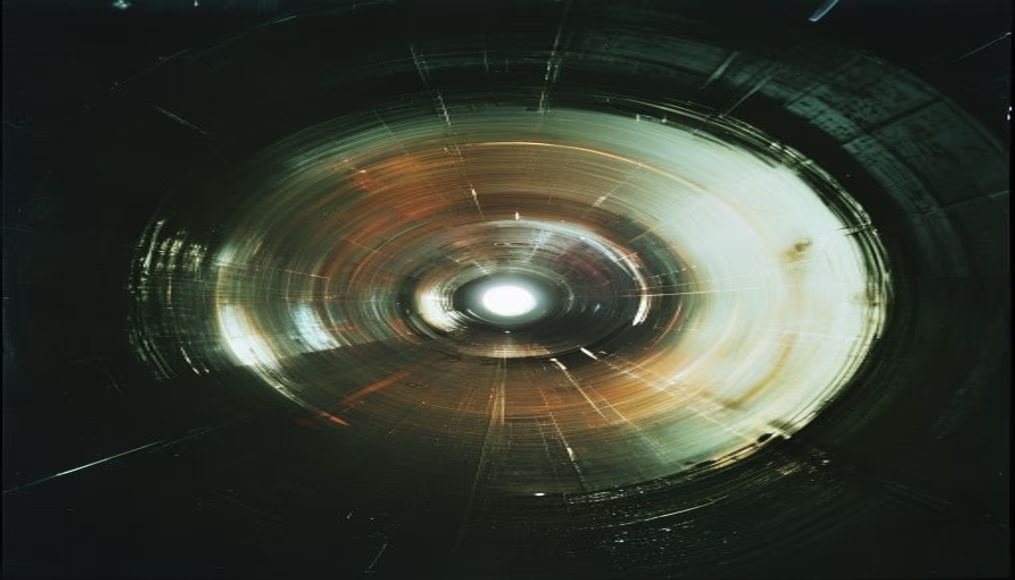
Protoplanetary disk forming
1344×768 · AVIF · CC BY 4.0

Protoplanetary disks are structures of gas and dust around young stars, where planets like Earth form over millions of years.
About this subject
A protoplanetary disk is a rotating cloud of gas and dust that surrounds a newly formed star. This structure is the birthplace of planetary systems: dust particles collide and clump together, forming increasingly larger bodies, from pebbles to planetesimals and eventually planets. The process begins when a molecular cloud collapses gravitationally, creating a protostar at the center and a disk around it. The disk contains materials such as hydrogen, helium, ice, and silicates, which are the basic ingredients for rocky and gas giant planets.
Observations with telescopes like ALMA (Atacama Large Millimeter/submillimeter Array) have revealed detailed structures in these disks, such as rings and gaps, which indicate the presence of forming planets. Our Solar System, for instance, originated from a protoplanetary disk about 4.6 billion years ago. Protoplanetary disks are estimated to last from 1 to 10 million years, a critical period for planet formation. The chemical composition of the disk directly influences the types of planets that emerge, such as terrestrial or gas giants.
Interestingly, protoplanetary disks are not exclusive to our galaxy. They have been observed in other regions of the Milky Way, such as the Orion Nebula. They also vary in size: some have radii of just a few astronomical units, while others extend hundreds. Studying these disks helps astronomers understand not only the origin of planets but also stellar evolution and the conditions that may lead to the emergence of life.
Frequently Asked Questions
What is a protoplanetary disk?
It is a structure of gas and dust orbiting a young star, where planet formation occurs. It forms from the collapse of a molecular cloud.
How long does a protoplanetary disk last?
Typically between 1 and 10 million years. After that, the gas dissipates and the dust aggregates into planets or other bodies.
How do planets form inside the disk?
Dust particles collide and stick together via electrostatic and gravitational forces, forming larger bodies. This accretion process leads to planetesimals and eventually planets.
Direct URL
https://pub-c7d6a6ea828543ac903a74a341ccb2e1.r2.dev/imagens/protoplanetary-disk-forming-high-fashion-editorial-p12.avifHow to credit
Include a visible link back to UtilizAí. Copy one of the snippets below:
<a href="https://xn--utiliza-eza.com/en/midia/imagens/protoplanetary-disk-forming-high-fashion-editorial-p12">Protoplanetary disk forming</a> by <a href="https://xn--utiliza-eza.com">UtilizAí</a>, licensed under <a href="https://creativecommons.org/licenses/by/4.0/">CC BY 4.0</a>.
[Protoplanetary disk forming](https://xn--utiliza-eza.com/en/midia/imagens/protoplanetary-disk-forming-high-fashion-editorial-p12) by [UtilizAí](https://xn--utiliza-eza.com), CC BY 4.0
License: CC-BY-4.0