Protoplanetary disk forming
1344×768 · AVIF · CC BY 4.0
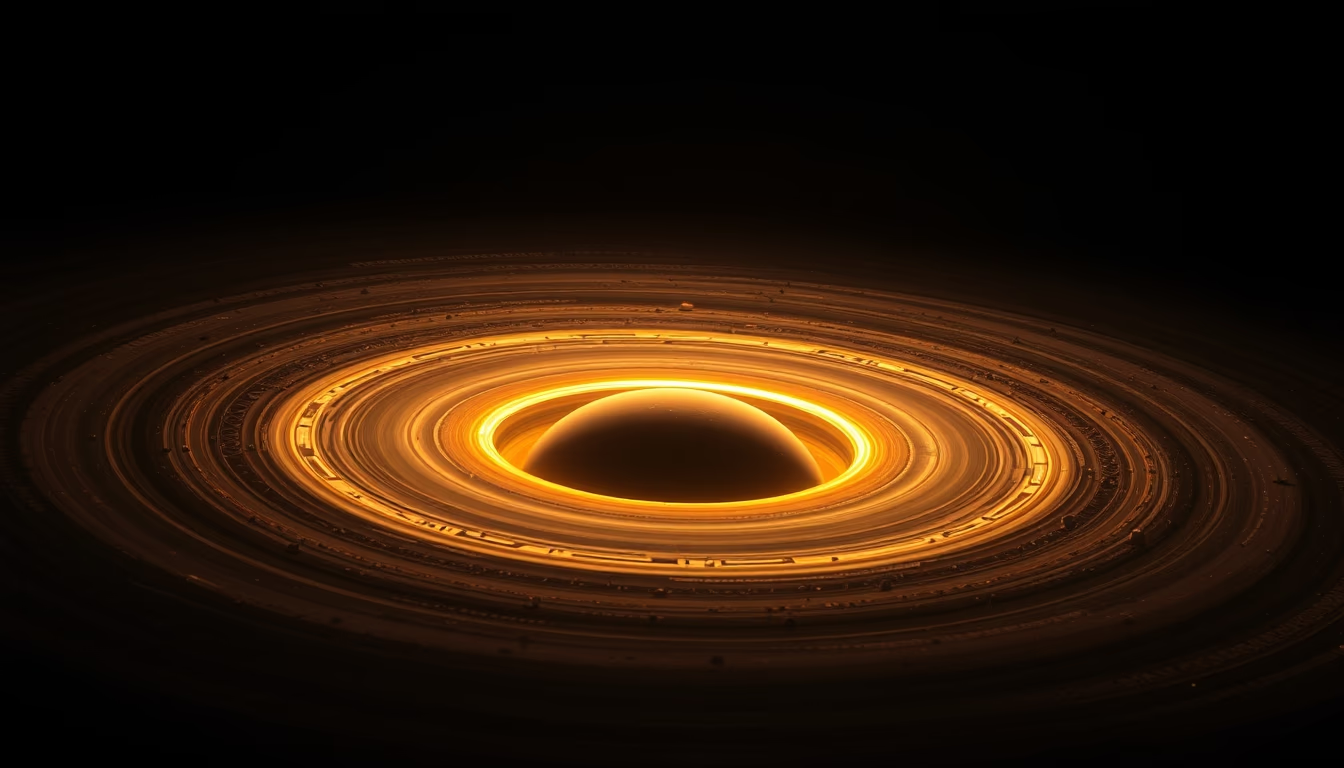
Protoplanetary disks are rotating structures of gas and dust around young stars, the nurseries of planetary systems like our own.
About this subject
Protoplanetary disks form from the collapse of giant molecular clouds. When a dense region of gas and dust undergoes gravitational collapse, most of the material concentrates in the center to form a young star. The remaining material, due to conservation of angular momentum, flattens into a rotating disk around the star. This disk is composed mainly of molecular hydrogen and helium, along with dust made of silicates, carbon, and ices. Temperatures range from thousands of Kelvin in the inner region to tens of Kelvin in the outer parts, influencing chemical and physical processes.
Observation of these disks is possible thanks to telescopes like ALMA (Atacama Large Millimeter/submillimeter Array), which captures emissions from dust and gas at millimeter and submillimeter wavelengths. One of the most famous examples is the disk around the star HL Tauri, whose images revealed rings and gaps indicating planet formation. Another example are the proplyds (protoplanetary disks) in the Orion Nebula, photographed by the Hubble Space Telescope. They appear as dark silhouettes against the bright gas, showing disk evaporation by radiation from nearby massive stars.
The significance of protoplanetary disks extends beyond planet formation. They are natural laboratories to study the chemical and physical evolution that leads to the diversity of planetary systems. In the Solar System, the original protoplanetary disk is thought to have lasted about 10 million years before dissipating, either by accretion onto planets or by stellar winds and radiation. Studying these disks helps understand how our own system formed 4.6 billion years ago and why some planets are rocky and others gaseous.
Frequently Asked Questions
What are protoplanetary disks?
They are rotating structures of gas and dust orbiting young stars. They provide the raw material for forming planets, asteroids, and comets.
How do we know planets form in them?
High-resolution images, such as those from ALMA, show gaps and rings in the disks. These features are interpreted as regions where forming planets are clearing their orbits.
How long does a protoplanetary disk last?
Typically 1 to 10 million years. After that, the disk dissipates due to planetary accretion, stellar winds, and radiation, leaving a planetary system.
Direct URL
https://pub-c7d6a6ea828543ac903a74a341ccb2e1.r2.dev/imagens/protoplanetary-disk-forming-documentary-photography-p1.avifHow to credit
Include a visible link back to UtilizAí. Copy one of the snippets below:
<a href="https://xn--utiliza-eza.com/en/midia/imagens/protoplanetary-disk-forming-documentary-photography-p1">Protoplanetary disk forming</a> by <a href="https://xn--utiliza-eza.com">UtilizAí</a>, licensed under <a href="https://creativecommons.org/licenses/by/4.0/">CC BY 4.0</a>.
[Protoplanetary disk forming](https://xn--utiliza-eza.com/en/midia/imagens/protoplanetary-disk-forming-documentary-photography-p1) by [UtilizAí](https://xn--utiliza-eza.com), CC BY 4.0
License: CC-BY-4.0





