Protoplanetary disk forming
1344×768 · AVIF · CC BY 4.0
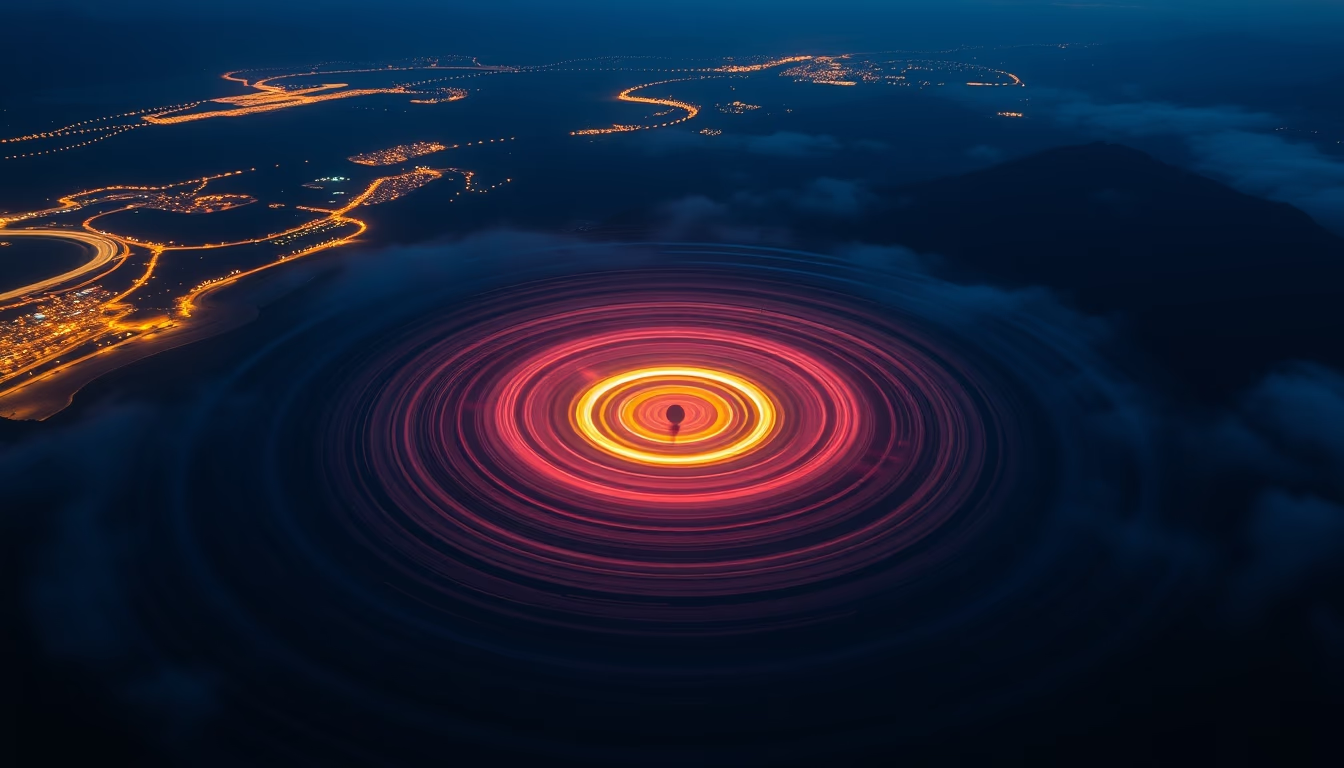
A protoplanetary disk is a structure of gas and dust around a young star, where planets like Earth form over millions of years.
About this subject
Protoplanetary disks are rotating clouds of gas and dust surrounding newly formed stars. They are the birthplaces of planetary systems. Material in the disk gradually collapses under gravity, forming planetesimals that merge to create planets. These disks are common in star-forming regions like the Orion Nebula and can be observed with telescopes such as ALMA (Atacama Large Millimeter/submillimeter Array). The Solar System likely originated from a protoplanetary disk about 4.6 billion years ago.
The structure of a protoplanetary disk is complex: gas (mainly hydrogen and helium) and dust grains (silicates, ice, organic compounds) concentrate in an equatorial plane. The central star heats the disk, creating temperature gradients that influence the composition of future planets. Hotter regions near the star favor refractory materials; farther out, volatiles like water can condense as ice.
Recent observations show protoplanetary disks are not uniform: they exhibit rings and gaps, likely carved by forming planets. ALMA revealed striking structures in the disk of star HL Tauri, with rings suggesting the presence of protoplanets. Studies also indicate that typical disk lifetimes range from 1 to 10 million years, sufficient to form rocky and gas giant planets.
Understanding protoplanetary disks is crucial for astrobiology, as it helps predict exoplanet habitability. Missions like the James Webb Space Telescope are investigating the chemistry of these disks, searching for organic molecules that are precursors to life.
Frequently Asked Questions
What is a protoplanetary disk?
A protoplanetary disk is a structure of gas and dust surrounding a young star, where planet formation occurs. It is the reservoir of material that will form planetary systems.
How do planets form from a protoplanetary disk?
Dust particles in the disk collide and stick together, forming larger grains. These grains coalesce into planetesimals, which through accretion grow into protoplanets and eventually planets.
Where can protoplanetary disks be observed?
Protoplanetary disks are observed in star-forming regions like the Orion Nebula, using infrared and radio telescopes, especially ALMA in Chile.
Direct URL
https://pub-c7d6a6ea828543ac903a74a341ccb2e1.r2.dev/imagens/protoplanetary-disk-forming-aerial-drone-shot-p4.avifHow to credit
Include a visible link back to UtilizAí. Copy one of the snippets below:
<a href="https://xn--utiliza-eza.com/en/midia/imagens/protoplanetary-disk-forming-aerial-drone-shot-p4">Protoplanetary disk forming</a> by <a href="https://xn--utiliza-eza.com">UtilizAí</a>, licensed under <a href="https://creativecommons.org/licenses/by/4.0/">CC BY 4.0</a>.
[Protoplanetary disk forming](https://xn--utiliza-eza.com/en/midia/imagens/protoplanetary-disk-forming-aerial-drone-shot-p4) by [UtilizAí](https://xn--utiliza-eza.com), CC BY 4.0
License: CC-BY-4.0