Pluto surface ice
1344×768 · AVIF · CC BY 4.0
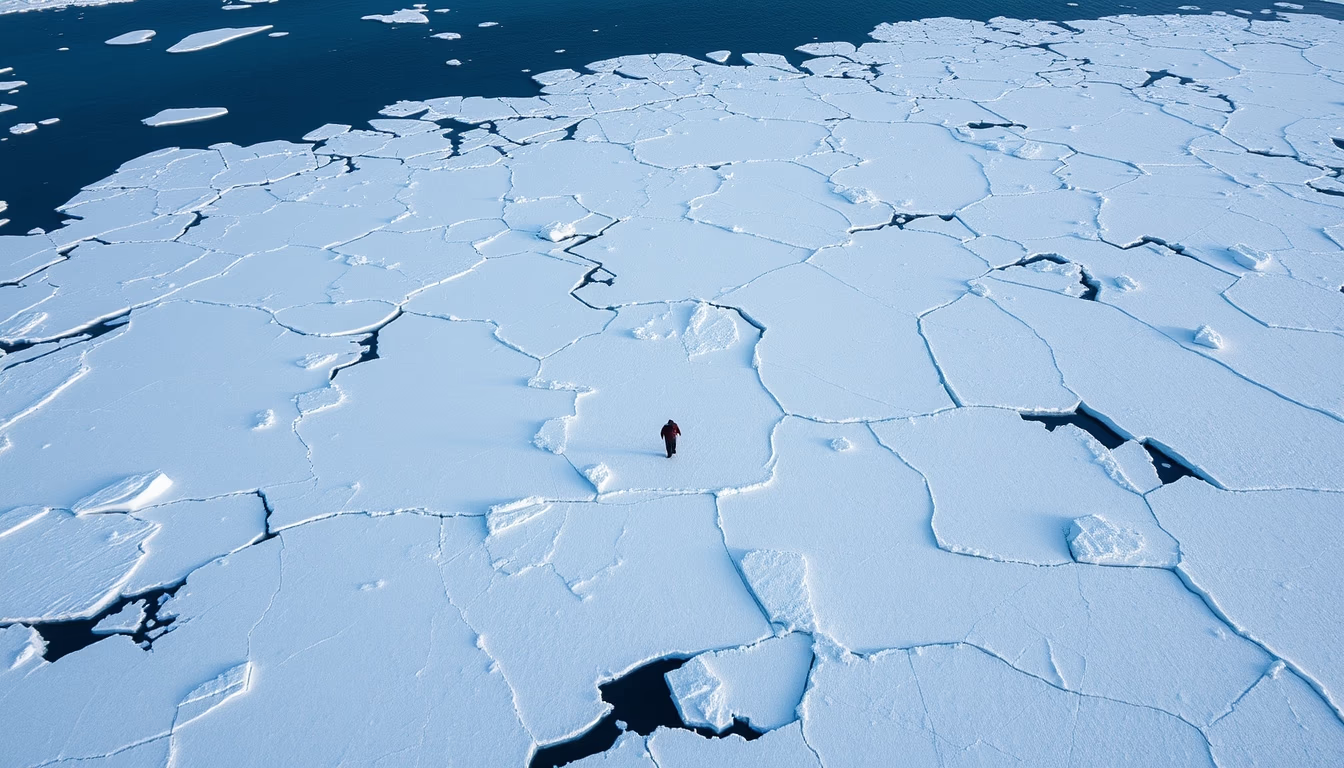
Pluto's surface is covered by a complex layer of nitrogen, methane, and carbon monoxide ices, with water-ice mountains and vast glacial plains.
About this subject
Pluto, the most famous dwarf planet in the solar system, has a surface dominated by volatile ices. Unlike Earth, where ice is made of water, Pluto's dominant ice is nitrogen, with significant amounts of methane and carbon monoxide. These ices form a crust that behaves similarly to terrestrial glaciers, flowing slowly over geological time.
The most iconic region is Sputnik Planitia, a vast impact basin filled with nitrogen ice. This plain is about 1,000 km wide and exhibits polygonal convection patterns, where warmer ice rises and cooler ice sinks, like a lava lamp. Surrounding mountains, such as Hillary and Tenzing Montes, are made of water ice, which is more rigid under Pluto's conditions and forms peaks up to 5 km high.
Temperatures on Pluto are extremely low, around -230°C, allowing these ices to exist in solid state. NASA's New Horizons spacecraft, which flew by Pluto in 2015, revealed these landscapes in unprecedented detail. Observations showed a geologically active surface with glacial flows, water-ice mountains floating on denser nitrogen ice, and even possible cryovolcanoes.
Interestingly, the reddish color of some areas on Pluto comes from organic compounds called tholins, formed by solar and cosmic radiation acting on methane ices. This combination of exotic ices and geological activity makes Pluto a fascinating world, much more dynamic than imagined before the New Horizons visit.
Frequently Asked Questions
Why is Pluto's surface covered with ice?
Pluto is very far from the Sun, with extremely low temperatures (about -230°C). This allows gases like nitrogen, methane, and carbon monoxide to freeze and form a surface layer of ice.
What is Sputnik Planitia?
Sputnik Planitia is a large impact basin on Pluto, filled with nitrogen ice. It is about 1,000 km wide and exhibits convection patterns, where the ice moves like lava in a lava lamp.
How did we discover the details of Pluto's surface?
NASA's New Horizons spacecraft flew by Pluto in 2015 and sent back detailed images and data. Before that, telescopic observations showed only blurry patches.
Direct URL
https://pub-c7d6a6ea828543ac903a74a341ccb2e1.r2.dev/imagens/pluto-surface-ice-aerial-drone-shot-p1.avifHow to credit
Include a visible link back to UtilizAí. Copy one of the snippets below:
<a href="https://xn--utiliza-eza.com/en/midia/imagens/pluto-surface-ice-aerial-drone-shot-p1">Pluto surface ice</a> by <a href="https://xn--utiliza-eza.com">UtilizAí</a>, licensed under <a href="https://creativecommons.org/licenses/by/4.0/">CC BY 4.0</a>.
[Pluto surface ice](https://xn--utiliza-eza.com/en/midia/imagens/pluto-surface-ice-aerial-drone-shot-p1) by [UtilizAí](https://xn--utiliza-eza.com), CC BY 4.0
License: CC-BY-4.0