Photon wave particle
1344×768 · AVIF · CC BY 4.0

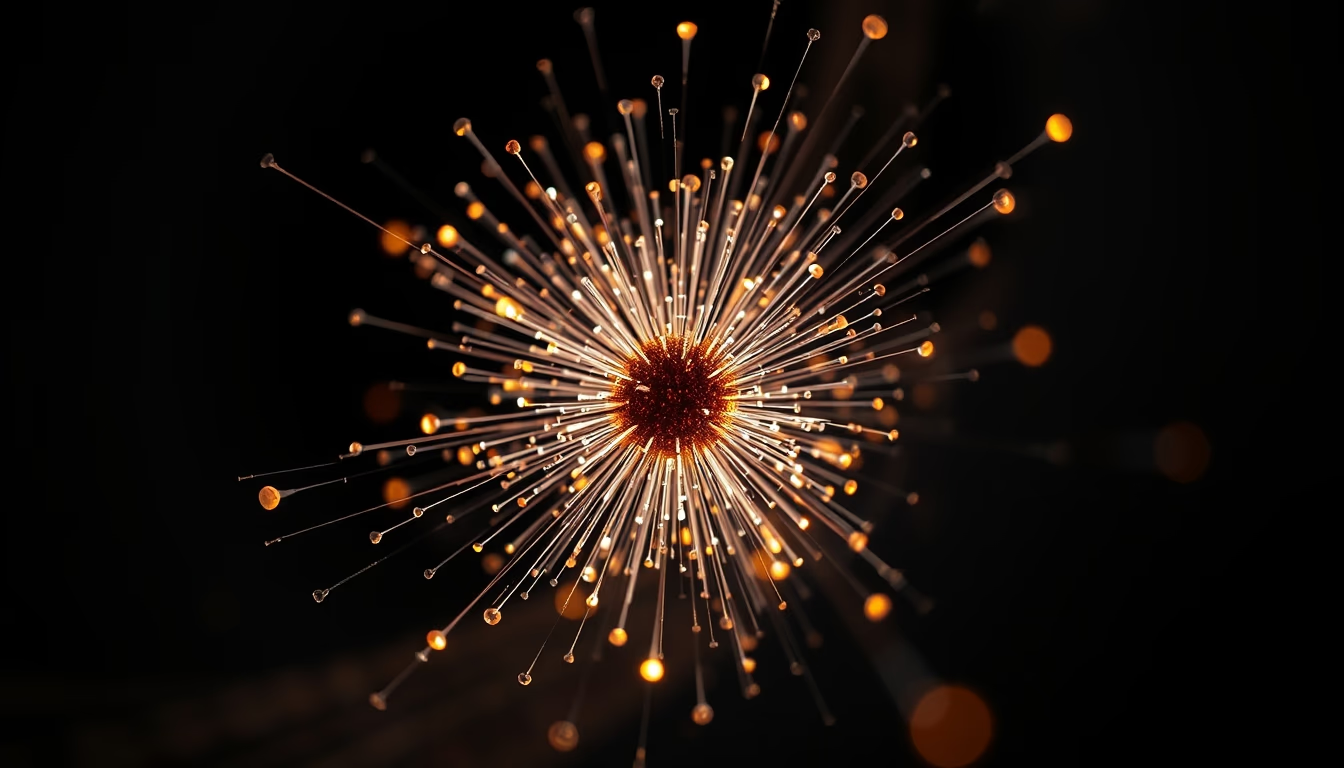
The wave-particle duality of photons is a fundamental concept in quantum mechanics, where light behaves as both a particle and a wave simultaneously.
About this subject
The wave-particle duality of photons is a cornerstone of quantum mechanics, revealing that light is neither exclusively a wave nor a particle but exhibits properties of both depending on the experiment. This phenomenon was first observed in the early 20th century through experiments like the photoelectric effect, explained by Albert Einstein in 1905, which showed that light consists of energy quanta (photons) capable of ejecting electrons from a metal surface. On the other hand, interference experiments, such as Thomas Young's double-slit experiment (1801), demonstrated that light produces interference patterns typical of waves. The synthesis of these contradictory behaviors led to the development of quantum mechanics, with Schrödinger's wave equation and Niels Bohr's complementarity principle.
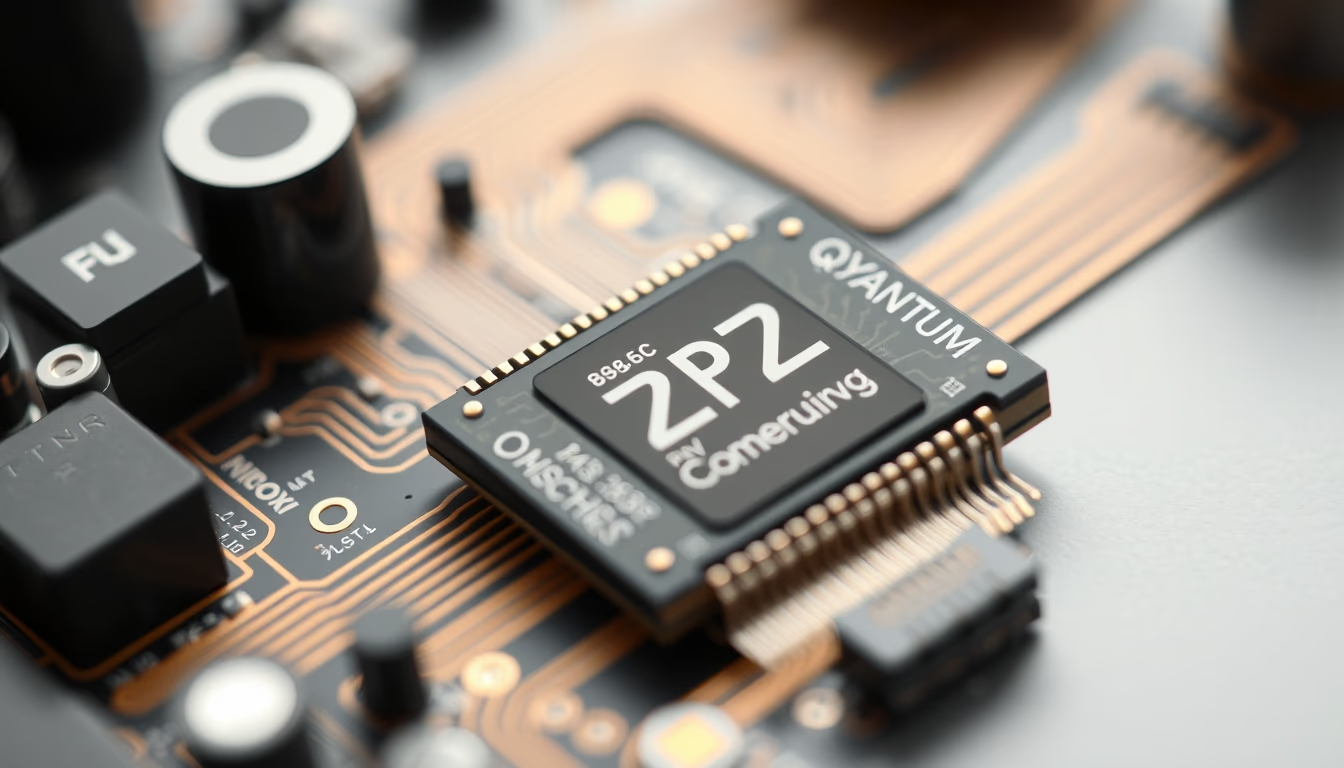
In modern physics, duality is mathematically described by the wave function, which gives the probability of finding a photon at a given location. Each photon carries quantized energy, given by E = hf (where h is Planck's constant and f is frequency), and also has an associated wavelength, λ = c/f. This dual nature is essential for technologies such as lasers, semiconductors, and quantum computing. A practical example is the Mach-Zehnder interferometer, where a single photon can interfere with itself, exhibiting wave-like behavior, but upon detection, manifests as a localized particle.
Interestingly, duality is not limited to light: particles such as electrons, protons, and even complex molecules also exhibit wave-like behavior, as predicted by de Broglie's hypothesis (1924). This was experimentally confirmed for electrons in 1927 by Davisson and Germer, and more recently for fullerene molecules (C60) in 1999. Understanding the wave-particle duality of photons has revolutionized our view of reality, showing that the quantum world challenges classical intuition and requires a probabilistic approach to describe fundamental phenomena.
Frequently Asked Questions
What is the wave-particle duality of the photon?
It is the quantum property that makes the photon behave as a wave in interference experiments and as a particle in interactions like the photoelectric effect, mathematically described by a probabilistic wave function.
How was the wave-particle duality of light discovered?
Duality was evidenced by experiments such as Young's double-slit (wave behavior) and the photoelectric effect explained by Einstein (particle behavior), culminating in the formulation of quantum mechanics.
What practical applications rely on wave-particle duality?
Technologies such as lasers, semiconductors, electron microscopy, and quantum computing are based on understanding the dual behavior of photons and other particles.
Direct URL
https://pub-c7d6a6ea828543ac903a74a341ccb2e1.r2.dev/imagens/photon-wave-particle-film-grain-authentic-p4.avifHow to credit
Include a visible link back to UtilizAí. Copy one of the snippets below:
<a href="https://xn--utiliza-eza.com/en/midia/imagens/photon-wave-particle-film-grain-authentic-p4">Photon wave particle</a> by <a href="https://xn--utiliza-eza.com">UtilizAí</a>, licensed under <a href="https://creativecommons.org/licenses/by/4.0/">CC BY 4.0</a>.
[Photon wave particle](https://xn--utiliza-eza.com/en/midia/imagens/photon-wave-particle-film-grain-authentic-p4) by [UtilizAí](https://xn--utiliza-eza.com), CC BY 4.0
License: CC-BY-4.0