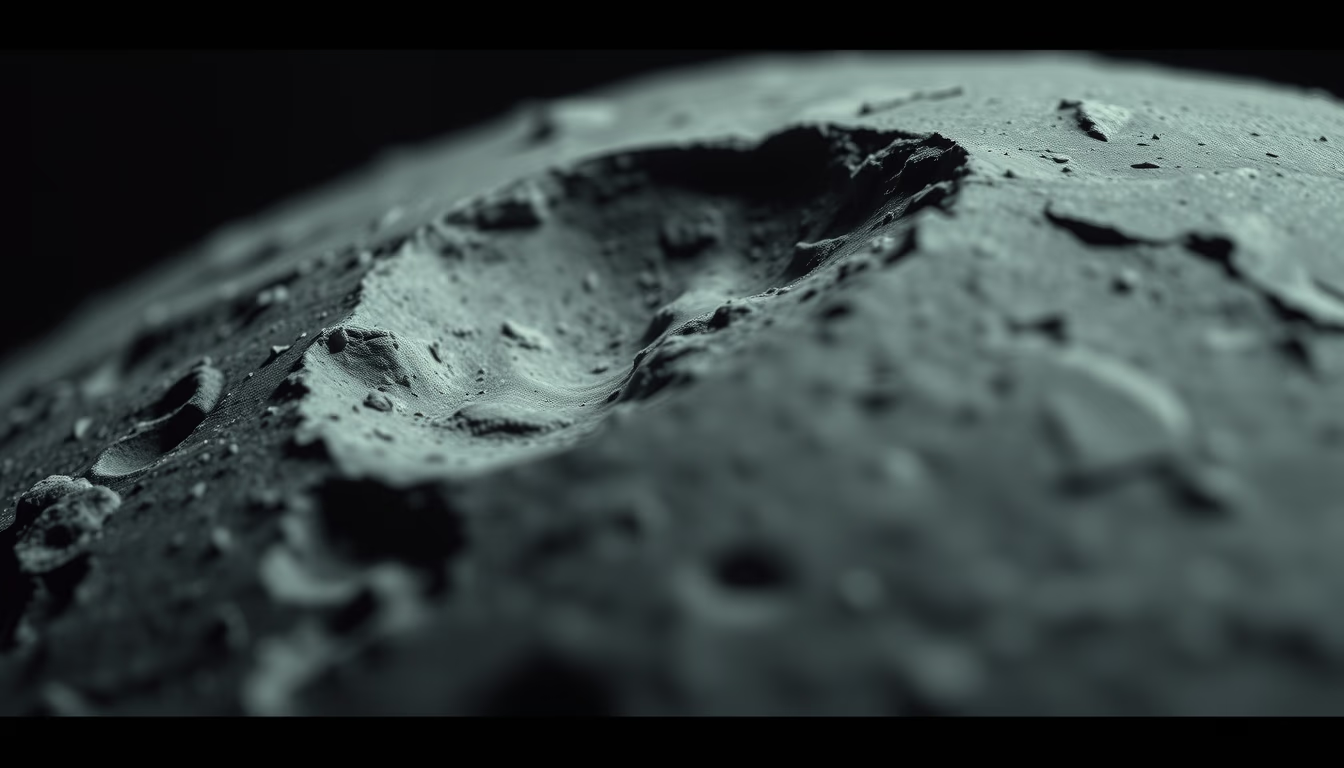
Parker solar probe sun
1344×768 · AVIF · CC BY 4.0

The Parker Solar Probe is the first spacecraft to fly through the Sun's corona, approaching closer to the Sun than any previous mission, revolutionizing our understanding of the star.
About this subject
Launched on August 12, 2018, by NASA, the Parker Solar Probe aims to study the Sun's corona, solar wind, and magnetic fields. The mission uses a series of progressively closer approaches to the Sun, called perihelia, with decreasing distances over its orbital cycle. In April 2021, the probe achieved a historic milestone by becoming the first spacecraft to "touch" the Sun, crossing the corona boundary and collecting direct data from that region.
The probe reaches record speeds, exceeding 600,000 km/h at its closest perihelia, making it the fastest human-made object. To withstand extreme temperatures up to 1,377°C, it features a carbon composite heat shield 11.4 cm thick, keeping scientific instruments operating at about 30°C. The shield is continuously pointed at the Sun, while solar panels retract to avoid overheating.
Scientifically, the Parker Solar Probe has already transformed our understanding of coronal heating and solar wind acceleration. One of its most notable discoveries are "switchbacks," zigzag magnetic structures that propel particles into interplanetary space. The probe also identified a region near the Sun virtually free of dust, surprising astronomers. Ongoing measurements help predict solar storms that affect satellites and power grids on Earth.
The mission honors astrophysicist Eugene Parker, who in the 1950s predicted the existence of the solar wind. A plaque aboard carries his photo and a quote, along with a digital memory containing the names of over 1.1 million people who signed up to symbolically travel to the Sun. The Parker Solar Probe will continue its orbits until the mid-2020s, getting even closer to the Sun and providing data that may solve solar mysteries that have persisted for decades.
Frequently Asked Questions
What is the closest distance the Parker Solar Probe has reached to the Sun?
As of late 2024, the probe has come within approximately 6.5 million kilometers of the solar surface, with closer approaches planned in future orbits.
How does the Parker Solar Probe avoid melting near the Sun?
It has a carbon composite heat shield 11.4 cm thick that withstands temperatures up to 1,377°C, keeping the instruments at room temperature.
What important discoveries has the mission made?
The probe revealed zigzag structures in the solar wind called switchbacks and confirmed the existence of a dust-free region near the Sun.
Direct URL
https://pub-c7d6a6ea828543ac903a74a341ccb2e1.r2.dev/imagens/parker-solar-probe-sun-aerial-drone-shot-fresh15.avifHow to credit
Include a visible link back to UtilizAí. Copy one of the snippets below:
<a href="https://xn--utiliza-eza.com/en/midia/imagens/parker-solar-probe-sun-aerial-drone-shot-fresh15">Parker solar probe sun</a> by <a href="https://xn--utiliza-eza.com">UtilizAí</a>, licensed under <a href="https://creativecommons.org/licenses/by/4.0/">CC BY 4.0</a>.
[Parker solar probe sun](https://xn--utiliza-eza.com/en/midia/imagens/parker-solar-probe-sun-aerial-drone-shot-fresh15) by [UtilizAí](https://xn--utiliza-eza.com), CC BY 4.0
License: CC-BY-4.0