Osmosis membrane diagram
1344×768 · AVIF · CC BY 4.0
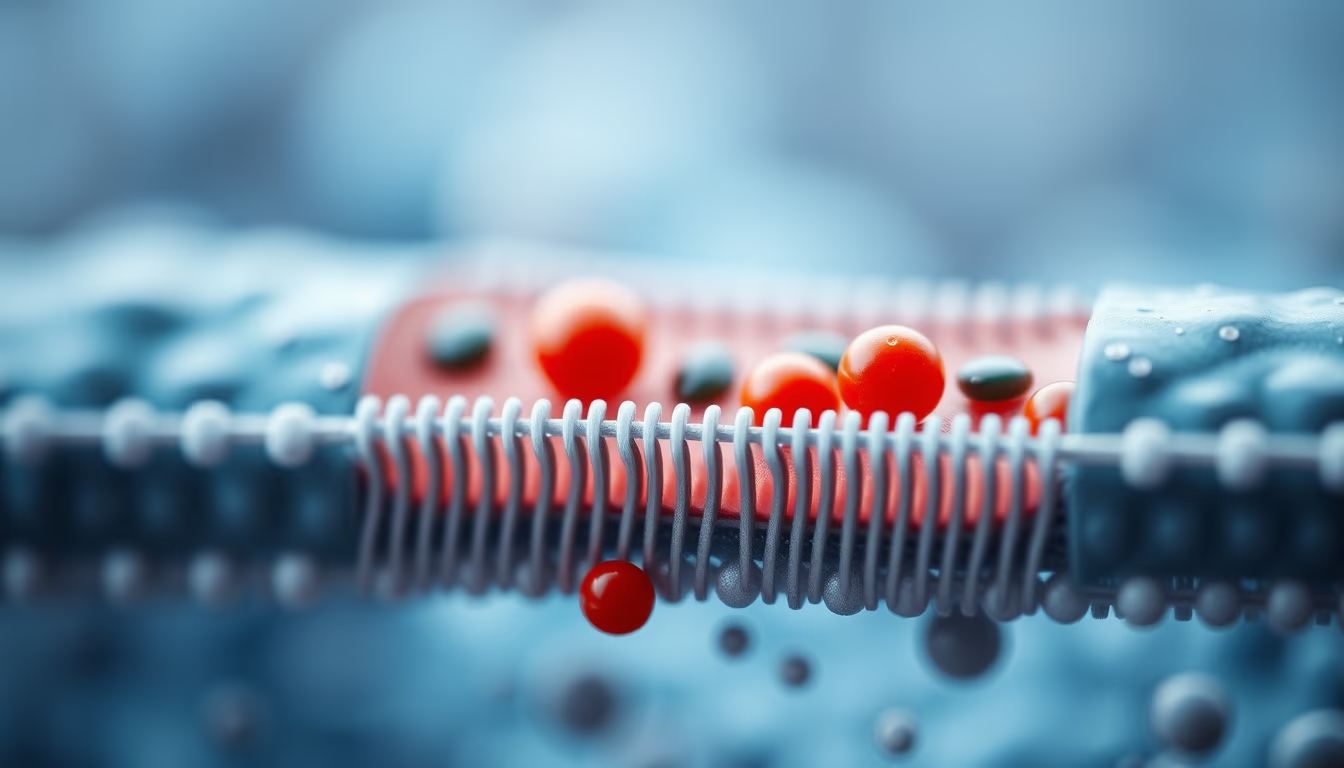
Diagram illustrating the process of osmosis across a semipermeable membrane, showing water movement from hypotonic to hypertonic medium.
About this subject
Osmosis is a fundamental physicochemical process for life, characterized by the spontaneous movement of solvent (usually water) across a semipermeable membrane. This membrane allows solvent passage but restricts or prevents solute movement. The flow occurs from a region of lower solute concentration (hypotonic medium) to higher solute concentration (hypertonic medium), aiming to equalize osmotic pressures on both sides. This passive transport requires no energy expenditure.
In biological cells, osmosis is crucial for homeostasis. The plasma membrane acts as a selective barrier, controlling water entry and exit. In plants, osmosis drives water absorption by roots and maintains cell turgor pressure, essential for structural support. In animals, it regulates cell volume and renal function: nephrons use osmotic principles to reabsorb water and solutes. Osmotic imbalances can lead to dehydration or edema.
Osmosis also has important technological applications. Reverse osmosis, for example, uses pressure to force water across a membrane in the opposite direction, retaining salts and impurities. This method is widely used in desalination, water purification, and the food industry to concentrate juices. In Brazil, desalination plants in semi-arid regions employ reverse osmosis to produce potable water. Additionally, osmosis is a recurring topic in college entrance exams, requiring understanding of concentration gradients and water movement.
Interestingly, osmosis was first observed by Nollet in 1748, but the term was coined later. In laboratories, experiments with plant cells or chicken eggs visually demonstrate the phenomenon: immersing a cell in distilled water causes it to swell (reverse plasmolysis); in saline solution, it shrinks (plasmolysis). These observations reinforce the importance of osmosis in maintaining life and water balance in organisms.
Frequently Asked Questions
What is osmosis?
Osmosis is the net movement of water across a semipermeable membrane from a region of lower solute concentration (hypotonic) to higher solute concentration (hypertonic), requiring no energy.
How does osmosis occur in cells?
In cells, the plasma membrane acts as a semipermeable membrane. Water enters or leaves the cell according to the concentration gradient, regulating cell volume and maintaining homeostasis.
What is the difference between osmosis and diffusion?
Diffusion is the movement of particles (solute or solvent) from higher to lower concentration. Osmosis is a specific type of diffusion involving only solvent movement across a semipermeable membrane.
Direct URL
https://pub-c7d6a6ea828543ac903a74a341ccb2e1.r2.dev/imagens/osmosis-membrane-diagram-tilt-shift-miniature-p11.avifHow to credit
Include a visible link back to UtilizAí. Copy one of the snippets below:
<a href="https://xn--utiliza-eza.com/en/midia/imagens/osmosis-membrane-diagram-tilt-shift-miniature-p11">Osmosis membrane diagram</a> by <a href="https://xn--utiliza-eza.com">UtilizAí</a>, licensed under <a href="https://creativecommons.org/licenses/by/4.0/">CC BY 4.0</a>.
[Osmosis membrane diagram](https://xn--utiliza-eza.com/en/midia/imagens/osmosis-membrane-diagram-tilt-shift-miniature-p11) by [UtilizAí](https://xn--utiliza-eza.com), CC BY 4.0
License: CC-BY-4.0