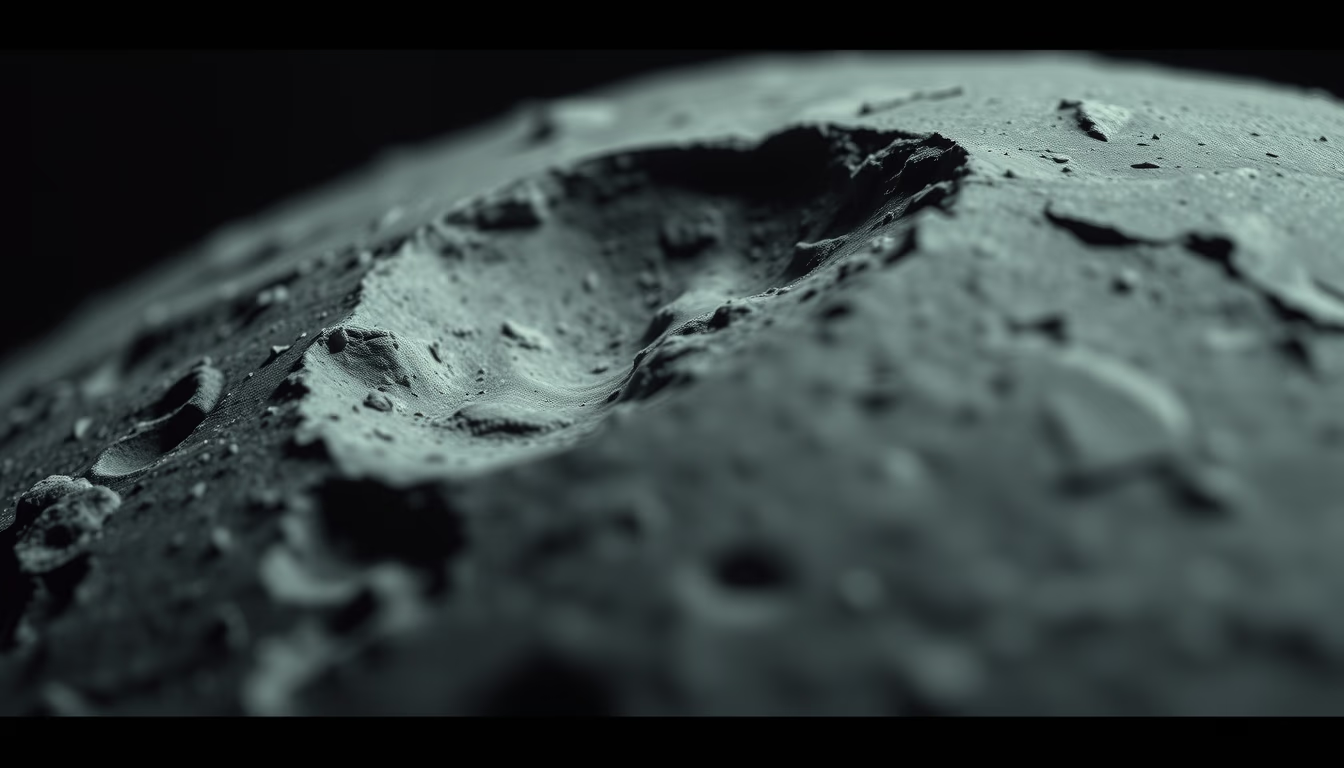
Osiris-rex bennu asteroid
1344×768 · AVIF · CC BY 4.0

NASA's OSIRIS-REx mission collected samples from asteroid Bennu, a primitive celestial body that may hold clues about the origin of life on Earth.
About this subject
The OSIRIS-REx mission (Origins, Spectral Interpretation, Resource Identification, Security, Regolith Explorer) was launched on September 8, 2016, with the goal of studying and collecting samples from asteroid Bennu. Bennu is a carbonaceous B-type asteroid, approximately 500 meters in diameter. It orbits the Sun at an average distance of 168 million kilometers, completing one revolution every 1.2 Earth years. Its primitive composition is considered a fossil record of the early solar system, containing organic materials and hydrated minerals that may have contributed to the building blocks of life on Earth.
The OSIRIS-REx spacecraft arrived at Bennu in December 2018 and spent over two years mapping the asteroid's surface. On October 20, 2020, it performed the Touch-and-Go (TAG) maneuver, collecting approximately 250 grams of regolith. The sample was stored in a special capsule and returned to Earth on September 24, 2023, landing in the Utah desert. Scientists hope that analysis of these samples will reveal insights into the organic chemistry of the early solar system and potential precursors to life.
Bennu is also classified as a potentially hazardous asteroid, with a small chance of impacting Earth in the 22nd century. Therefore, mission data helps refine orbit models and planetary defense strategies. Additionally, the discovery of particle plumes ejected from Bennu's surface surprised scientists, indicating active processes on the asteroid. The mission is a milestone in space exploration, as NASA's first asteroid sample return, following the success of Japan's Hayabusa2 mission.
Frequently Asked Questions
What was the main goal of the OSIRIS-REx mission?
The main goal was to collect a sample from the surface of asteroid Bennu and return it to Earth for analysis, helping to understand the formation of the solar system and the origin of organic compounds that may have led to life.
How many grams of Bennu material did OSIRIS-REx collect?
The mission collected approximately 250 grams of regolith, far exceeding the minimum goal of 60 grams. The sample arrived on Earth in September 2023.
Why is Bennu considered a hazardous asteroid?
Bennu has a small probability (about 1 in 2700) of colliding with Earth in the late 22nd century. Therefore, it is classified as a potentially hazardous asteroid and is a target for planetary defense studies.
Direct URL
https://pub-c7d6a6ea828543ac903a74a341ccb2e1.r2.dev/imagens/osiris-rex-bennu-asteroid-cinematic-wide-shot-fresh14.avifHow to credit
Include a visible link back to UtilizAí. Copy one of the snippets below:
<a href="https://xn--utiliza-eza.com/en/midia/imagens/osiris-rex-bennu-asteroid-cinematic-wide-shot-fresh14">Osiris-rex bennu asteroid</a> by <a href="https://xn--utiliza-eza.com">UtilizAí</a>, licensed under <a href="https://creativecommons.org/licenses/by/4.0/">CC BY 4.0</a>.
[Osiris-rex bennu asteroid](https://xn--utiliza-eza.com/en/midia/imagens/osiris-rex-bennu-asteroid-cinematic-wide-shot-fresh14) by [UtilizAí](https://xn--utiliza-eza.com), CC BY 4.0
License: CC-BY-4.0