Oscilloscope display waveform
1344×768 · AVIF · CC BY 4.0
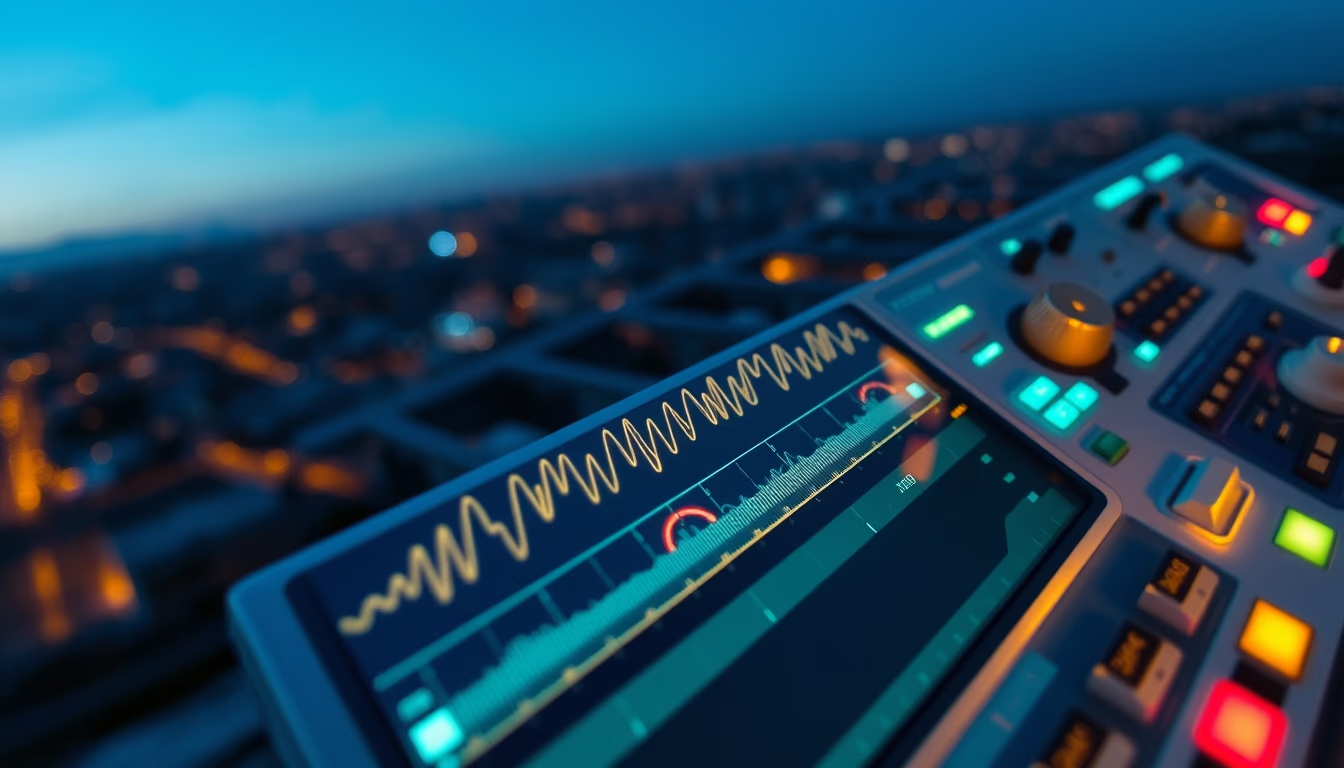
Waveform displayed on an oscilloscope, a fundamental instrument for engineers and technicians analyzing electrical signals.
About this subject
The oscilloscope is one of the most important instruments in electronics and electrical engineering. Its main function is to visualize voltage variation over time, displayed as a waveform on a screen. The first version was created by Karl Ferdinand Braun in 1897, and it has since evolved from analog models to modern digital storage oscilloscopes capable of capturing and processing complex signals.
Common waveforms include sine, square, triangle, and pulses. Each provides specific information about the circuit under test. For instance, an oscilloscope can measure amplitude, frequency, period, and distortion of a signal. Engineers use these measurements to diagnose faults in circuits, verify data transmission integrity, and design electronic systems.
An advanced feature in digital oscilloscopes is the Fast Fourier Transform (FFT), which converts the signal from the time domain to the frequency domain, enabling spectral analysis. This is essential for identifying noise, harmonics, and interference in audio, radio, and communication signals. Many modern oscilloscopes also have USB and Ethernet interfaces to export data for computer analysis.
In the context of aerial drone shots, an oscilloscope image can be captured in controlled environments such as labs or tech fairs to illustrate the equipment in use. The waveform displayed on the screen is typically generated by a function generator or the output of a circuit under test, demonstrating how the instrument aids in visualizing electrical phenomena.
Frequently Asked Questions
What does an oscilloscope screen show?
The screen displays the voltage variation of an electrical signal over time, forming a waveform that reveals characteristics such as amplitude, frequency, and distortion.
What is the practical use of an oscilloscope?
It is used to diagnose faults in electronic circuits, measure signals from sensors, check timing in digital systems, and analyze the quality of audio and video signals.
What is the difference between analog and digital oscilloscopes?
Analog oscilloscopes display the signal in real time using an electron beam, while digital oscilloscopes sample and store the signal, allowing precise measurements, zooming, and mathematical analysis like FFT.
Direct URL
https://pub-c7d6a6ea828543ac903a74a341ccb2e1.r2.dev/imagens/oscilloscope-display-waveform-aerial-drone-shot-p10.avifHow to credit
Include a visible link back to UtilizAí. Copy one of the snippets below:
<a href="https://xn--utiliza-eza.com/en/midia/imagens/oscilloscope-display-waveform-aerial-drone-shot-p10">Oscilloscope display waveform</a> by <a href="https://xn--utiliza-eza.com">UtilizAí</a>, licensed under <a href="https://creativecommons.org/licenses/by/4.0/">CC BY 4.0</a>.
[Oscilloscope display waveform](https://xn--utiliza-eza.com/en/midia/imagens/oscilloscope-display-waveform-aerial-drone-shot-p10) by [UtilizAí](https://xn--utiliza-eza.com), CC BY 4.0
License: CC-BY-4.0