Orion nebula glowing
1344×768 · AVIF · CC BY 4.0
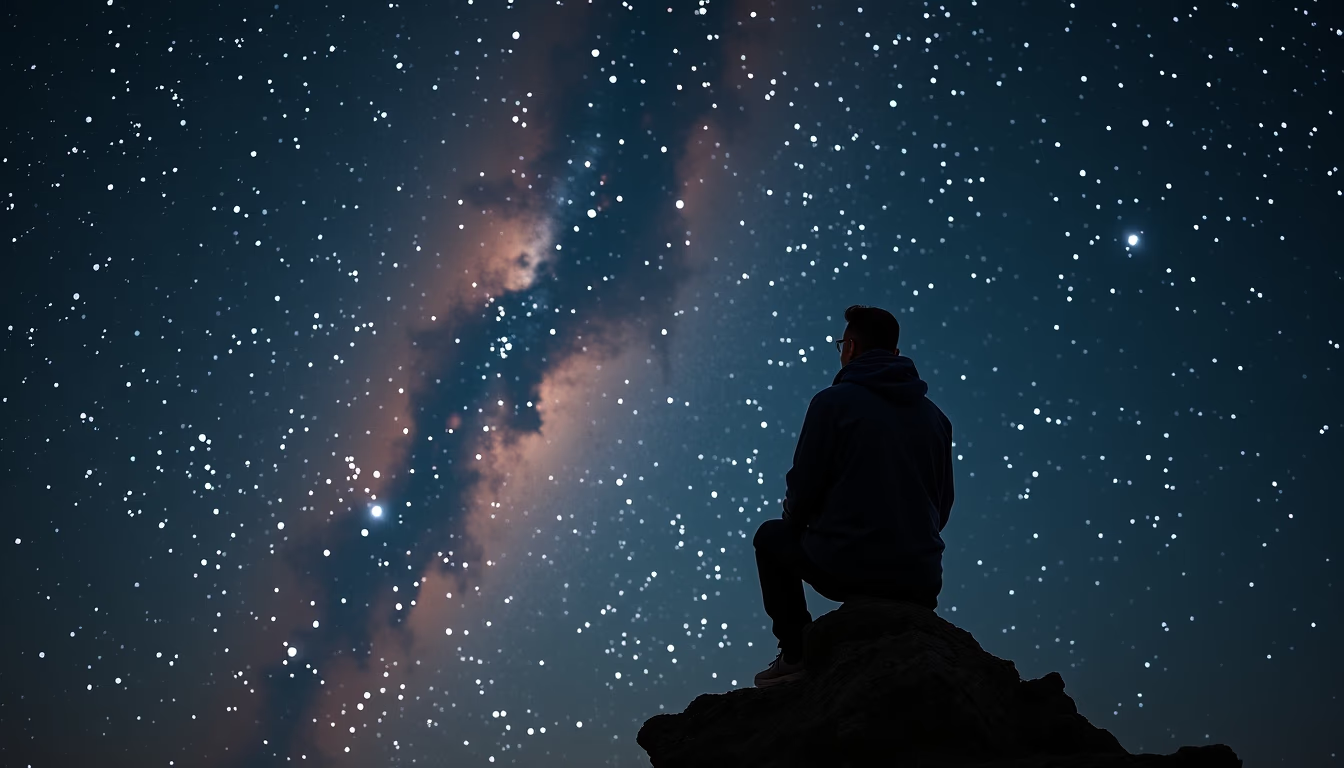
The Orion Nebula is one of the brightest and most studied star-forming regions in the night sky, visible to the naked eye.
About this subject
The Orion Nebula, also cataloged as Messier 42 or M42, is an emission nebula located in the constellation Orion, about 1,344 light-years from Earth. It is a massive cloud of gas and dust where new stars are being born, making it the closest massive star-forming region to our planet. Its brightness is so intense that it can be seen with the naked eye, even in areas with moderate light pollution, appearing as a fuzzy patch below Orion's Belt.
Known since antiquity, the nebula was first described in 1610 by French astronomer Nicolas-Claude Fabri de Peiresc, but its internal structures were only revealed with the advancement of telescopes. At its center lies the Trapezium Cluster, a group of young, hot stars that ionize the surrounding gas, causing it to glow. These stars formed only about 1 million years ago, a blink of an eye on cosmic timescales.
The Orion Nebula serves as a natural laboratory for studying star and planet formation. Observations by the Hubble Space Telescope have revealed hundreds of protostars, protoplanetary disks (proplyds), and jets of ejected material. It is estimated that the nebula contains enough material to form thousands of Sun-like stars. Additionally, the region is rich in complex organic molecules, providing clues about the chemistry that precedes the emergence of planetary systems.
For astronomy enthusiasts, the Orion Nebula is one of the most rewarding objects to observe with binoculars or small telescopes, revealing a greenish nebulous structure and a bright star cluster. It is also a popular target for astrophotographers, who capture its vibrant colors and filamentary details. In 2023, the James Webb Space Telescope released unprecedented infrared images of the region, showing never-before-seen details of the gas and dust surrounding young stars.
Frequently Asked Questions
How can I locate the Orion Nebula in the sky?
The Orion Nebula is found in the constellation Orion, just below the three stars that make up Orion's Belt. Look southwest during winter in the Northern Hemisphere (summer in the Southern Hemisphere) and search for a slightly pinkish or greenish patch with the naked eye. Binoculars or a simple telescope will reveal its nebulous shape.
How far is the Orion Nebula from Earth?
The distance is approximately 1,344 light-years, equivalent to about 12.7 quadrillion kilometers. It is the closest massive star-forming region to our planet.
What are the proplyds observed in the Orion Nebula?
Proplyds are protoplanetary disks around young stars, composed of gas and dust, where planets may be forming. The Hubble Space Telescope has detected dozens of them in the Orion Nebula, providing direct evidence that planetary systems like our own are common in the universe.
Direct URL
https://pub-c7d6a6ea828543ac903a74a341ccb2e1.r2.dev/imagens/orion-nebula-glowing-minimalist-composition-p11.avifHow to credit
Include a visible link back to UtilizAí. Copy one of the snippets below:
<a href="https://xn--utiliza-eza.com/en/midia/imagens/orion-nebula-glowing-minimalist-composition-p11">Orion nebula glowing</a> by <a href="https://xn--utiliza-eza.com">UtilizAí</a>, licensed under <a href="https://creativecommons.org/licenses/by/4.0/">CC BY 4.0</a>.
[Orion nebula glowing](https://xn--utiliza-eza.com/en/midia/imagens/orion-nebula-glowing-minimalist-composition-p11) by [UtilizAí](https://xn--utiliza-eza.com), CC BY 4.0
License: CC-BY-4.0