Orion nebula glowing
1344×768 · AVIF · CC BY 4.0
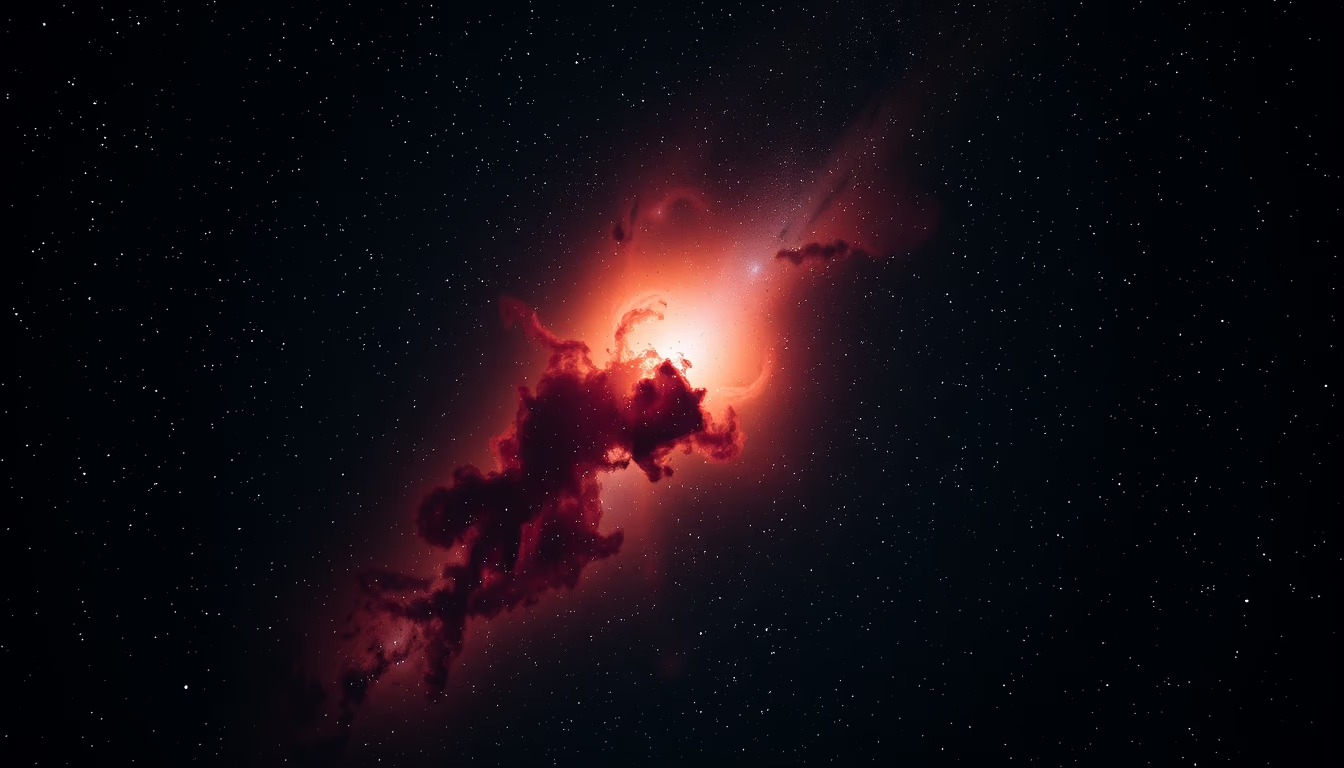
The Orion Nebula is one of the brightest and closest stellar nurseries to Earth, visible to the naked eye in Orion's belt.
About this subject
The Orion Nebula (also known as Messier 42, M42, or NGC 1976) is a diffuse emission nebula located in the constellation Orion, about 1,344 light-years from Earth. It is one of the most active and studied star-forming regions in the sky, serving as the birthplace of thousands of young stars, many still embedded in clouds of gas and dust. The nebula shines intensely due to ultraviolet radiation from massive stars in the Trapezium Cluster, an open star cluster at its core.
Discovered in 1610 by French astronomer Nicolas-Claude Fabri de Peiresc, the nebula is one of the most photographed and observed celestial objects. With an apparent magnitude of 4.0, it is visible to the naked eye under dark skies, but binoculars or small telescopes reveal stunning details: a vast greenish and reddish cloud with dark filaments of interstellar dust. The characteristic green glow comes from doubly ionized oxygen, while red comes from hydrogen alpha emissions.
The Orion Nebula plays a key role in understanding star and planet formation. Observations by the Hubble Space Telescope have revealed protoplanetary disks (proplyds) around young stars, providing direct evidence of how solar systems like ours form. The nebula contains over 2,000 young stars with ages between 100,000 and 1 million years, and it is constantly evolving, with stellar winds and radiation shaping its clouds. For astronomy enthusiasts, it is a must-see target during winter nights in the southern hemisphere, when Orion dominates the sky.
Frequently Asked Questions
What is the Orion Nebula?
It is an emission nebula in the constellation Orion, a star-forming region about 1,344 light-years from Earth. It is one of the brightest objects in the night sky and visible to the naked eye.
Why does the Orion Nebula glow?
The glow comes from ultraviolet radiation from young, massive stars at its core, especially the Trapezium cluster. This radiation ionizes the gas, which then emits visible light.
Why is the Orion Nebula important for astronomy?
It serves as a natural laboratory for studying star and planet formation. The Hubble Telescope discovered protoplanetary disks there, helping to understand how solar systems develop.
Direct URL
https://pub-c7d6a6ea828543ac903a74a341ccb2e1.r2.dev/imagens/orion-nebula-glowing-fine-art-photography-p12.avifHow to credit
Include a visible link back to UtilizAí. Copy one of the snippets below:
<a href="https://xn--utiliza-eza.com/en/midia/imagens/orion-nebula-glowing-fine-art-photography-p12">Orion nebula glowing</a> by <a href="https://xn--utiliza-eza.com">UtilizAí</a>, licensed under <a href="https://creativecommons.org/licenses/by/4.0/">CC BY 4.0</a>.
[Orion nebula glowing](https://xn--utiliza-eza.com/en/midia/imagens/orion-nebula-glowing-fine-art-photography-p12) by [UtilizAí](https://xn--utiliza-eza.com), CC BY 4.0
License: CC-BY-4.0