Opal play of color
1344×768 · AVIF · CC BY 4.0
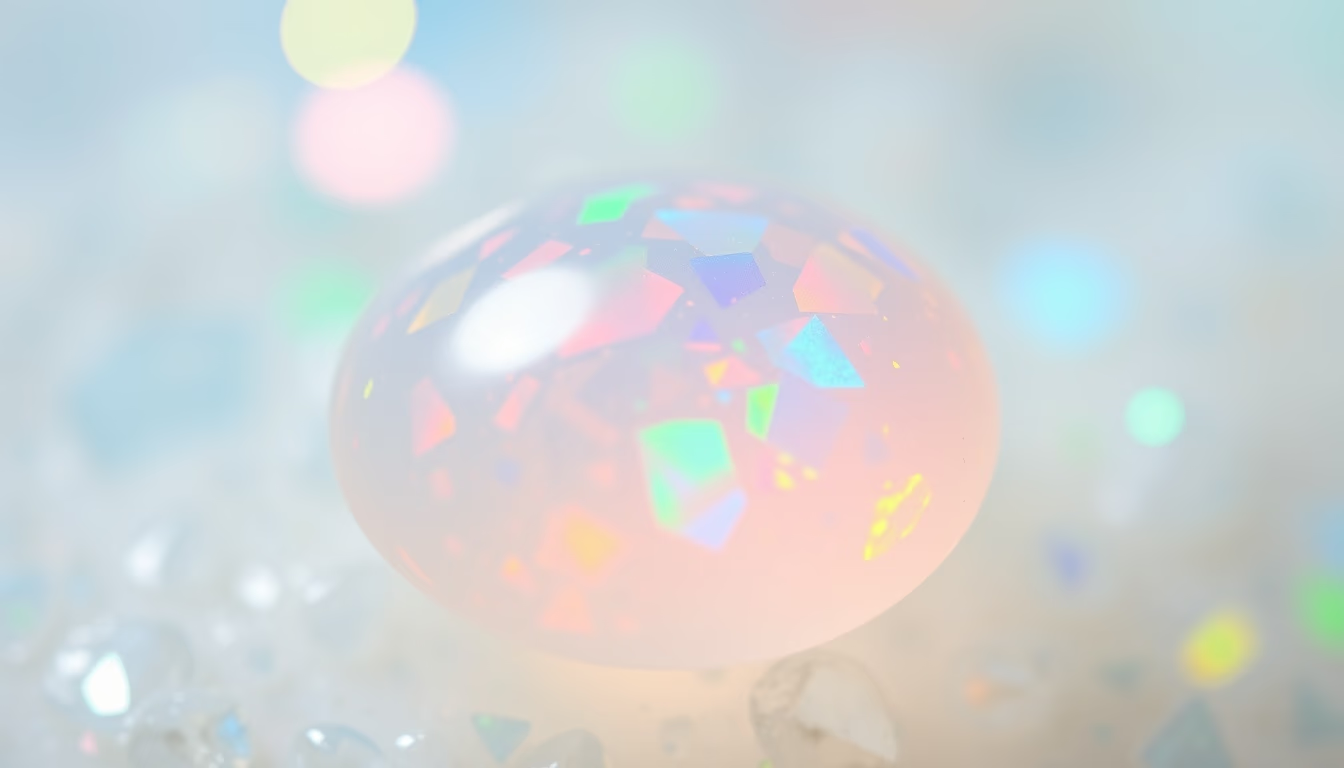
The play of color in opal is a unique optical phenomenon caused by light diffracting through tiny silica spheres, creating a kaleidoscopic display.
About this subject
Opal is a hydrated silica gemstone (SiO₂·nH₂O) with water content ranging from 3% to 21%. The mesmerizing play of color in precious opal results from its internal structure: microscopic silica spheres, 150-300 nanometers in diameter, arranged in a regular three-dimensional grid. When white light enters, it is diffracted and separated into spectral colors, shifting with the viewing angle. This phenomenon, opalescence, distinguishes precious opal from common varieties.
Australia produces roughly 90% of the world's precious opal, with historic deposits at Coober Pedy, Lightning Ridge, and Mintabie. Lightning Ridge is renowned for black opals, the rarest and most valuable, while Coober Pedy yields white and crystal opals. Other sources include Ethiopia (hydrophane opals), Mexico (fire opals), and Brazil, with noble opals from Piauí and Rio Grande do Sul.
Culturally, opal is the birthstone for October. In ancient Rome, it symbolized purity and hope, but medieval Europe associated it with bad luck due to its brittleness and confusion with the "evil eye" stone. In Australia, it is a national treasure and symbol of creativity. The largest opal ever found, the "Olympic Australis," weighs 17,000 carats and was discovered in 1956.
The science of play of color was explained in 1964 by physicist John V. Sanders, who identified diffraction by silica spheres. Synthetic opals, such as those by Pierre Gilson, mimic the effect but with less iridescence. Opal has moderate durability (Mohs hardness 5.5-6.5) and requires care to avoid cracking from sudden temperature or humidity changes.
Frequently Asked Questions
What causes the play of color in opal?
The play of color is caused by light diffracting through tiny silica spheres (150-300 nm) arranged in a regular lattice, splitting white light into spectral colors.
Where are the most valuable opals found?
The most valuable opals, especially black opals, come from Lightning Ridge, Australia. Coober Pedy also produces high-quality precious opal.
Can opal lose its play of color over time?
Yes, if opal dehydrates or experiences thermal shock, it may crack and lose the phenomenon. Storing it in a humid environment and avoiding sudden temperature changes is recommended.
Direct URL
https://pub-c7d6a6ea828543ac903a74a341ccb2e1.r2.dev/imagens/opal-play-of-color-macro-closeup-p4.avifHow to credit
Include a visible link back to UtilizAí. Copy one of the snippets below:
<a href="https://xn--utiliza-eza.com/en/midia/imagens/opal-play-of-color-macro-closeup-p4">Opal play of color</a> by <a href="https://xn--utiliza-eza.com">UtilizAí</a>, licensed under <a href="https://creativecommons.org/licenses/by/4.0/">CC BY 4.0</a>.
[Opal play of color](https://xn--utiliza-eza.com/en/midia/imagens/opal-play-of-color-macro-closeup-p4) by [UtilizAí](https://xn--utiliza-eza.com), CC BY 4.0
License: CC-BY-4.0