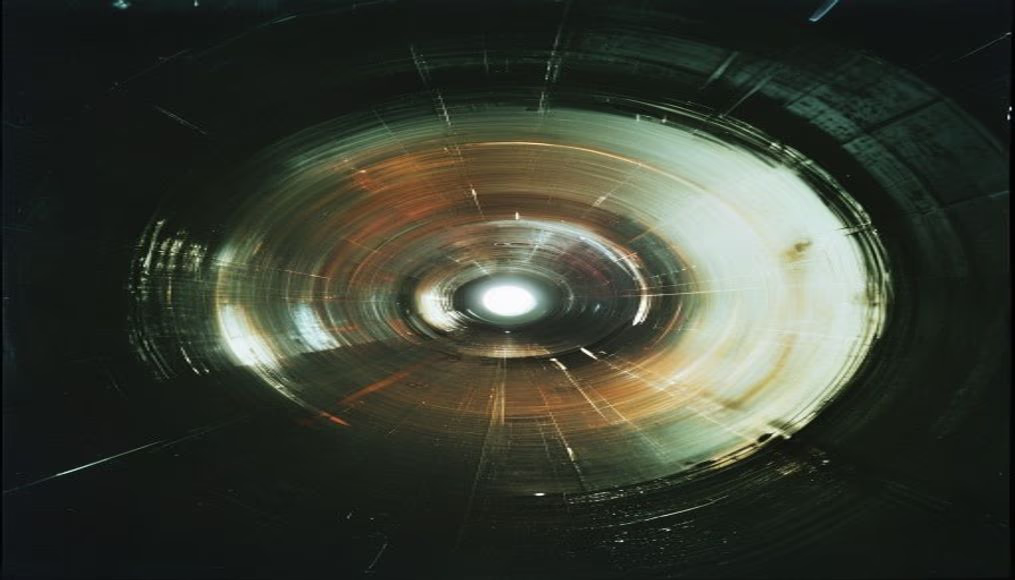
Neutron star pulsar
1344×768 · AVIF · CC BY 4.0

Pulsars are rapidly rotating neutron stars that emit beams of electromagnetic radiation, acting as cosmic lighthouses.
About this subject
A neutron star is the collapsed core of a massive star that exploded as a supernova. With a diameter of about 20 km and a mass greater than the Sun's, its density is so extreme that a teaspoon of its material would weigh billions of tons. When a neutron star rotates rapidly and has a strong magnetic field, it can become a pulsar, emitting beams of radiation from its magnetic poles. These beams sweep through space like a lighthouse, producing regular pulses of radio waves, X-rays, or gamma rays.
The discovery of pulsars occurred in 1967, when Jocelyn Bell Burnell detected pulsing radio signals at the Cambridge Observatory. The first known pulsar, PSR B1919+21, had a period of 1.337 seconds. Since then, thousands have been cataloged, with periods ranging from milliseconds to several seconds. Millisecond pulsars, for instance, spin hundreds of times per second due to accretion of matter from a companion star.
These objects serve as natural laboratories for testing general relativity and high-energy physics. In 1974, the binary pulsar PSR B1913+16 provided the first indirect evidence of gravitational waves, earning a Nobel Prize for Hulse and Taylor. More recently, the pulsar PSR J0437-4715 is used to calibrate gravitational wave detectors. Additionally, pulsars act as extremely precise cosmic clocks, rivaling the best atomic clocks, enabling studies of astrometry and the detection of exoplanets.
Frequently Asked Questions
How does a pulsar emit radiation?
Beams of radiation are emitted from the pulsar's magnetic poles due to the acceleration of charged particles in its intense magnetic field. As the star rotates, these beams sweep across space, producing periodic pulses detectable on Earth.
What is the difference between a neutron star and a pulsar?
Every neutron star is the collapsed remnant of a supernova. A pulsar is a neutron star that rotates rapidly and has a strong enough magnetic field to emit beams of radiation aligned with its poles.
Why are pulsars so precise as clocks?
A pulsar's rotation is extremely stable due to its enormous moment of inertia and the absence of disturbing external factors. This regularity allows time measurements with precision comparable to the best atomic clocks.
Direct URL
https://pub-c7d6a6ea828543ac903a74a341ccb2e1.r2.dev/imagens/neutron-star-pulsar-tilt-shift-miniature-p3.avifHow to credit
Include a visible link back to UtilizAí. Copy one of the snippets below:
<a href="https://xn--utiliza-eza.com/en/midia/imagens/neutron-star-pulsar-tilt-shift-miniature-p3">Neutron star pulsar</a> by <a href="https://xn--utiliza-eza.com">UtilizAí</a>, licensed under <a href="https://creativecommons.org/licenses/by/4.0/">CC BY 4.0</a>.
[Neutron star pulsar](https://xn--utiliza-eza.com/en/midia/imagens/neutron-star-pulsar-tilt-shift-miniature-p3) by [UtilizAí](https://xn--utiliza-eza.com), CC BY 4.0
License: CC-BY-4.0