Neutron star pulsar
1344×768 · AVIF · CC BY 4.0
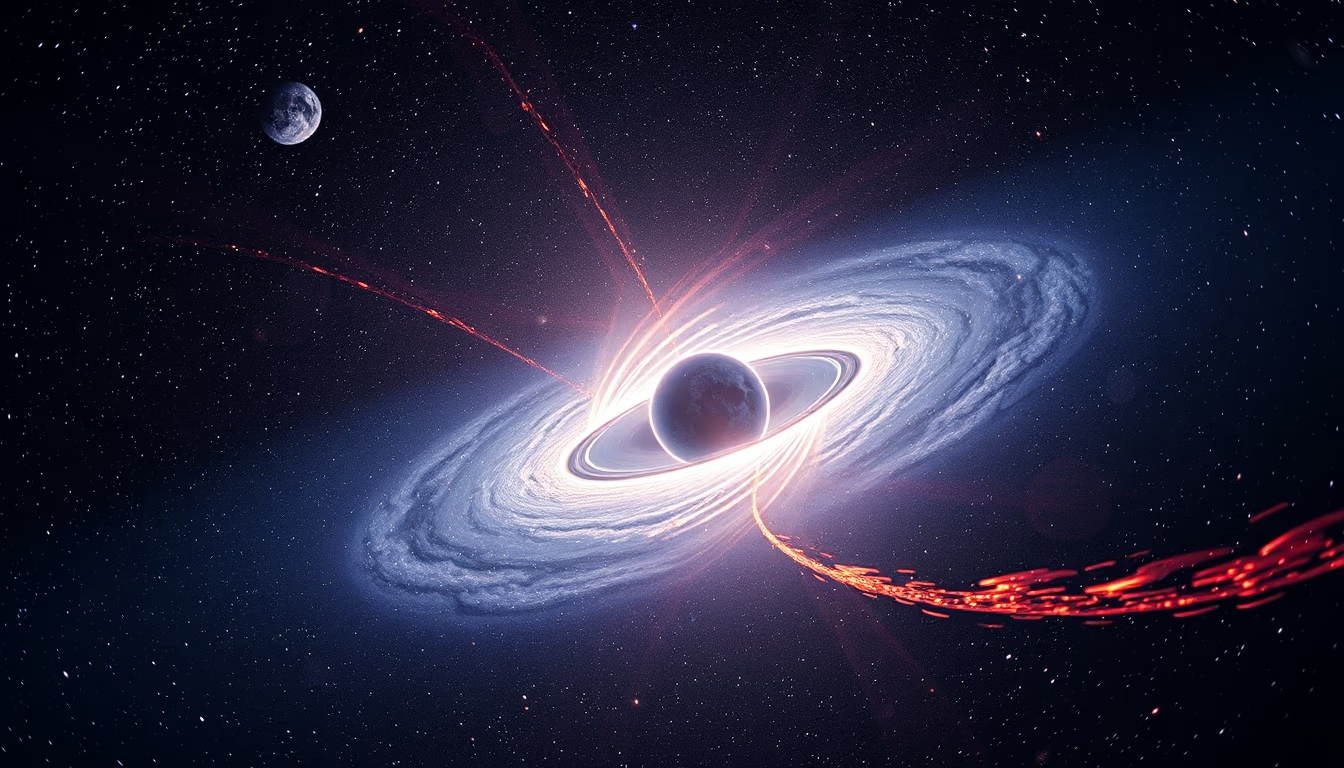
Pulsars are neutron stars that emit regular beams of radiation, like cosmic lighthouses. Discovered in 1967, they spin at extremely high speeds.
About this subject
Pulsars are rotating neutron stars that emit beams of electromagnetic radiation. They form when massive stars, over 8 solar masses, explode as supernovae. The core collapses under gravity, compressing protons and electrons into neutrons, creating an incredibly dense object: a teaspoon of neutron star matter would weigh billions of tons on Earth. The pulsar inherits the angular momentum of the original star, spinning rapidly from a few rotations per second to hundreds. Additionally, it possesses an intense magnetic field, trillions of times stronger than Earth's, which channels charged particles into narrow beams.
The term 'pulsar' comes from 'pulsating star', because the radiation beams sweep across space with each rotation, like a lighthouse. If Earth is aligned with the beam, we detect regular pulses of radio waves, visible light, X-rays, or gamma rays. The first pulsar was discovered in 1967 by Jocelyn Bell Burnell and Antony Hewish, initially nicknamed LGM-1 (Little Green Men) due to suspicion of an artificial signal. Today, thousands of pulsars are known.
Among the most famous pulsars is the Crab Pulsar, at the center of the Crab Nebula, the remnant of a supernova observed in 1054 by Chinese astronomers. It spins 30 times per second and is visible across multiple wavelengths. Pulsars serve as highly accurate natural clocks, helping detect exoplanets, test general relativity, and even map the interstellar medium. The binary pulsar PSR B1913+16 provided the first indirect evidence of gravitational waves, confirming Einstein's predictions.
Frequently Asked Questions
How does a pulsar form?
When a massive star explodes as a supernova, its core collapses into a neutron star. If it rotates rapidly and has a strong magnetic field, it emits radiation beams that sweep across space, creating the pulsation effect.
What is the typical rotation speed of a pulsar?
Pulsars can rotate from a few times per second to hundreds of times per second. The Crab Pulsar, for example, rotates 30 times per second.
Why are pulsars important to astronomy?
They serve as extremely precise cosmic clocks, allowing tests of gravitational theories, detection of gravitational waves, and studies of the interstellar medium.
Direct URL
https://pub-c7d6a6ea828543ac903a74a341ccb2e1.r2.dev/imagens/neutron-star-pulsar-fish-eye-wide-angle-p2.avifHow to credit
Include a visible link back to UtilizAí. Copy one of the snippets below:
<a href="https://xn--utiliza-eza.com/en/midia/imagens/neutron-star-pulsar-fish-eye-wide-angle-p2">Neutron star pulsar</a> by <a href="https://xn--utiliza-eza.com">UtilizAí</a>, licensed under <a href="https://creativecommons.org/licenses/by/4.0/">CC BY 4.0</a>.
[Neutron star pulsar](https://xn--utiliza-eza.com/en/midia/imagens/neutron-star-pulsar-fish-eye-wide-angle-p2) by [UtilizAí](https://xn--utiliza-eza.com), CC BY 4.0
License: CC-BY-4.0