Neutron star pulsar
1344×768 · AVIF · CC BY 4.0
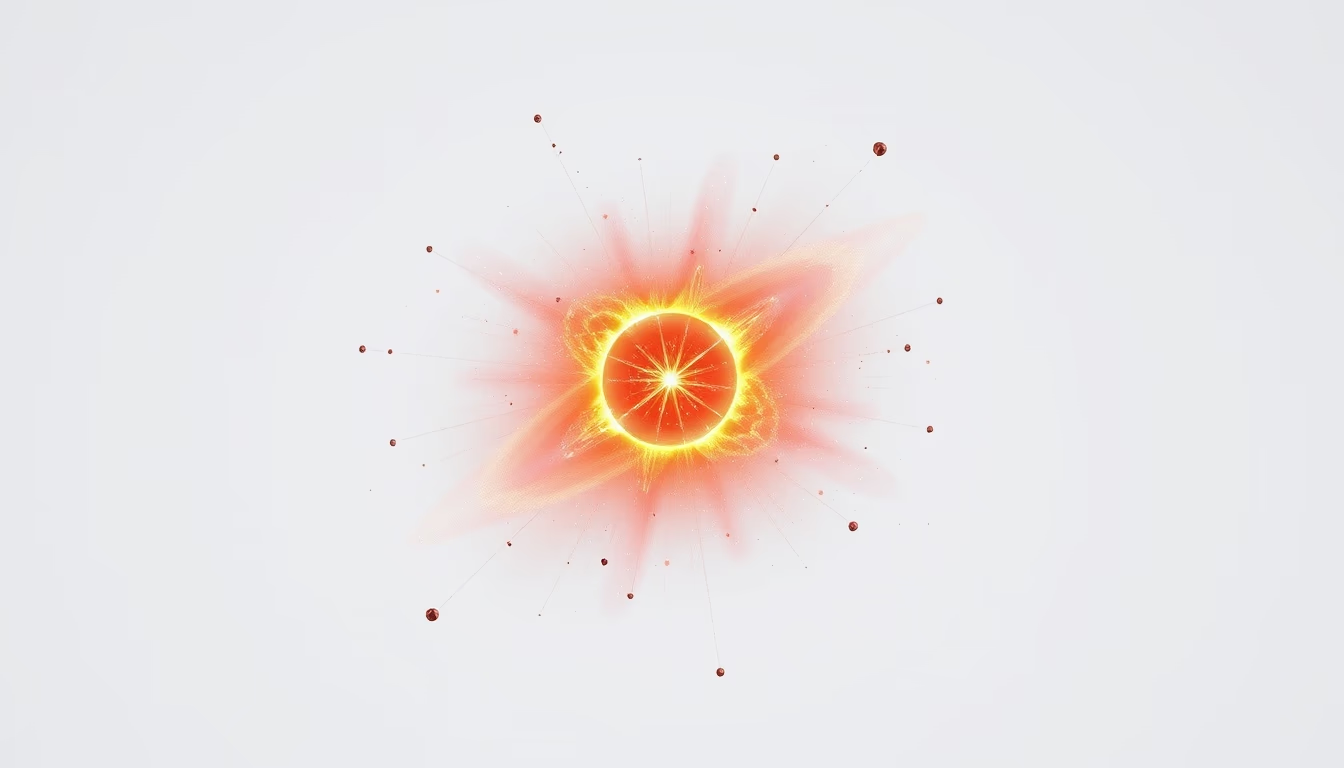
Pulsars are rapidly rotating neutron stars that emit beams of electromagnetic radiation, acting as cosmic lighthouses.
About this subject
Pulsars are neutron stars, extremely dense objects that form after the gravitational collapse of a massive star in a supernova. A typical neutron star has a mass between 1.4 and 2.16 solar masses compressed into a radius of only about 10 kilometers. Its density is so high that a teaspoon of neutron star matter would weigh billions of tons. What makes a pulsar special is its rapid rotation and intense magnetic field, which channels charged particles and produces beams of radiation that sweep across space like a lighthouse.
When one of these beams points toward Earth, we detect regular pulses of radio waves, X-rays, or gamma rays. The first pulsar was discovered in 1967 by Jocelyn Bell Burnell, then a graduate student, using a radio telescope in Cambridge. The pulses were so regular that initially the possibility of artificial signals from an extraterrestrial civilization was considered, hence the nickname "LGM" (Little Green Men). However, the natural origin of the phenomenon was soon confirmed.
Rotation periods of pulsars range from milliseconds to several seconds. Millisecond pulsars, the fastest, spin hundreds of times per second. They are extremely precise cosmic clocks, comparable to the best atomic clocks on Earth. This precision allows them to be used to test theories of general relativity, detect gravitational waves, and even as a navigation system for future interstellar travel. The Crab Pulsar (PSR B0531+21) and the Vela Pulsar are famous examples visible at different wavelengths.
Beyond their role in astrophysics, pulsars also fascinate the general public due to their exotic nature and the beauty of associated phenomena, such as pulsar wind nebulae. Images of pulsars often use false colors to represent different radiation intensities, but the essence of the object remains one of the most intriguing bodies in the universe. Studying pulsars helps understand physics under extreme conditions unattainable in terrestrial laboratories.
Frequently Asked Questions
What makes a pulsar pulse?
A pulsar pulses because its rapid rotation and intense magnetic field create beams of radiation that sweep across space. When a beam points toward Earth, we detect a pulse, similar to a lighthouse flash.
What is the difference between a neutron star and a pulsar?
Every neutron star that emits regular pulses of radiation is called a pulsar. Not every neutron star is a pulsar, as it requires its radiation beam to point toward Earth during rotation.
Can pulsars be used for space navigation?
Yes, the precision of millisecond pulsars allows them to be used as a navigation system, similar to GPS but for the entire solar system. NASA has successfully tested this technology aboard the space station.
Direct URL
https://pub-c7d6a6ea828543ac903a74a341ccb2e1.r2.dev/imagens/neutron-star-pulsar-commercial-product-photography-p12.avifHow to credit
Include a visible link back to UtilizAí. Copy one of the snippets below:
<a href="https://xn--utiliza-eza.com/en/midia/imagens/neutron-star-pulsar-commercial-product-photography-p12">Neutron star pulsar</a> by <a href="https://xn--utiliza-eza.com">UtilizAí</a>, licensed under <a href="https://creativecommons.org/licenses/by/4.0/">CC BY 4.0</a>.
[Neutron star pulsar](https://xn--utiliza-eza.com/en/midia/imagens/neutron-star-pulsar-commercial-product-photography-p12) by [UtilizAí](https://xn--utiliza-eza.com), CC BY 4.0
License: CC-BY-4.0