Neutron star pulsar
1344×768 · AVIF · CC BY 4.0
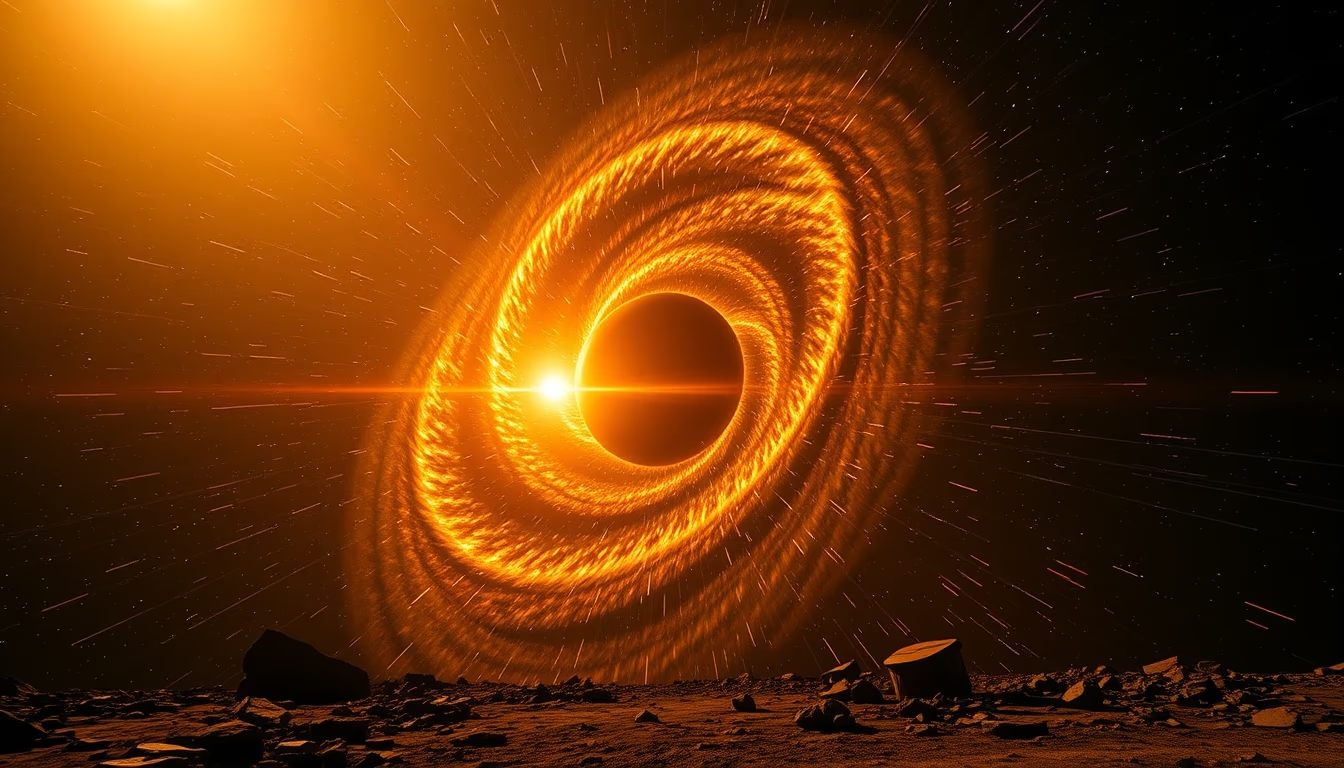
Pulsars are rapidly rotating neutron stars that emit beams of radiation, acting as cosmic lighthouses in the universe.
About this subject
Pulsars are among the most extreme objects in the cosmos, resulting from the gravitational collapse of massive stars in supernova explosions. When a star with between 8 and 20 solar masses explodes, its remaining core compresses to nuclear densities, forming a neutron star about 20 km in diameter. The accelerated rotation and intense magnetic field of this star generate radiation beams that sweep through space like lighthouses. These beams are detected from Earth as periodic pulses of radio waves, X-rays, or gamma rays, hence the name pulsar.
The first pulsar was discovered in 1967 by Jocelyn Bell Burnell and Antony Hewish, initially nicknamed LGM-1 (Little Green Men) due to the possibility of it being an artificial signal. Today we know thousands of pulsars, many used as precise clocks to test theories of gravitation, such as general relativity. The Crab Pulsar, remnant of the 1054 supernova, pulses about 30 times per second, while millisecond pulsars can rotate hundreds of times per second, resulting from accretion of matter from a companion star.
This cinematic wide-shot image captures the grandeur of a pulsar in deep space, with its jets and surrounding nebula. Although an artistic representation, it illustrates real concepts: radiation beams emitted from the magnetic poles and the intense glow of the neutron star. These objects are natural laboratories for extreme physics, where intense gravitational fields and nuclear densities challenge human understanding.
Frequently Asked Questions
What is a pulsar?
A pulsar is a rapidly rotating neutron star that emits beams of radiation, detected as periodic pulses from Earth.
How are pulsars formed?
They form from the collapse of the core of massive stars (8 to 20 solar masses) during a supernova, compressing matter to nuclear densities.
Why are pulsars important for science?
They serve as precise cosmic clocks, allowing tests of gravitational theories, detection of gravitational waves, and study of physics under extreme conditions.
Direct URL
https://pub-c7d6a6ea828543ac903a74a341ccb2e1.r2.dev/imagens/neutron-star-pulsar-cinematic-wide-shot-p5.avifHow to credit
Include a visible link back to UtilizAí. Copy one of the snippets below:
<a href="https://xn--utiliza-eza.com/en/midia/imagens/neutron-star-pulsar-cinematic-wide-shot-p5">Neutron star pulsar</a> by <a href="https://xn--utiliza-eza.com">UtilizAí</a>, licensed under <a href="https://creativecommons.org/licenses/by/4.0/">CC BY 4.0</a>.
[Neutron star pulsar](https://xn--utiliza-eza.com/en/midia/imagens/neutron-star-pulsar-cinematic-wide-shot-p5) by [UtilizAí](https://xn--utiliza-eza.com), CC BY 4.0
License: CC-BY-4.0