Neptune deep blue storms
1344×768 · AVIF · CC BY 4.0
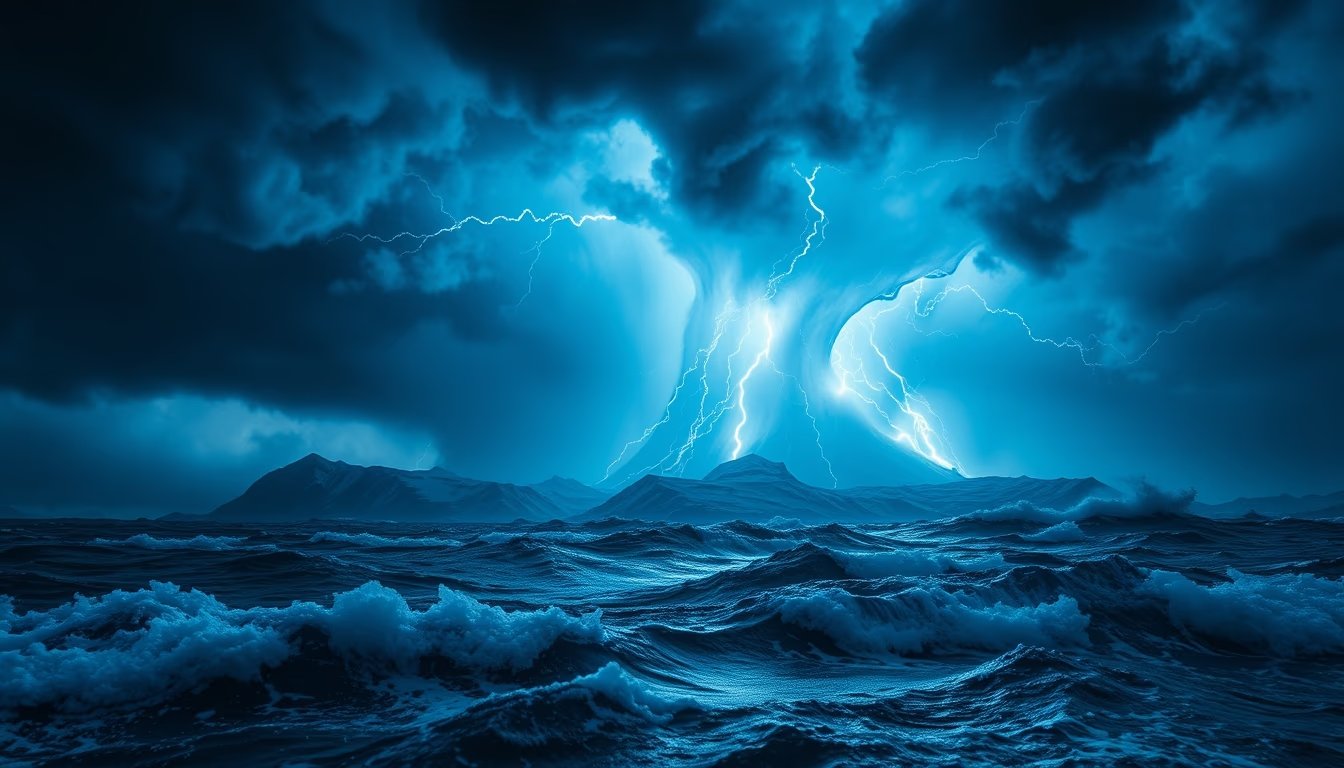
Neptune, the eighth planet from the Sun, is famous for its deep blue hue and powerful storms that challenge our understanding of climate.
About this subject
Neptune has the fastest winds in the Solar System, reaching speeds over 2,100 km/h (1,300 mph). Its atmosphere is mainly composed of hydrogen and helium, but the deep blue color comes from methane absorbing red light. This distinct hue sets Neptune apart from Uranus, which appears a paler blue.
The storms on Neptune are remarkable features. The Great Dark Spot, discovered by Voyager 2 in 1989, was an anticyclonic storm the size of Earth. It faded away after a few years, but other dark spots have appeared, such as one observed by the Hubble Space Telescope in 2018. These storms are often accompanied by bright methane ice clouds, called cirrus clouds.
Neptune's atmospheric dynamics are puzzling. Despite receiving only 0.1% of the sunlight that reaches Earth, its weather activity is vigorous. This suggests that internal heat drives the storms. Temperatures in the upper atmosphere plunge to -218°C (-360°F), but the core may be extremely hot, generating convection.
Recent observations show that Neptune's storms are evolving. In 2019, Hubble detected a large dark spot dissipating quickly while a new one formed in the northern hemisphere. Scientists believe these changes are linked to Neptune's seasonal cycle, which lasts 164 Earth years. There is still much to learn about the weather patterns of this distant planet.
Frequently Asked Questions
Why is Neptune blue?
Neptune's blue color is due to methane in its atmosphere. Methane absorbs red light from the Sun and reflects blue light back into space. This process is similar to Uranus, but Neptune appears more intense because of additional atmospheric components.
How large are Neptune's storms?
Storms on Neptune, such as the Great Dark Spot, can be as large as Earth. They are high-pressure systems that rotate anticlockwise in the southern hemisphere. Smaller storms are also observed, varying in duration and intensity.
Does Neptune have rings?
Yes, Neptune has a faint and dark ring system, discovered by Voyager 2 in 1989. The rings are composed of dust and ice particles and are thinner and less bright than Saturn's rings. They are named Galle, Leverrier, Lassell, and Adams.
Direct URL
https://pub-c7d6a6ea828543ac903a74a341ccb2e1.r2.dev/imagens/neptune-deep-blue-storms-fine-art-photography-p5.avifHow to credit
Include a visible link back to UtilizAí. Copy one of the snippets below:
<a href="https://xn--utiliza-eza.com/en/midia/imagens/neptune-deep-blue-storms-fine-art-photography-p5">Neptune deep blue storms</a> by <a href="https://xn--utiliza-eza.com">UtilizAí</a>, licensed under <a href="https://creativecommons.org/licenses/by/4.0/">CC BY 4.0</a>.
[Neptune deep blue storms](https://xn--utiliza-eza.com/en/midia/imagens/neptune-deep-blue-storms-fine-art-photography-p5) by [UtilizAí](https://xn--utiliza-eza.com), CC BY 4.0
License: CC-BY-4.0