Milky way galaxy long exposure
1344×768 · AVIF · CC BY 4.0
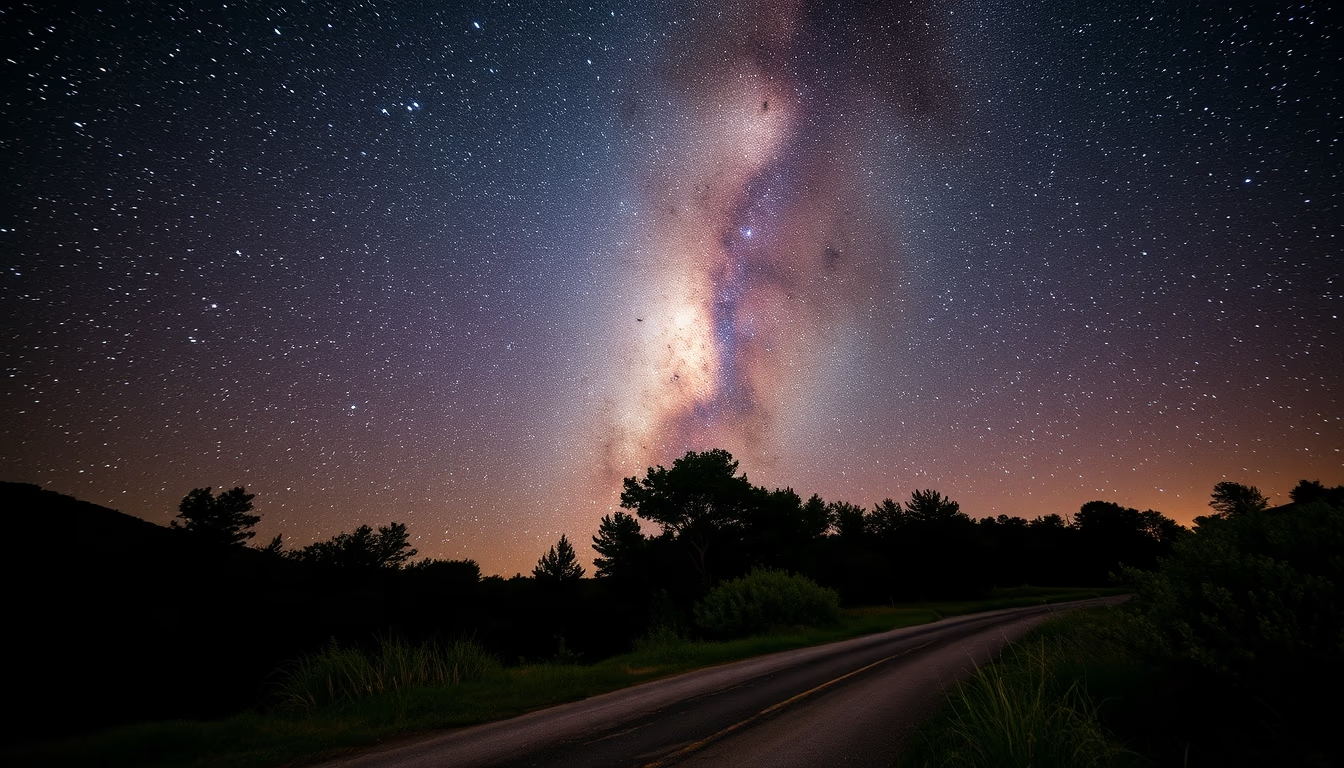
The Milky Way is the galaxy that houses the Solar System, revealed in detail by long-exposure photographs that capture its spiral structure and billions of stars.
About this subject
The Milky Way is a barred spiral galaxy with an estimated diameter between 100,000 and 180,000 light-years. It contains between 100 billion and 400 billion stars, along with nebulae, star clusters, and vast amounts of interstellar dust. At the galaxy's center lies a supermassive black hole known as Sagittarius A*, with a mass of about 4.3 million solar masses. The Milky Way is part of the Local Group, a cluster of more than 50 galaxies that also includes Andromeda and the Triangulum Galaxy.
In Brazil, the best locations for naked-eye observation of the Milky Way are areas far from light pollution, such as the Atacama Desert (on the border with Chile), the Chapada dos Veadeiros National Park in Goiás, and the northeastern hinterlands. During the austral winter (June to August), the galactic core becomes more visible in the night sky. Long-exposure photography is essential to capture details like the milky band, which is actually composed of millions of stars that cannot be distinguished individually with the naked eye.
Interestingly, the name 'Milky Way' comes from the Greek 'galaxias kyklos' (milky circle), referring to its appearance as a white band across the sky. The Solar System is estimated to take about 230 million years to complete one orbit around the galactic center. Long-exposure photography of the Milky Way not only produces stunning images but also has scientific value. Amateur and professional astronomers use these images to study the distribution of stars, nebulae, and interstellar dust, as well as to monitor events such as supernovae and the formation of new stars.
Frequently Asked Questions
What is the best time to observe the Milky Way in Brazil?
The best time is during the austral winter, from June to August, when the galactic core is higher in the night sky. Additionally, being in areas with low light pollution is crucial.
How many stars are in the Milky Way?
The Milky Way is estimated to contain between 100 billion and 400 billion stars. This is approximate, as stars in dense regions obscured by dust are difficult to count.
How to take a long-exposure photo of the Milky Way?
Use a DSLR or mirrorless camera with a wide-angle lens (14-24mm), aperture f/2.8 or wider, ISO between 1600 and 6400, and exposure time of 15 to 30 seconds. A sturdy tripod and remote shutter release are essential to avoid shake.
Direct URL
https://pub-c7d6a6ea828543ac903a74a341ccb2e1.r2.dev/imagens/milky-way-galaxy-long-exposure-documentary-photography-p2.avifHow to credit
Include a visible link back to UtilizAí. Copy one of the snippets below:
<a href="https://xn--utiliza-eza.com/en/midia/imagens/milky-way-galaxy-long-exposure-documentary-photography-p2">Milky way galaxy long exposure</a> by <a href="https://xn--utiliza-eza.com">UtilizAí</a>, licensed under <a href="https://creativecommons.org/licenses/by/4.0/">CC BY 4.0</a>.
[Milky way galaxy long exposure](https://xn--utiliza-eza.com/en/midia/imagens/milky-way-galaxy-long-exposure-documentary-photography-p2) by [UtilizAí](https://xn--utiliza-eza.com), CC BY 4.0
License: CC-BY-4.0