Milky way center galactic
1344×768 · AVIF · CC BY 4.0
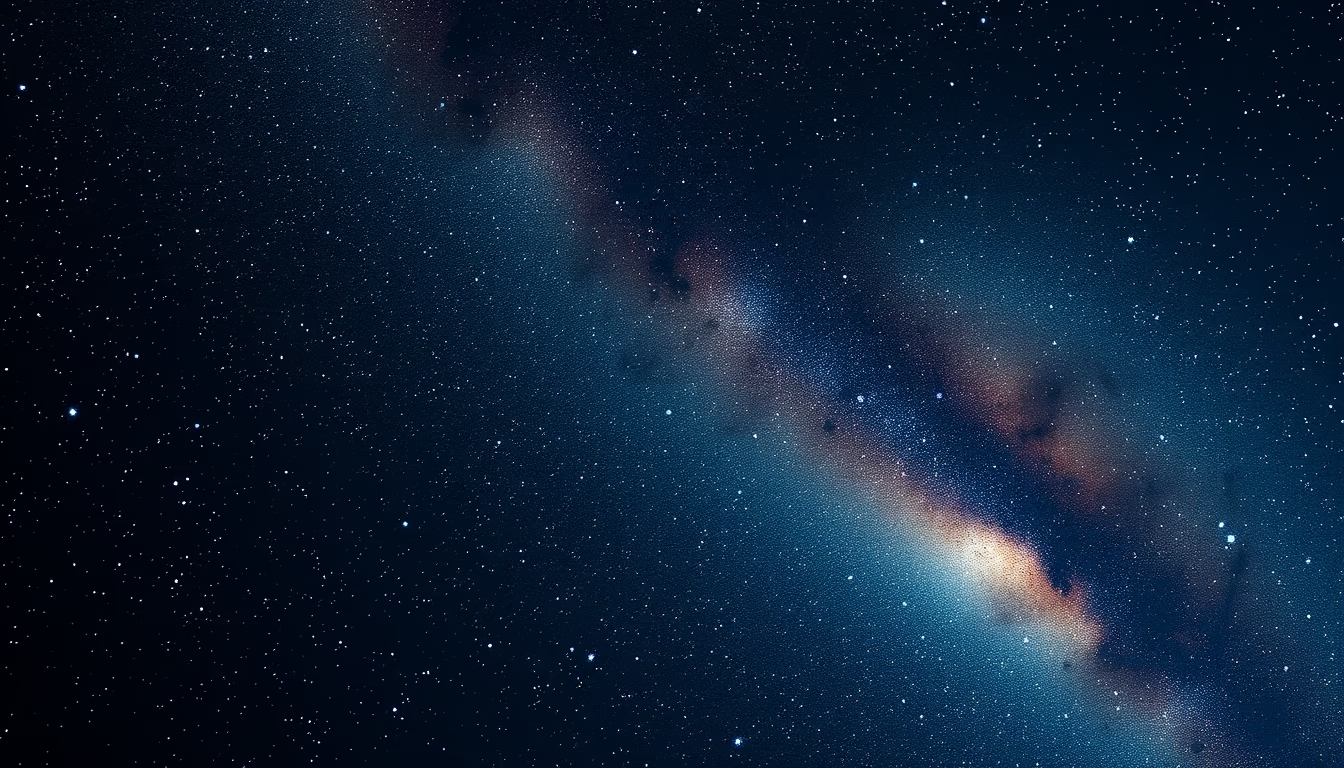
About 27,000 light-years from Earth, the center of the Milky Way hosts a supermassive black hole and dense star clusters, revealed by multi-wavelength observations.
About this subject
The center of the Milky Way lies in the constellation Sagittarius, about 27,000 light-years from Earth. This region is dominated by the supermassive black hole Sagittarius A*, with a mass equivalent to 4 million Suns. Around it, stars like S2 orbit at extreme speeds, providing precise tests of Einstein's general theory of relativity. Stellar density in the core is hundreds of times higher than in our solar neighborhood, with compact clusters and young stars formed amidst intense radiation.
Interstellar dust, composed of carbon and silicate grains, completely blocks visible light from the Galactic Center. Therefore, astronomers use telescopes operating in infrared, radio, and X-rays to study the region. Observations have revealed structures such as the Central Stellar Cluster and giant molecular clouds that fuel star formation. The black hole emits periodic X-ray flares, indicating it is still active, accreting matter from its surroundings.
The Milky Way is classified as a barred spiral galaxy, and the central stellar bar extends about 10,000 light-years. This bar channels gas and dust toward the nucleus, influencing Sagittarius A* activity and galactic evolution. Measurements of stellar motions near the black hole confirmed a compact object with over 4 million solar masses, one of the strongest pieces of evidence for the existence of supermassive black holes. The Galactic Center is a unique laboratory for physicists and astronomers to study high-energy phenomena, extreme magnetic fields, and the dynamics of intense gravitational systems.
Frequently Asked Questions
What is the center of the Milky Way?
The center of the Milky Way is the central region of our galaxy, located in the constellation Sagittarius. It contains a supermassive black hole called Sagittarius A*, along with dense star clusters and dust clouds.
Why is the Galactic Center difficult to observe?
Interstellar dust blocks visible light, but infrared, radio, and X-ray telescopes can penetrate this dust, revealing structures such as stars orbiting the black hole.
What is the importance of the Milky Way's center?
Studying the Galactic Center helps understand galaxy formation and evolution, the physics of supermassive black holes, and stellar dynamics in extreme environments.
Direct URL
https://pub-c7d6a6ea828543ac903a74a341ccb2e1.r2.dev/imagens/milky-way-center-galactic-isometric-flat-lay-p8.avifHow to credit
Include a visible link back to UtilizAí. Copy one of the snippets below:
<a href="https://xn--utiliza-eza.com/en/midia/imagens/milky-way-center-galactic-isometric-flat-lay-p8">Milky way center galactic</a> by <a href="https://xn--utiliza-eza.com">UtilizAí</a>, licensed under <a href="https://creativecommons.org/licenses/by/4.0/">CC BY 4.0</a>.
[Milky way center galactic](https://xn--utiliza-eza.com/en/midia/imagens/milky-way-center-galactic-isometric-flat-lay-p8) by [UtilizAí](https://xn--utiliza-eza.com), CC BY 4.0
License: CC-BY-4.0





