Mercury surface craters
1344×768 · AVIF · CC BY 4.0
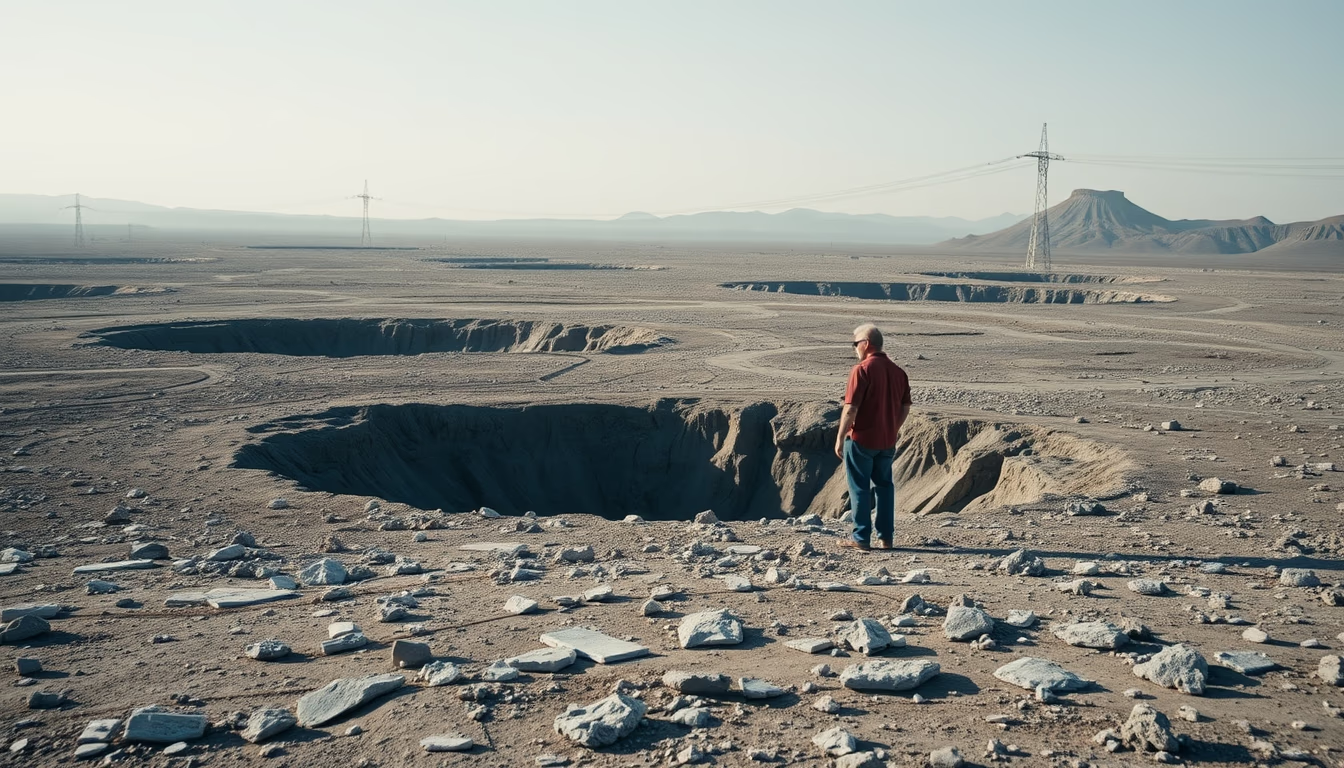
Covered by thousands of impact craters, Mercury's surface reveals billions of years of Solar System geological history.
About this subject
Mercury, the closest planet to the Sun, has a surface covered with impact craters that bear witness to the intense bombardment during the first billion years of the Solar System. Like the Moon, the planet lacks a significant atmosphere to protect its crust, resulting in a landscape marked by asteroid and comet impacts. The largest known impact structure on Mercury is the Caloris Basin, about 1,550 km in diameter, formed approximately 3.8 billion years ago.
Mercurian craters range from small simple depressions to complex multi-ring basins. Unlike the Moon, craters on Mercury tend to be shallower due to the planet's higher gravity, which suppresses the formation of high central peaks. NASA's MESSENGER mission, which orbited Mercury from 2011 to 2015, mapped the entire surface in high resolution, revealing details never seen before. Observations showed that the surface consists of smooth volcanic plains interspersed with heavily cratered regions, indicating past volcanic activity.
A fascinating curiosity is the presence of water ice in permanently shadowed craters at Mercury's poles, despite daytime temperatures reaching 430°C. These deposits were confirmed by radar and the MESSENGER spacecraft. Additionally, Mercury has a thin exosphere composed of atoms ejected from the surface by impacts and the solar wind. Studying craters helps scientists understand the impact history not only of Mercury but of the entire inner Solar System, providing crucial data on planetary evolution.
Frequently Asked Questions
How many craters are on Mercury?
Mercury has hundreds of thousands of craters, ranging from small depressions a few meters wide to large basins hundreds of kilometers across. The largest is the Caloris Basin, 1,550 km in diameter.
Why are Mercury's craters different from the Moon's?
Due to Mercury's higher gravity, its craters tend to be shallower with less prominent central peaks. Additionally, the surface has volcanic plains that have smoothed some ancient craters.
How do craters help understand the Solar System's history?
The density and distribution of craters provide a relative timeline of impacts. By dating different surfaces, scientists can reconstruct the evolution of asteroid and comet bombardment during the first billion years.
Direct URL
https://pub-c7d6a6ea828543ac903a74a341ccb2e1.r2.dev/imagens/mercury-surface-craters-documentary-photography-p5.avifHow to credit
Include a visible link back to UtilizAí. Copy one of the snippets below:
<a href="https://xn--utiliza-eza.com/en/midia/imagens/mercury-surface-craters-documentary-photography-p5">Mercury surface craters</a> by <a href="https://xn--utiliza-eza.com">UtilizAí</a>, licensed under <a href="https://creativecommons.org/licenses/by/4.0/">CC BY 4.0</a>.
[Mercury surface craters](https://xn--utiliza-eza.com/en/midia/imagens/mercury-surface-craters-documentary-photography-p5) by [UtilizAí](https://xn--utiliza-eza.com), CC BY 4.0
License: CC-BY-4.0