Manga panels black white
1344×768 · AVIF · CC BY 4.0
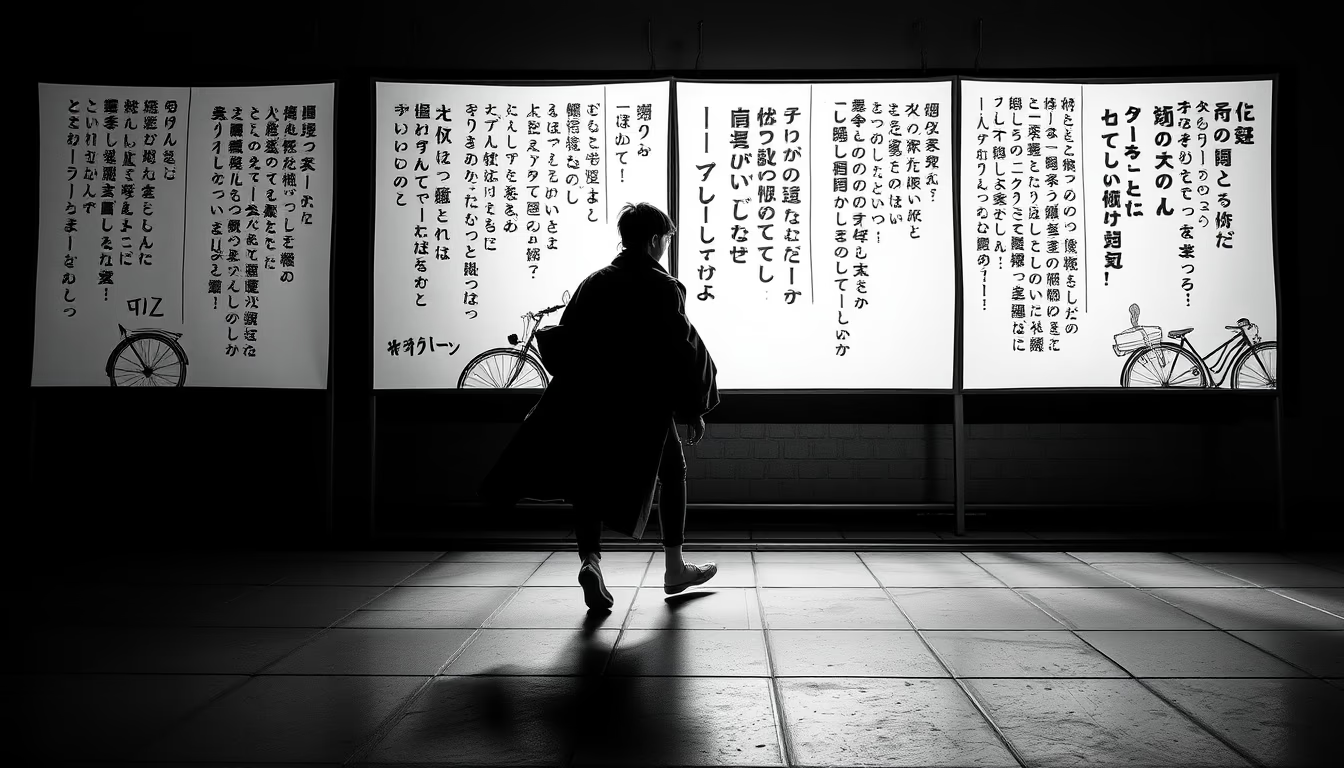
Black and white manga panels embody the essence of Japanese visual storytelling, merging expressive lines with economical detail.
About this subject
Manga, as a sequential art form originating in Japan, traditionally uses black and white for both practical and aesthetic reasons. Since the 1950s with Osamu Tezuka, the absence of color forced artists to master contrast, texture, and visual rhythm. Each panel is a microcomposition where hatching, stippling, and solid black areas create depth and emotion without relying on color palettes. This technical limitation became a stylistic signature, allowing complex stories to be published economically in weekly magazines like Shonen Jump.
Black and white is not merely functional but carries a unique expressive weight. Mangakas such as Katsuhiro Otomo (Akira) and Kentaro Miura (Berserk) explored chiaroscuro to convey tension and atmosphere. In action scenes, the contrast between fine lines and black masses guides the reader's eye, while in contemplative moments, negative space suggests silence or isolation. The visual impact of a well-executed black and white panel can be more powerful than a colored illustration, as it demands active participation from the reader to fill in gaps.
In the context of fine art photography, capturing manga panels in black and white highlights their graphic qualities. Removing color eliminates distractions, revealing the underlying structure of the page: distribution of visual weight, movement lines, and panel hierarchy. This conceptual approach connects manga to the tradition of printmaking and line drawing, bringing Japanese pop culture closer to fine arts. Exhibitions such as 'Manga: The Language of Comics' at the Museum of Modern Art in New York have already addressed this aesthetic dimension.
Globally, the black and white aesthetic of manga has influenced not only other comics but also graphic design and fashion. Western artists like Frank Miller adopted extreme contrasts in works such as Sin City. The 'Wave Fresh 10K' series to which this image belongs celebrates the universality of line work, showing how specific cultural elements can be appreciated as pure visual art, free from language barriers.
Frequently Asked Questions
Why is manga traditionally black and white?
Historically, black and white printing reduced costs and allowed for weekly serialization. The technical limitation forced mangakas to develop contrast, texture, and visual storytelling techniques that became hallmarks of the style.
What is the importance of contrast in manga panels?
Contrast between black and white creates depth, guides the reader's gaze, and intensifies emotions. In action scenes, black masses suggest impact; in quiet moments, white spaces evoke silence. It is a powerful narrative tool.
How has the monochrome aesthetic of manga influenced other arts?
Beyond comics, manga's black and white aesthetic has inspired graphic designers, filmmakers, and artists like Frank Miller. Exhibitions in modern art museums highlight its graphic quality, connecting Japanese pop culture to fine arts.
Direct URL
https://pub-c7d6a6ea828543ac903a74a341ccb2e1.r2.dev/imagens/manga-panels-black-white-fine-art-photography-fresh14.avifHow to credit
Include a visible link back to UtilizAí. Copy one of the snippets below:
<a href="https://xn--utiliza-eza.com/en/midia/imagens/manga-panels-black-white-fine-art-photography-fresh14">Manga panels black white</a> by <a href="https://xn--utiliza-eza.com">UtilizAí</a>, licensed under <a href="https://creativecommons.org/licenses/by/4.0/">CC BY 4.0</a>.
[Manga panels black white](https://xn--utiliza-eza.com/en/midia/imagens/manga-panels-black-white-fine-art-photography-fresh14) by [UtilizAí](https://xn--utiliza-eza.com), CC BY 4.0
License: CC-BY-4.0