Juno jupiter polar
1344×768 · AVIF · CC BY 4.0
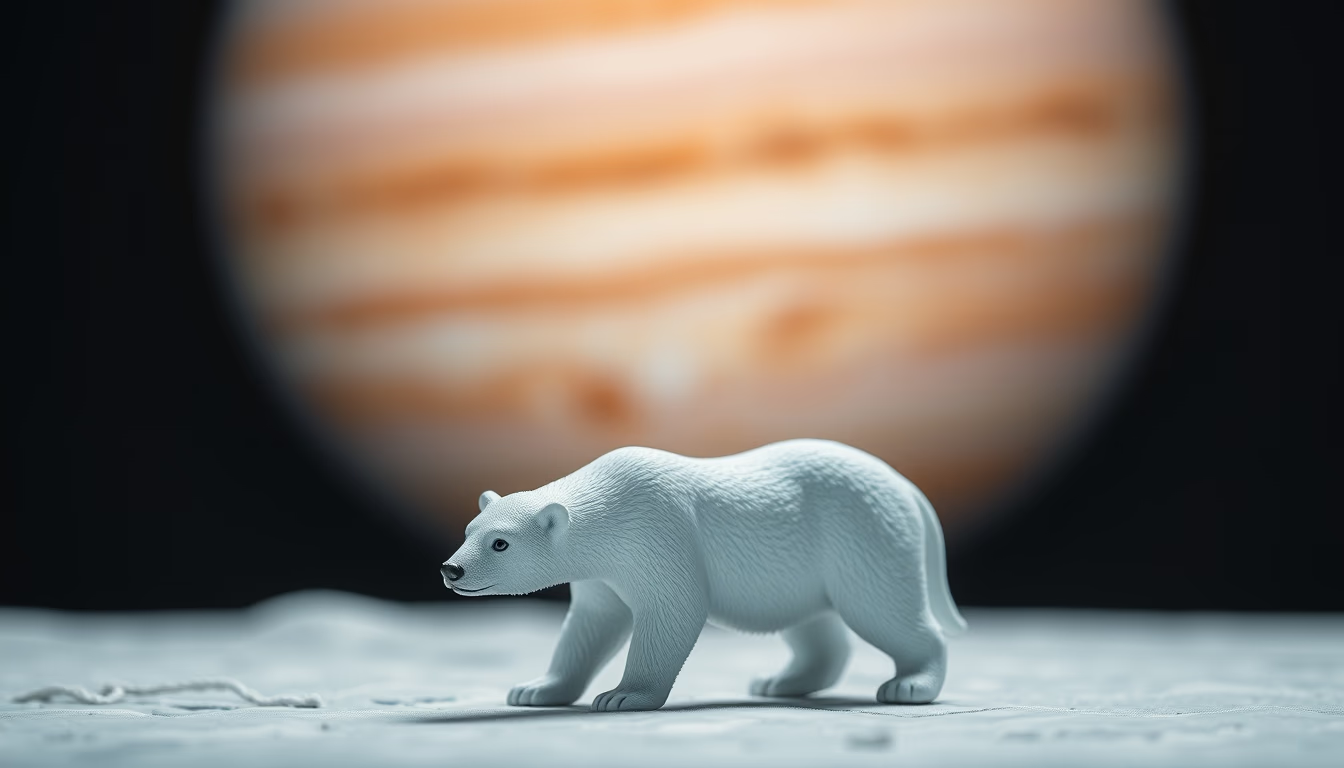
NASA's Juno spacecraft captures unprecedented images of Jupiter's north pole, revealing cyclone storms and unique features of the gas giant.
About this subject
Launched in 2011, NASA's Juno spacecraft arrived at Jupiter in 2016 and began a mission to study the composition, magnetic field, and atmosphere of the largest planet in the solar system. Its polar orbit allows detailed observations of the polar regions, previously poorly understood. The captured images reveal clusters of cyclones at the north pole, with diameters comparable to Earth's, organized in geometric patterns. This discovery surprised scientists, who did not expect such stable and long-lasting structures. The Juno mission has been extended and continues to send data that challenges theoretical models of Jupiter's atmospheric dynamics. The south pole also features cyclones, but with a different arrangement, indicating distinct processes in each hemisphere. Instruments onboard, such as JunoCam and the microwave radiometer, map cloud depth and thermal structure. Additionally, the probe investigates the Jovian aurora, the most powerful in the solar system. With its elliptical orbits and perijove every 53 days, Juno avoids Jupiter's intense radiation belt, extending its operational life. The tilt-shift images, although artificial, help visualize the three-dimensional characteristics of the storms. Continued study of Jupiter provides insights into planetary formation and the evolution of giant planets, both in our system and in exoplanets.
Frequently Asked Questions
What did the Juno spacecraft discover at Jupiter's north pole?
Juno discovered clusters of cyclones at Jupiter's north pole, with diameters comparable to Earth's, organized in stable geometric patterns.
Why do Jupiter's north and south poles have different cyclone arrangements?
The different arrangements indicate distinct atmospheric processes in each hemisphere, possibly related to rotation and magnetic field.
How does Juno avoid Jupiter's intense radiation?
Juno uses a highly elliptical polar orbit that keeps it away from the most radiative regions, passing quickly through perijove and spending most of its time far from the planet.
Direct URL
https://pub-c7d6a6ea828543ac903a74a341ccb2e1.r2.dev/imagens/juno-jupiter-polar-tilt-shift-miniature-fresh12.avifHow to credit
Include a visible link back to UtilizAí. Copy one of the snippets below:
<a href="https://xn--utiliza-eza.com/en/midia/imagens/juno-jupiter-polar-tilt-shift-miniature-fresh12">Juno jupiter polar</a> by <a href="https://xn--utiliza-eza.com">UtilizAí</a>, licensed under <a href="https://creativecommons.org/licenses/by/4.0/">CC BY 4.0</a>.
[Juno jupiter polar](https://xn--utiliza-eza.com/en/midia/imagens/juno-jupiter-polar-tilt-shift-miniature-fresh12) by [UtilizAí](https://xn--utiliza-eza.com), CC BY 4.0
License: CC-BY-4.0