Juno jupiter polar
1344×768 · AVIF · CC BY 4.0
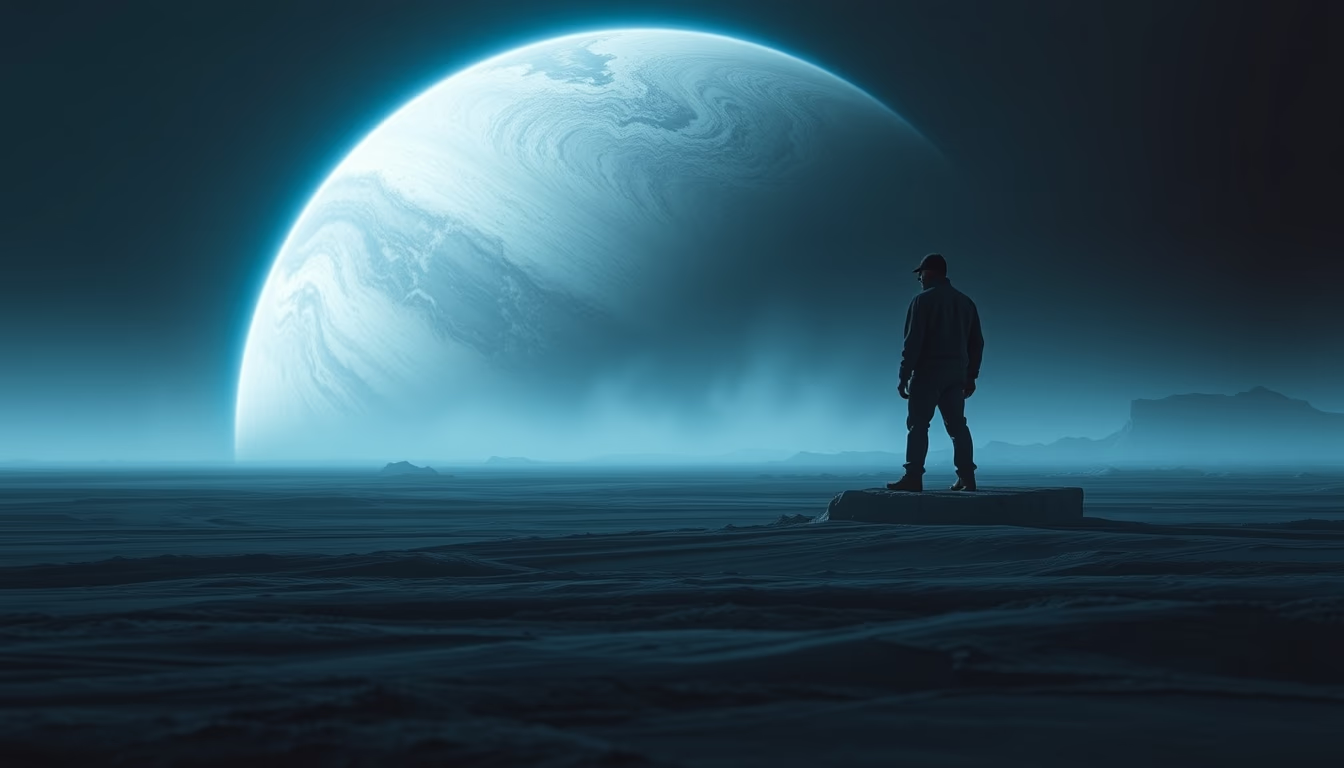
NASA's Juno spacecraft unveils unprecedented details of Jupiter's poles, a gas giant with colossal storms and extreme magnetic fields.
About this subject
The Juno mission, launched by NASA in 2011 and inserted into Jupiter's orbit in July 2016, aims primarily to study the origin, evolution, and internal structure of the largest planet in the Solar System. Unlike previous missions that focused on the equatorial bands, Juno was designed to fly over Jupiter's poles, gathering data that transformed our understanding of atmospheric dynamics and magnetic fields.
Jupiter's poles are chaotic and fascinating regions. Images from the JunoCam revealed clusters of cyclones the size of Earth, arranged in stable geometric patterns, especially at the south pole, where a pentagon of storms forms. These structures remain stable over years, challenging previous climate models. Additionally, Jupiter's polar auroras, much more intense than Earth's, are generated by charged particles interacting with a magnetic field that is the strongest in the Solar System (about 20,000 times that of Earth).
Juno's highly elliptical polar orbit allows it to avoid most of Jupiter's intense radiation and collect close-up measurements every 53 days. Instruments such as the Fluxgate Magnetometer (FGM) and the Radio and Plasma Wave Experiment (Waves) mapped the gravitational and magnetic fields with unprecedented precision, revealing a differentiated interior: a diffuse core of heavy elements, possibly dissolved in metallic hydrogen. Mission data also suggest that Jupiter's winds penetrate up to 3,000 km deep, far beyond expectations.
Interestingly, fine art photography of Jupiter's poles often highlights the vivid colors (blues, oranges, whites) that are processed from raw JunoCam data, as the spacecraft captures visible and infrared light. These representations, while aesthetically enhanced, are based on real science, allowing the public to appreciate the beauty of a hostile and distant environment.
Frequently Asked Questions
What did the Juno spacecraft discover at Jupiter's poles?
Juno discovered permanent polar cyclones arranged in geometric patterns, such as a hexagon at the north and a pentagon at the south, along with intense auroras and an extremely strong magnetic field.
Why is studying Jupiter's poles important?
The poles reveal deep atmospheric processes and the planet's internal structure, helping to understand the formation of gas giants and planetary dynamics in general.
Are artistic images of Jupiter's poles accurate?
Yes, they are based on real JunoCam data, though enhanced for aesthetic purposes. The colors correspond to wavelengths captured by the spacecraft.
Direct URL
https://pub-c7d6a6ea828543ac903a74a341ccb2e1.r2.dev/imagens/juno-jupiter-polar-fine-art-photography-fresh0.avifHow to credit
Include a visible link back to UtilizAí. Copy one of the snippets below:
<a href="https://xn--utiliza-eza.com/en/midia/imagens/juno-jupiter-polar-fine-art-photography-fresh0">Juno jupiter polar</a> by <a href="https://xn--utiliza-eza.com">UtilizAí</a>, licensed under <a href="https://creativecommons.org/licenses/by/4.0/">CC BY 4.0</a>.
[Juno jupiter polar](https://xn--utiliza-eza.com/en/midia/imagens/juno-jupiter-polar-fine-art-photography-fresh0) by [UtilizAí](https://xn--utiliza-eza.com), CC BY 4.0
License: CC-BY-4.0