Juno jupiter polar
1344×768 · AVIF · CC BY 4.0

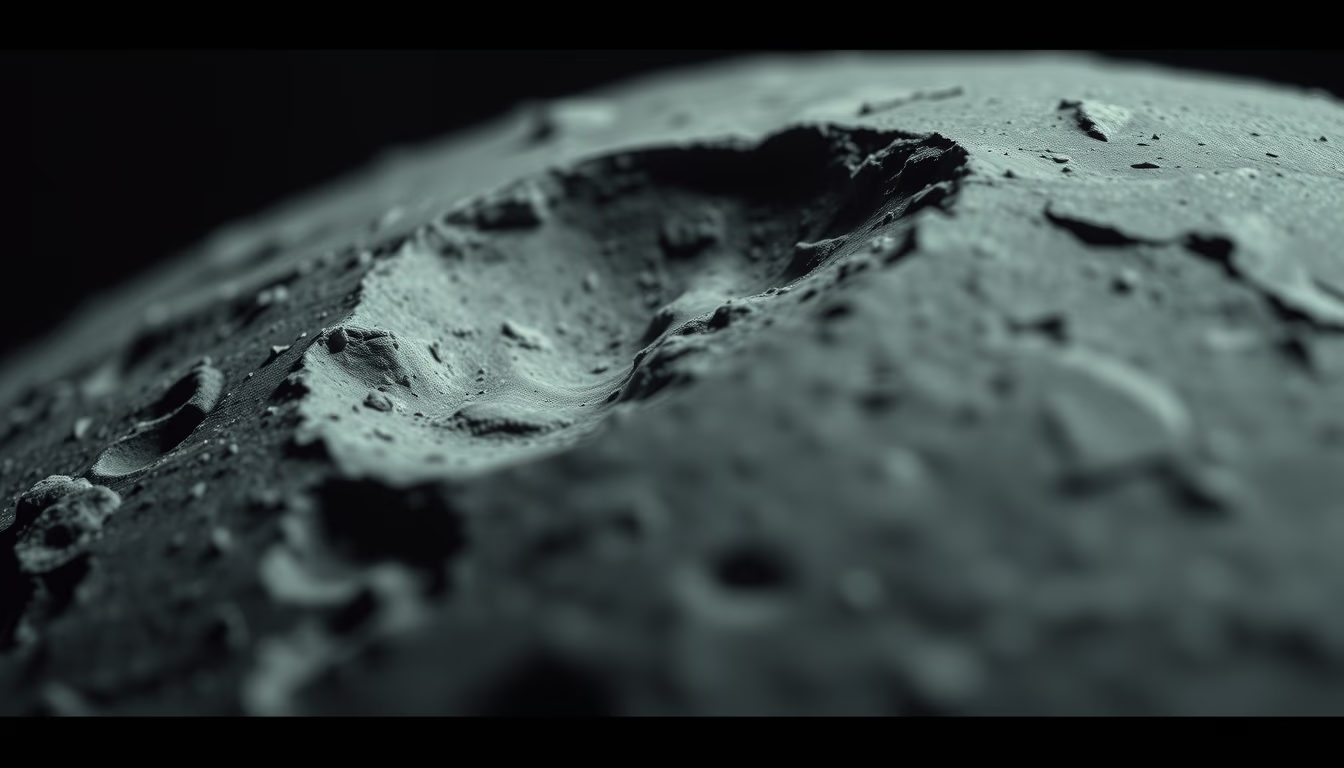
NASA's Juno spacecraft revealed Jupiter's intricate polar cyclones in unprecedented detail.
About this subject
NASA's Juno mission, launched in 2011 and inserted into Jupiter's orbit in July 2016, is the first to explore the gas giant's poles up close. Unlike previous orbiters that stayed near the equator, Juno follows a highly elliptical polar orbit, passing as close as 4,200 km above the cloud tops every 53 days. This trajectory enables its instruments, such as the JunoCam visible light camera and the Microwave Radiometer (MWR), to observe the polar regions with unprecedented resolution.
One of Juno's most striking discoveries is the presence of cyclone clusters at both poles. At the north pole, a central cyclone is surrounded by eight smaller cyclones arranged in an octagonal pattern; at the south pole, a central cyclone is encircled by five cyclones forming a pentagon. These vortices are enormous, with diameters up to 1,000 km, and have remained stable over years, challenging previous atmospheric models.
Beyond cyclone structure, Juno has mapped Jupiter's magnetic field in high precision, revealing it is more complex than a simple dipole. The spacecraft also detected powerful polar auroras, distinct from Earth's, generated by charged particles from the volcanic moon Io. Gravity data indicate Jupiter's core is diffuse and partially dissolved, with a mass of about 10 to 30 Earth masses.
Juno's mission has been extended to 2025, continuing to monitor seasonal changes at the poles and providing critical data to understand Jupiter's atmospheric dynamics. The polar images, with their turbulent patterns and varied colors, are not only visually stunning but also represent a fundamental advance in planetary science.
Frequently Asked Questions
Why was the Juno spacecraft sent to Jupiter?
Juno was sent to study Jupiter's origin and evolution by investigating its interior, magnetic field, atmosphere, and auroras. The polar orbit enables, for the first time, observation of the planet's poles.
What did Juno discover about Jupiter's poles?
Juno discovered a stable system of polar cyclones: eight in the north and five in the south, arranged in geometric patterns. It also detected intense ultraviolet auroras and a complex magnetic field.
How does Juno's polar orbit differ from previous missions?
Previous missions, like Galileo and Voyager, observed Jupiter from equatorial orbits or flybys. Juno has a highly elliptical polar orbit that passes directly over the poles, providing unique coverage.
Direct URL
https://pub-c7d6a6ea828543ac903a74a341ccb2e1.r2.dev/imagens/juno-jupiter-polar-film-grain-authentic-fresh6.avifHow to credit
Include a visible link back to UtilizAí. Copy one of the snippets below:
<a href="https://xn--utiliza-eza.com/en/midia/imagens/juno-jupiter-polar-film-grain-authentic-fresh6">Juno jupiter polar</a> by <a href="https://xn--utiliza-eza.com">UtilizAí</a>, licensed under <a href="https://creativecommons.org/licenses/by/4.0/">CC BY 4.0</a>.
[Juno jupiter polar](https://xn--utiliza-eza.com/en/midia/imagens/juno-jupiter-polar-film-grain-authentic-fresh6) by [UtilizAí](https://xn--utiliza-eza.com), CC BY 4.0
License: CC-BY-4.0