Juno jupiter polar
1344×768 · AVIF · CC BY 4.0

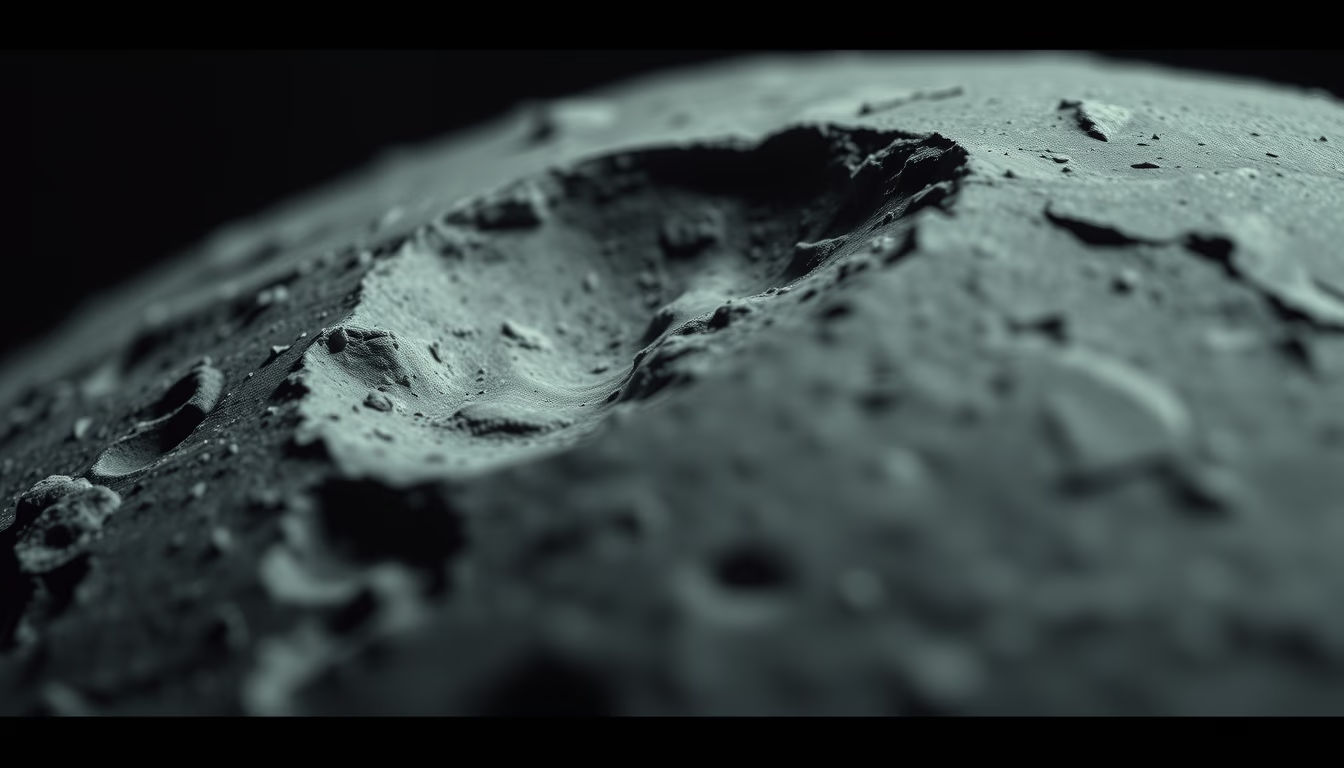
NASA's Juno spacecraft has been orbiting Jupiter since 2016, revealing unprecedented details of its poles, cyclonic storms, and magnetic field.
About this subject
NASA's Juno mission, launched in 2011, entered Jupiter's orbit in July 2016 with the primary goal of studying the composition, gravity, and magnetic field of the gas giant. Unlike previous missions that orbited in the equatorial plane, Juno adopted a highly elliptical polar orbit, coming as close as 4,200 km above the clouds every 53 days. This unprecedented trajectory allowed direct observation of Jupiter's poles, areas never before photographed in detail.
One of the most remarkable discoveries was the presence of persistent cyclone clusters at the poles: at the south pole, a central cyclone surrounded by five others of similar size, each hundreds of kilometers in diameter, forming a stable geometric pattern. Instruments such as JIRAM (infrared spectrometer) revealed that these storms consist of ammonia and water ice, with winds exceeding 350 km/h. Jupiter's magnetic field, the strongest in the Solar System, was also mapped with precision, showing asymmetries and regions of variable intensity near the poles.
Furthermore, Juno detected powerful polar auroras, both in ultraviolet and infrared, resulting from the interaction of the magnetic field with charged particles from the Sun. These auroras are hundreds of times more energetic than Earth's. The spacecraft also revealed that Jupiter's interior has a complex structure, with a diffuse core and layers of metallic hydrogen. Juno data continue to be analyzed, and the mission has been extended through 2025, promising further insights into the largest planet in the Solar System.
Frequently Asked Questions
Why was Juno placed in a polar orbit around Jupiter?
A polar orbit allows the spacecraft to fly directly over the poles, which are critical areas for understanding Jupiter's magnetic field and atmospheric dynamics. Additionally, this trajectory avoids the intense equatorial radiation belts, protecting the instruments.
What did the images of Jupiter's poles reveal?
The images showed clusters of polar cyclones with a stable geometric pattern of storms. At the south pole, for example, there is a central cyclone surrounded by five others, all with complex cloud structures and extreme winds.
Is Juno still operating?
Yes, the primary mission ended in 2021, but NASA extended the mission through 2025. Juno continues to perform close flybys every 53 days, collecting data on Jupiter's atmosphere, magnetic field, and internal structure.
Direct URL
https://pub-c7d6a6ea828543ac903a74a341ccb2e1.r2.dev/imagens/juno-jupiter-polar-cinematic-wide-shot-fresh15.avifHow to credit
Include a visible link back to UtilizAí. Copy one of the snippets below:
<a href="https://xn--utiliza-eza.com/en/midia/imagens/juno-jupiter-polar-cinematic-wide-shot-fresh15">Juno jupiter polar</a> by <a href="https://xn--utiliza-eza.com">UtilizAí</a>, licensed under <a href="https://creativecommons.org/licenses/by/4.0/">CC BY 4.0</a>.
[Juno jupiter polar](https://xn--utiliza-eza.com/en/midia/imagens/juno-jupiter-polar-cinematic-wide-shot-fresh15) by [UtilizAí](https://xn--utiliza-eza.com), CC BY 4.0
License: CC-BY-4.0