Juno jupiter polar
1344×768 · AVIF · CC BY 4.0

NASA's Juno spacecraft reveals unprecedented details of Jupiter's poles, including giant cyclones and intense auroras, transforming our understanding of the largest planet in the Solar System.
About this subject
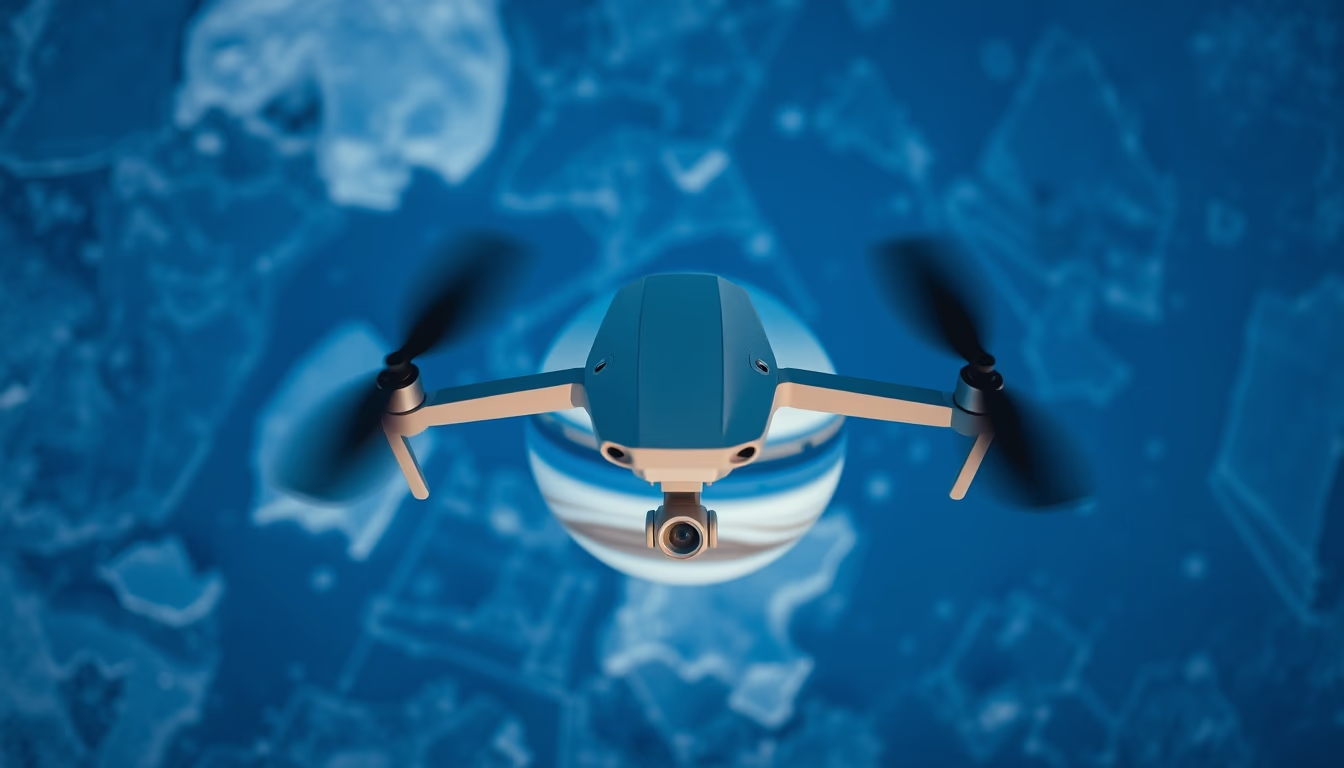
Launched in 2011 and inserted into Jupiter's orbit in 2016, the Juno spacecraft was designed to study the composition, gravitational and magnetic fields of the gas giant, with a special focus on its polar regions. Unlike previous missions that observed Jupiter from lower latitudes, Juno follows a highly elliptical polar orbit, passing directly over the poles every 53 days. This unique trajectory allows detailed mapping of structures never seen before.
Images taken by the JunoCam instrument, a visible-light telescope, revealed that Jupiter's poles are dramatically different from the rest of the planet. While the equator displays horizontal bands of colorful clouds, the poles show a chaotic pattern of cyclones arranged in polygons. At the north pole, eight cyclones surround a central cyclone, forming an octagon; at the south pole, five cyclones circle a central one in a pentagon. These storm systems, up to 4,000 km in diameter, persist for years and appear stable, challenging existing atmospheric models.
In addition to cyclones, Juno detected much more intense polar auroras than Earth's, generated by the interaction of Jupiter's magnetic field with charged particles from the Sun and its moon Io. The probe also precisely measured the gravitational field, indicating that Jupiter's core is diffuse and partially dissolved, rather than compact as previously thought. Data on the abundance of water and ammonia deep in the atmosphere are helping reconstruct the planet's formation history. The mission, originally scheduled to last until 2021, has been extended to 2025, continuing to send crucial data about Jupiter's internal structure and atmospheric dynamics.
Frequently Asked Questions
Why was Juno sent to study Jupiter's poles?
Jupiter's polar regions were largely unknown before Juno. The polar orbit allows the probe to collect data on the planet's magnetic field, atmosphere, and internal structure in areas never before observed up close.
How many cyclones exist at Jupiter's poles?
At the north pole, there are eight cyclones arranged in an octagon around a central cyclone. At the south pole, five cyclones form a pentagon around a central one. These patterns are unique in the Solar System.
What is Juno's main discovery about Jupiter's interior?
Juno revealed that Jupiter's core is not solid and compact, but diffuse and partially dissolved, with heavy materials mixed into metallic hydrogen. This suggests the planet underwent mergers with planetesimals during its formation.
Direct URL
https://pub-c7d6a6ea828543ac903a74a341ccb2e1.r2.dev/imagens/juno-jupiter-polar-architectural-photography-fresh5.avifHow to credit
Include a visible link back to UtilizAí. Copy one of the snippets below:
<a href="https://xn--utiliza-eza.com/en/midia/imagens/juno-jupiter-polar-architectural-photography-fresh5">Juno jupiter polar</a> by <a href="https://xn--utiliza-eza.com">UtilizAí</a>, licensed under <a href="https://creativecommons.org/licenses/by/4.0/">CC BY 4.0</a>.
[Juno jupiter polar](https://xn--utiliza-eza.com/en/midia/imagens/juno-jupiter-polar-architectural-photography-fresh5) by [UtilizAí](https://xn--utiliza-eza.com), CC BY 4.0
License: CC-BY-4.0