James webb deep field
1344×768 · AVIF · CC BY 4.0

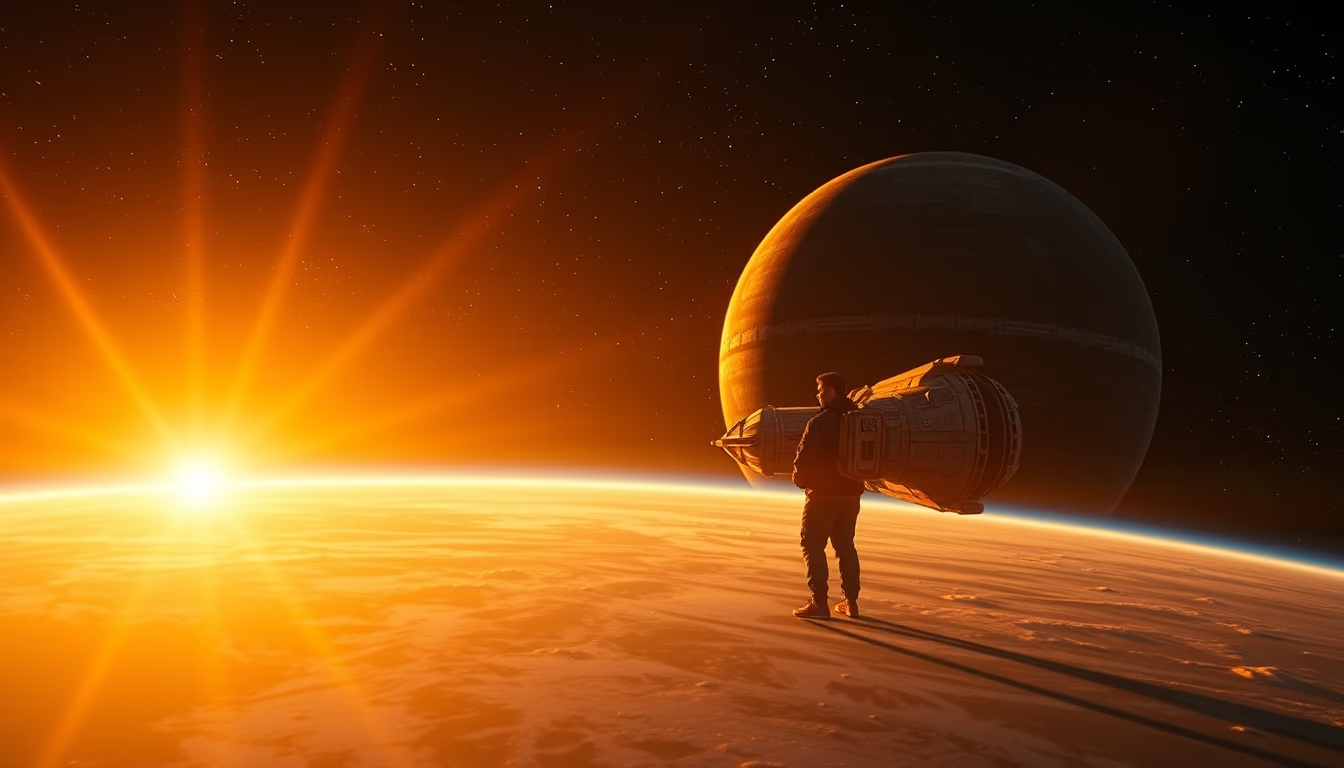
The James Webb deep field revealed thousands of never-before-seen galaxies, including some of the most distant ever observed.
About this subject
The James Webb Space Telescope's (JWST) deep field, officially released by NASA on July 11, 2022, was the first scientific image from the observatory. While Hubble's deep fields required exposures lasting days or weeks, Webb achieved comparable detail in just 12.5 hours. This capability stems from its 6.5-meter primary mirror and infrared sensitivity, which is ideal for capturing the redshifted light of extremely distant galaxies.
The image targets the galaxy cluster SMACS 0723, located about 4.6 billion light-years from Earth. Using gravitational lensing caused by the cluster's mass, Webb reveals galaxies even farther behind it, some with redshifts above 8, corresponding to ages less than 600 million years after the Big Bang. This allows scientists to study the formation of the first stars and galaxies, a feat previously unattainable.
Webb's deep field not only set distance records but also found an unexpectedly high number of bright, massive galaxies in the early universe. This challenges current cosmological models, which predicted a fainter, less abundant population. Astronomers are now revising theories of cosmic structure formation, while the telescope continues to survey the sky. Each Webb image is a window into the past, offering clues about how the universe evolved to its present state.
Frequently Asked Questions
What makes the James Webb deep field different from Hubble's?
Webb observes in infrared, enabling it to see more distant and ancient galaxies. Its larger mirror also gathers more light in less time: Webb's deep field was captured in 12.5 hours, while Hubble's required days.
Why was the galaxy cluster SMACS 0723 chosen for this image?
SMACS 0723 is a massive cluster that acts as a gravitational lens, magnifying and distorting the light of even more distant objects behind it. This allows Webb to observe galaxies that would otherwise be invisible.
What surprising discoveries has JWST made with deep fields?
The telescope has found luminous, massive galaxies at very early times (less than 600 million years after the Big Bang), in larger numbers than models predicted. This forces astronomers to rethink the initial formation of structures in the universe.
Direct URL
https://pub-c7d6a6ea828543ac903a74a341ccb2e1.r2.dev/imagens/james-webb-deep-field-documentary-nature-style-fresh0.avifHow to credit
Include a visible link back to UtilizAí. Copy one of the snippets below:
<a href="https://xn--utiliza-eza.com/en/midia/imagens/james-webb-deep-field-documentary-nature-style-fresh0">James webb deep field</a> by <a href="https://xn--utiliza-eza.com">UtilizAí</a>, licensed under <a href="https://creativecommons.org/licenses/by/4.0/">CC BY 4.0</a>.
[James webb deep field](https://xn--utiliza-eza.com/en/midia/imagens/james-webb-deep-field-documentary-nature-style-fresh0) by [UtilizAí](https://xn--utiliza-eza.com), CC BY 4.0
License: CC-BY-4.0