Jade carved chinese
1344×768 · AVIF · CC BY 4.0
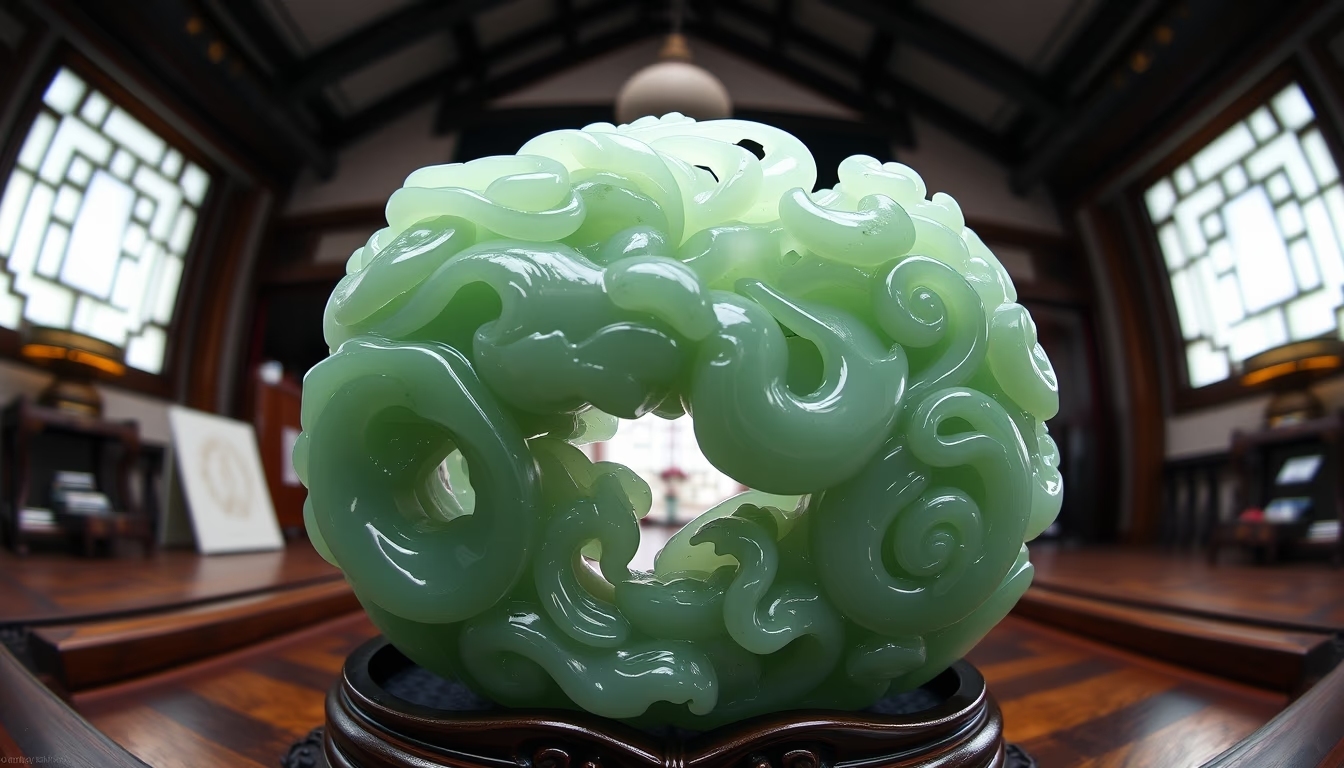
Chinese jade carving is a millennia-old art form symbolizing purity and immortality, with techniques dating back to the Neolithic period.
About this subject
Jade actually comprises two distinct minerals: nephrite and jadeite. Nephrite, more common in ancient China, is a calcium magnesium silicate, while jadeite (a sodium aluminum silicate) is rarer and more highly valued, sourced primarily from Myanmar. The art of jade carving in China dates back to the Neolithic period, with notable examples from the Hongshan culture (c. 4700, 2900 BCE) and the Liangzhu culture (c. 3300, 2300 BCE), which produced ritual objects like cong and bi. Jade was considered more valuable than gold in Chinese culture, associated with the five cardinal virtues: wisdom, justice, compassion, courage, and modesty, as described by Confucius.
Jade carving is extremely challenging due to the material's hardness (6 to 7 on the Mohs scale). Artisans use rotary tools with abrasives such as quartz sand or diamond, patiently sculpting intricate details. During the Shang dynasty (c. 1600, 1046 BCE), jade was used for ceremonial weapons and ornaments. In the Han dynasty (206 BCE, 220 CE), jade burial suits were believed to preserve the body, as evidenced by the famous jade suit of Prince Liu Sheng. During the Ming and Qing dynasties, carving reached its peak of virtuosity, with pieces depicting deities, mythical animals, and delicate vessels.
Jade symbolism is rich: the dragon represents the emperor, the phoenix the empress, and fish abundance and prosperity. Many pieces combine natural forms with auspicious meanings. Today, China continues to treasure jade, with carving centers in Guangzhou, Beijing, and Suzhou, and a thriving market for Burmese jadeite. Jade carving is recognized by UNESCO as an Intangible Cultural Heritage of Humanity. Each piece carries centuries of history and technique, serving as a testament to Chinese cultural depth.
Frequently Asked Questions
What is the difference between jadeite and nephrite?
Jadeite is rarer, more vitreous, and comes in vivid colors (imperial green, lavender), while nephrite is fibrous and opaque, with olive-green to gray tones. Jadeite is mainly from Myanmar; nephrite is found in China, Russia, and New Zealand.
Why is jade so highly valued in Chinese culture?
Jade symbolizes purity, virtue, and immortality. Confucius associated it with the five cardinal virtues. It was used in rituals, royal ornaments, and burial suits, prized even above gold.
How are jade carvings made?
Jade is carved using rotary tools (lathes) and abrasives like quartz sand or diamond. The process is slow and requires patience due to the material's hardness. Fine details are achieved with smaller burrs.
Direct URL
https://pub-c7d6a6ea828543ac903a74a341ccb2e1.r2.dev/imagens/jade-carved-chinese-fish-eye-wide-angle-p11.avifHow to credit
Include a visible link back to UtilizAí. Copy one of the snippets below:
<a href="https://xn--utiliza-eza.com/en/midia/imagens/jade-carved-chinese-fish-eye-wide-angle-p11">Jade carved chinese</a> by <a href="https://xn--utiliza-eza.com">UtilizAí</a>, licensed under <a href="https://creativecommons.org/licenses/by/4.0/">CC BY 4.0</a>.
[Jade carved chinese](https://xn--utiliza-eza.com/en/midia/imagens/jade-carved-chinese-fish-eye-wide-angle-p11) by [UtilizAí](https://xn--utiliza-eza.com), CC BY 4.0
License: CC-BY-4.0