Index cards stacked
1344×768 · AVIF · CC BY 4.0
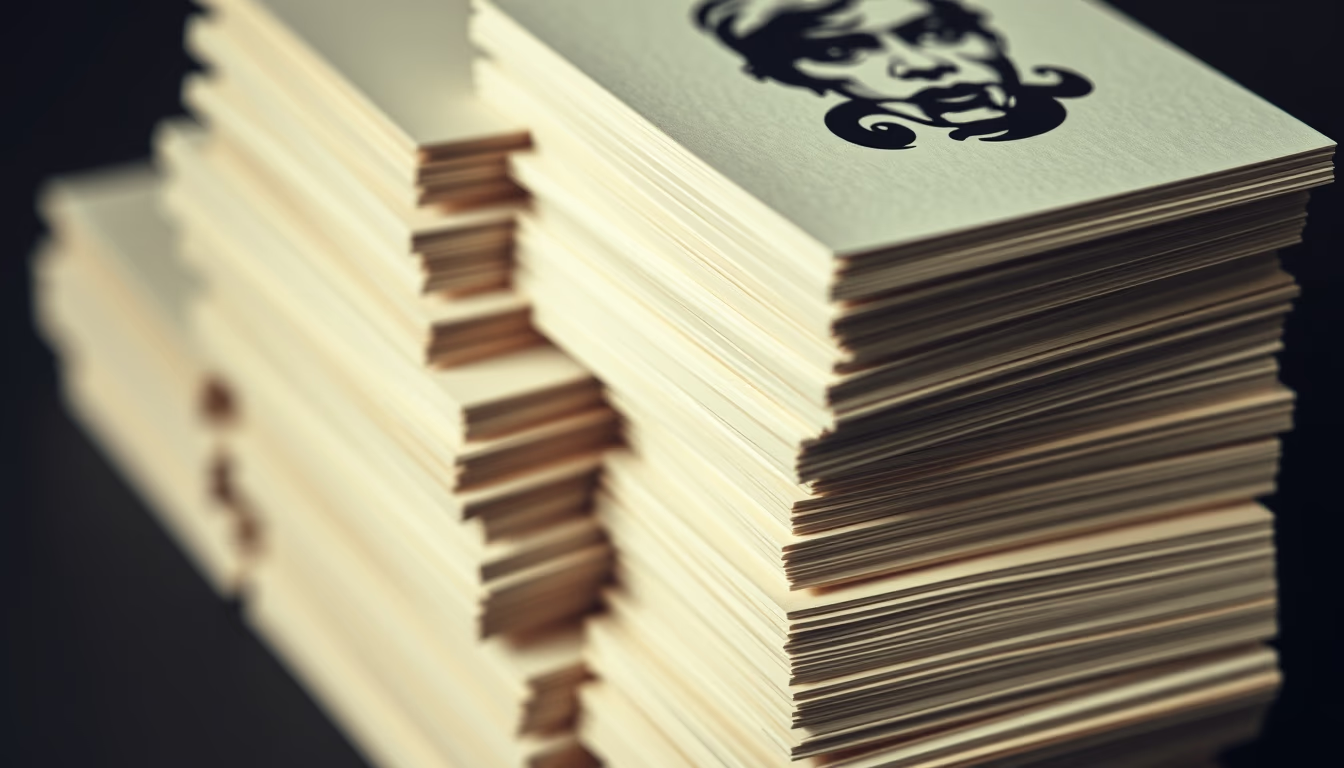
Stacks of index cards organize information in offices, libraries, and creative projects since the 19th century.
About this subject
Index cards are small rectangles of cardstock used to record and organize information in a portable and flexible manner. They emerged in the late 19th century as a library cataloging tool, especially after Melvil Dewey popularized standardized card formats. The most common size is 3 by 5 inches (7.6 by 12.7 cm), though variations like 4 by 6 inches exist. Each card holds notes, references, or data and is stored in specialized boxes or files.
The popularity of index cards exploded in the 20th century, extending beyond libraries. Writers such as Vladimir Nabokov and scientist Niklas Luhmann used them to structure novels and knowledge systems. Luhmann's Zettelkasten method relies on numbered, cross-referenced cards to generate interdisciplinary insights. In schools, index cards serve as flashcards for memorization, while creative professionals use them in brainstorming and project planning.
The simplicity of index cards allows physical reordering, handwritten annotations, and visual categorization by color. Despite digitization, many offices and scholars still prefer the tactile handling for organizing ideas. Cards are also used in crafts, scrapbooking, and decor. Their durability and low cost make them globally accessible. Stationery companies produce ruled, blank, or grid versions to suit various needs.
Today, there is a movement back to analog tools for focus and creativity. Index cards are celebrated for their adaptability: they can be carried in a pocket, pinned on boards, or turned into concept maps. They represent a democratic organizing tool that requires no battery or internet connection.
Frequently Asked Questions
What is the standard size of an index card?
The most common size is 3 by 5 inches (7.6 by 12.7 cm). Variations like 4 by 6 inches and 5 by 8 inches are also used for specific purposes.
What are index cards used for today?
They are used for studying (flashcards), creative writing (Zettelkasten), project organization, to-do lists, recipe catalogs, and even decoration. Many people prefer them to stay focused away from screens.
Who popularized the use of index cards for cataloging?
Melvil Dewey, an American librarian, was instrumental in adopting standardized card catalogs in libraries in the late 19th century, though the concept of cards existed earlier.
Direct URL
https://pub-c7d6a6ea828543ac903a74a341ccb2e1.r2.dev/imagens/index-cards-stacked-high-fashion-editorial-fresh2.avifHow to credit
Include a visible link back to UtilizAí. Copy one of the snippets below:
<a href="https://xn--utiliza-eza.com/en/midia/imagens/index-cards-stacked-high-fashion-editorial-fresh2">Index cards stacked</a> by <a href="https://xn--utiliza-eza.com">UtilizAí</a>, licensed under <a href="https://creativecommons.org/licenses/by/4.0/">CC BY 4.0</a>.
[Index cards stacked](https://xn--utiliza-eza.com/en/midia/imagens/index-cards-stacked-high-fashion-editorial-fresh2) by [UtilizAí](https://xn--utiliza-eza.com), CC BY 4.0
License: CC-BY-4.0