Index cards stacked
1344×768 · AVIF · CC BY 4.0
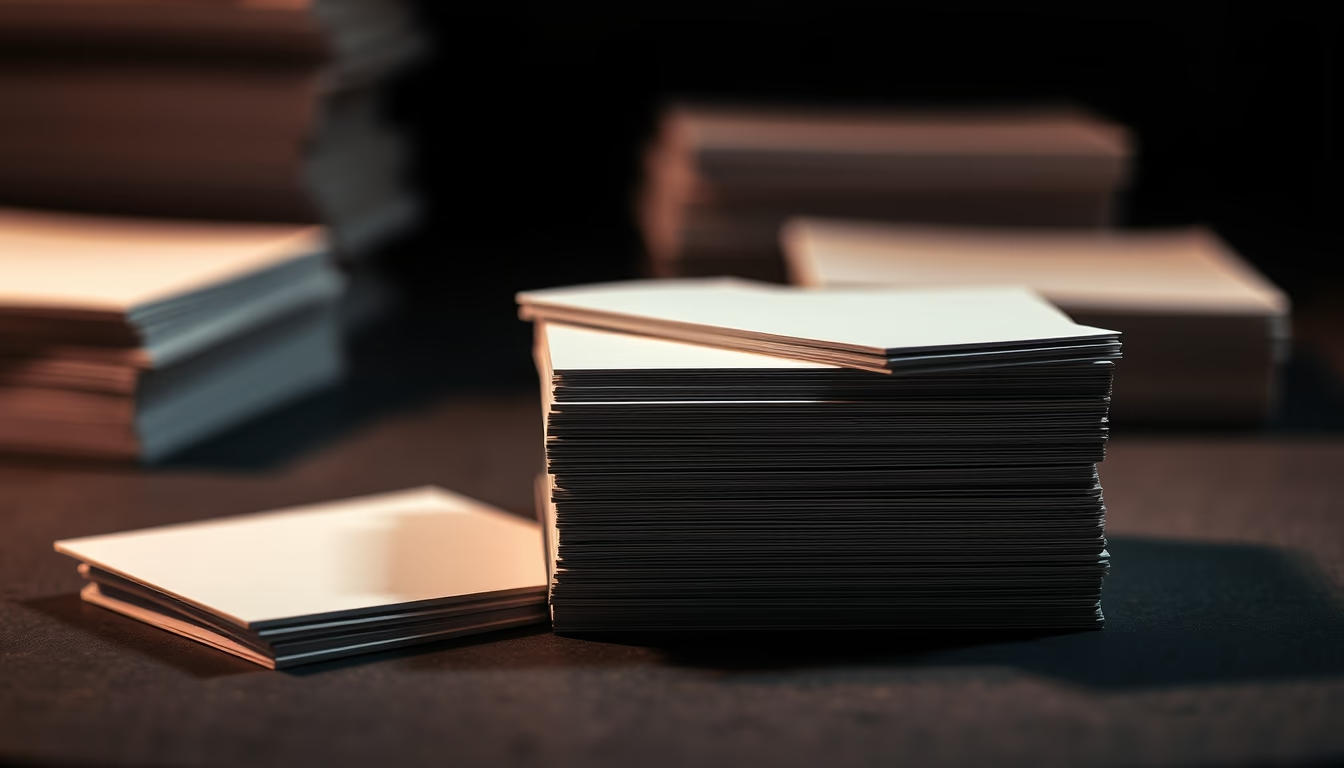
Stack of index cards, a traditional paper tool for organization, cataloging, and quick reference of information.
About this subject
Index cards are small rectangular paper cards, typically measuring 5 inches by 3 inches (12.5 cm by 7.5 cm), used for systematically recording and organizing information. Each card holds concise data such as titles, authors, keywords, or summaries, enabling classification in files or boxes. This system was widely adopted in libraries, offices, and educational institutions before the digital age, notably in the card catalog of the United States Library of Congress, which once contained over 25 million cards.
The index card method dates back to the late 18th century, but its popularization came with librarian Melvil Dewey, who standardized the format in the late 19th century. In the United States and globally, index cards were essential in university and public libraries, such as the British Library and the Library of Congress, for cataloging rare books and periodicals. Organization by alphabetical, numerical, or thematic order allowed efficient manual searches, serving as a precursor to digital databases.
Culturally, index cards represent an era of physical knowledge organization. Many researchers and writers, including French author Georges Perec, used card systems to structure their works. Today, their use has declined with computerization, but they still appear in nostalgic settings, such as vintage workstations or fine art projects evoking analog aesthetics. The image of stacked index cards highlights the materiality and discipline of traditional cataloging, contrasting with digital fluidity.
Frequently Asked Questions
What is the standard size of an index card?
The most common size is 5 inches by 3 inches (12.5 cm by 7.5 cm), but variations such as 4x6 inches also exist.
How were index cards organized in libraries?
They were arranged in drawers or boxes, typically in alphabetical order by author, title, or subject, with divider guides for easy retrieval.
Are index cards still used today?
Yes, though less frequently. They are used by artists, researchers, and in educational contexts for brainstorming, memorization (as flashcards), or vintage aesthetics.
Direct URL
https://pub-c7d6a6ea828543ac903a74a341ccb2e1.r2.dev/imagens/index-cards-stacked-fine-art-photography-fresh18.avifHow to credit
Include a visible link back to UtilizAí. Copy one of the snippets below:
<a href="https://xn--utiliza-eza.com/en/midia/imagens/index-cards-stacked-fine-art-photography-fresh18">Index cards stacked</a> by <a href="https://xn--utiliza-eza.com">UtilizAí</a>, licensed under <a href="https://creativecommons.org/licenses/by/4.0/">CC BY 4.0</a>.
[Index cards stacked](https://xn--utiliza-eza.com/en/midia/imagens/index-cards-stacked-fine-art-photography-fresh18) by [UtilizAí](https://xn--utiliza-eza.com), CC BY 4.0
License: CC-BY-4.0