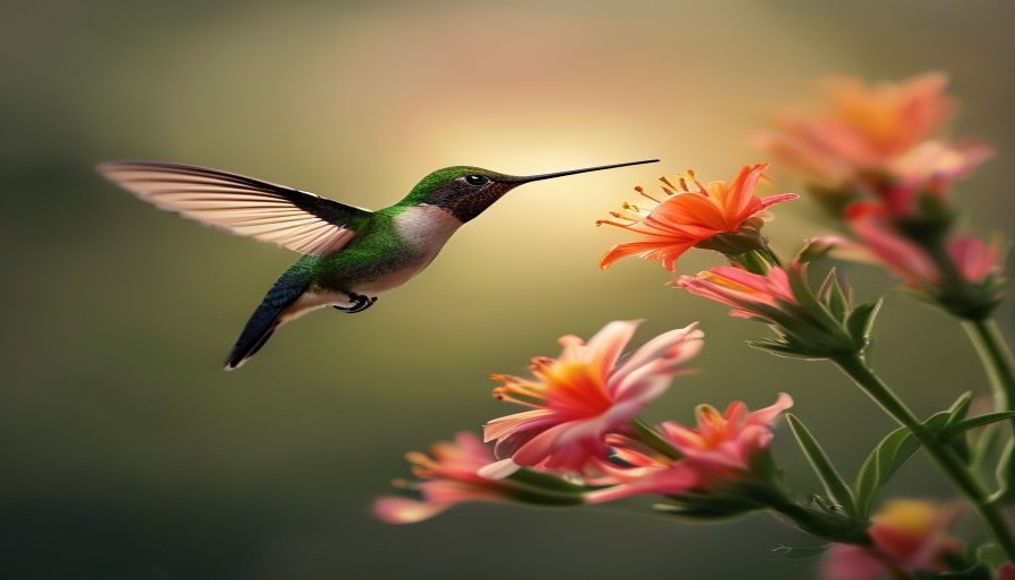
Hummingbird hovering flower
1344×768 · AVIF · CC BY 4.0
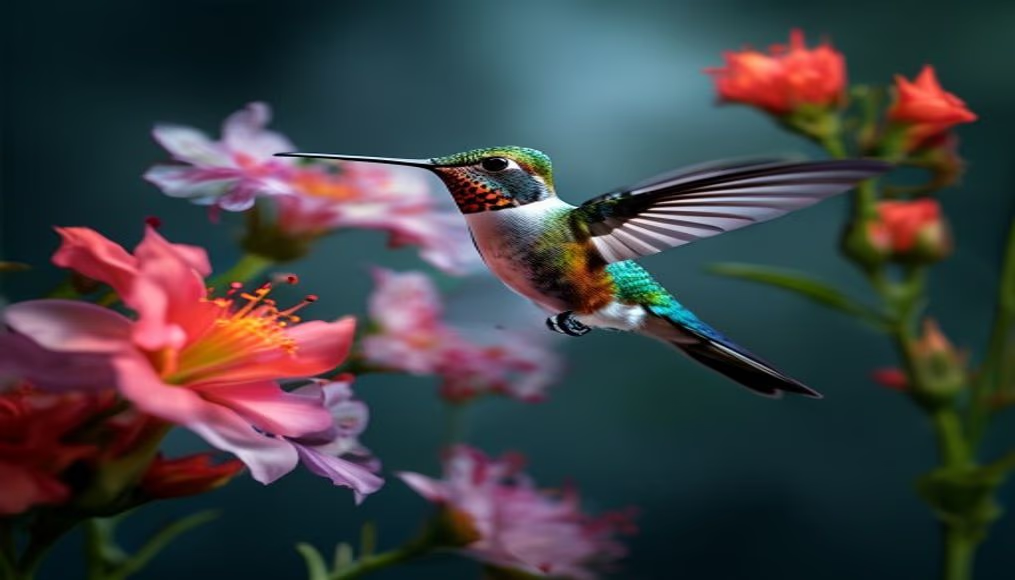
The hummingbird, with its hovering flight and long bill, is an essential pollinator in the Americas, especially during flowering waves.
About this subject
Hummingbirds, also known as colibris, belong to the family Trochilidae and are native to the Americas, ranging from Alaska to Tierra del Fuego. With over 300 species, they are renowned for their ability to fly backward and hover in midair, thanks to a figure-eight wing motion that generates lift on both the forward and backward strokes. This hovering capability is essential for feeding on flower nectar, allowing them to remain stationary while inserting their long, slender bill into the corolla.
These birds have the highest metabolism among vertebrates, beating their wings 50 to 200 times per second. To sustain this intense energy demand, they must feed every 10 to 15 minutes, consuming up to twice their body weight in nectar daily. In addition to nectar, they also capture small insects and spiders for protein. The hummingbird's tongue is forked and fringed with tiny hairs, aiding in liquid collection.
The role of hummingbirds in pollination is vital. As they visit flowers seeking nectar, pollen adheres to their bill and head, then is transferred to other flowers, promoting cross-pollination. Many plants have coevolved with these birds, developing tubular, brightly colored blossoms, especially reds and oranges, that are more visible to hummingbirds. The concept of "wave pollination" refers to the phenomenon where different plant species bloom in sequence throughout the year, ensuring a continuous food supply for pollinators and maintaining ecological balance.
Beyond their ecological importance, hummingbirds are admired for their beauty and agility, inspiring art, jewelry, and even high fashion. Their iridescent feathers, which change color depending on the light angle, are a striking example of structural color in nature. This characteristic has been a source of inspiration in fashion collections and design, reflecting the elegance and delicacy of these birds.
Frequently Asked Questions
Why can hummingbirds hover in midair?
Hummingbirds have wings that move in a figure-eight pattern, generating lift on both the upstroke and downstroke. This allows them to remain stationary in the air while feeding. They also have very strong pectoral muscles and a lightweight skeleton.
How do hummingbirds contribute to pollination?
When feeding on nectar, pollen from flowers sticks to their bill and head. When they visit another flower, some of that pollen is deposited, fertilizing the plant. Many flowers have evolved specifically to attract hummingbirds, with bright colors and tubular shapes.
What are wave pollinations?
Wave pollinations refer to the phenomenon where different plant species bloom in sequence throughout the year. This ensures that pollinators, such as hummingbirds, have a continuous food supply, and plants are efficiently pollinated, maintaining biodiversity.
Direct URL
https://pub-c7d6a6ea828543ac903a74a341ccb2e1.r2.dev/imagens/hummingbird-hovering-flower-high-fashion-editorial-p0.avifHow to credit
Include a visible link back to UtilizAí. Copy one of the snippets below:
<a href="https://xn--utiliza-eza.com/en/midia/imagens/hummingbird-hovering-flower-high-fashion-editorial-p0">Hummingbird hovering flower</a> by <a href="https://xn--utiliza-eza.com">UtilizAí</a>, licensed under <a href="https://creativecommons.org/licenses/by/4.0/">CC BY 4.0</a>.
[Hummingbird hovering flower](https://xn--utiliza-eza.com/en/midia/imagens/hummingbird-hovering-flower-high-fashion-editorial-p0) by [UtilizAí](https://xn--utiliza-eza.com), CC BY 4.0
License: CC-BY-4.0