Horsehead nebula dark
1344×768 · AVIF · CC BY 4.0
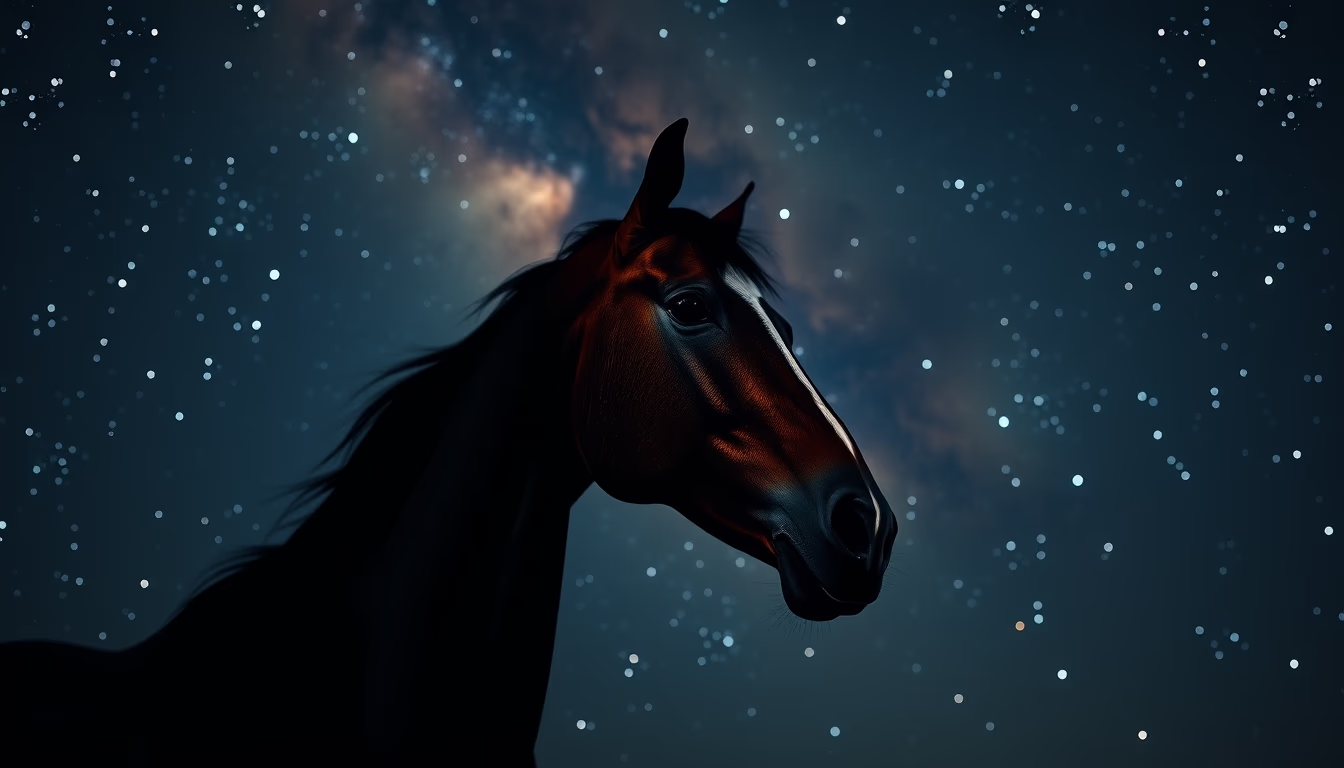
The Horsehead Nebula is a dark nebula in the constellation Orion, famous for its silhouette against the glowing IC 434.
About this subject
The Horsehead Nebula, cataloged as Barnard 33, is a dense cloud of interstellar dust and gas located about 1,500 light-years from Earth. It stands out in the constellation Orion, near the star Alnitak in the hunter's belt. Its iconic horse-head shape is created by absorbing background light from the emission nebula IC 434, which glows in red light due to ionized hydrogen.
Discovered in 1888 by astronomer Williamina Fleming from photographic plates, the nebula is one of the most photographed objects in the night sky. As a dark nebula, it does not emit its own light but blocks light from stars and nebulae behind it. This dramatic contrast makes it a popular target for astrophotographers, who use long exposures and hydrogen-alpha filters to capture its details.
Visual observation of the Horsehead requires very dark skies and telescopes with considerable aperture, but it remains extremely challenging. Most widely distributed images are obtained through long-exposure techniques, such as the one that produced this photograph. The region is part of the Orion Molecular Cloud Complex, a vast star-forming area that includes the Orion Nebula and Barnard's Loop.
Beyond its beauty, the nebula holds great scientific interest. Studies reveal that dark clouds like this are nurseries for new stars, where dust and gas clump under gravity. The Horsehead, in particular, is slowly dissipating due to radiation from the nearby star Sigma Orionis. It is estimated that it may disappear in about 5 million years, a short timescale in astronomical terms.
Frequently Asked Questions
Where is the Horsehead Nebula located?
It is located in the constellation Orion, near the star Alnitak, the easternmost star in Orion's belt, about 1,500 light-years from Earth.
Why is the nebula dark?
It is a dark nebula composed of dust and gas that blocks light from stars and nebulae behind it, creating a silhouette against the bright background.
How can I photograph the Horsehead Nebula?
Astrophotography requires long exposures, typically with hydrogen-alpha filters, and a telescope with precise tracking. Dark skies and sensitive equipment are essential.
Direct URL
https://pub-c7d6a6ea828543ac903a74a341ccb2e1.r2.dev/imagens/horsehead-nebula-dark-long-exposure-p5.avifHow to credit
Include a visible link back to UtilizAí. Copy one of the snippets below:
<a href="https://xn--utiliza-eza.com/en/midia/imagens/horsehead-nebula-dark-long-exposure-p5">Horsehead nebula dark</a> by <a href="https://xn--utiliza-eza.com">UtilizAí</a>, licensed under <a href="https://creativecommons.org/licenses/by/4.0/">CC BY 4.0</a>.
[Horsehead nebula dark](https://xn--utiliza-eza.com/en/midia/imagens/horsehead-nebula-dark-long-exposure-p5) by [UtilizAí](https://xn--utiliza-eza.com), CC BY 4.0
License: CC-BY-4.0