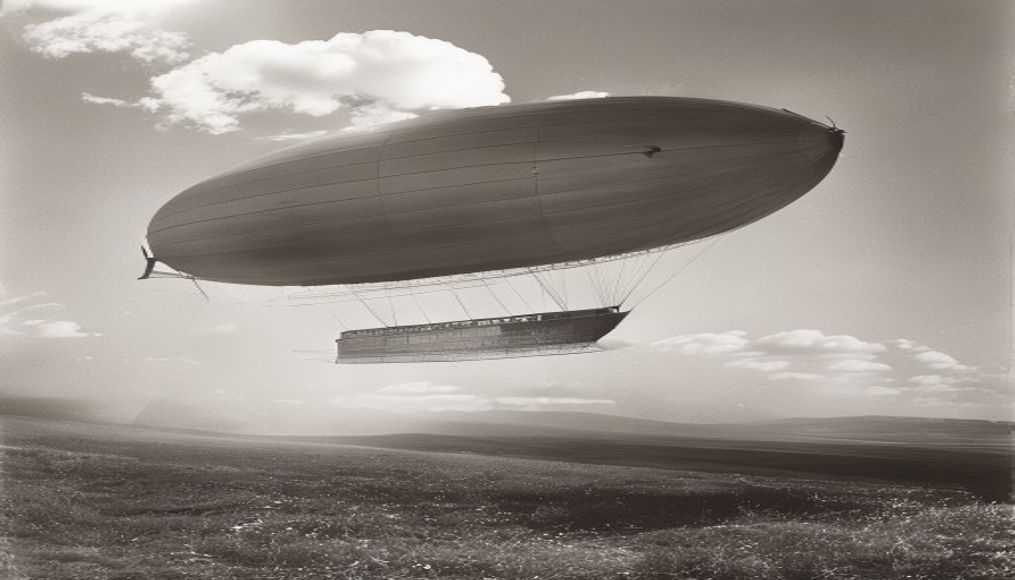
Hindenburg airship
1344×768 · JPG · CC BY 4.0

The Hindenburg was a German rigid airship, the largest ever built, that marked the zeppelin era and ended tragically in 1937.
About this subject
The Hindenburg (LZ 129 Hindenburg) was a German rigid airship built by Luftschiffbau Zeppelin GmbH between 1931 and 1936. At 245 meters long and 41 meters in diameter, it was the largest flying vehicle ever built at the time, surpassing the Graf Zeppelin. Its passenger capacity was 72 people in luxurious accommodations, including private cabins, a dining room, a library, and even a music salon with an aluminum piano, designed to offer comfort comparable to ocean liners.
The airship was powered by four Daimler-Benz LOF 6 diesel engines, allowing a maximum speed of 135 km/h. It used hydrogen as lifting gas, highly flammable, a technical decision that would prove fatal. The Hindenburg completed 63 commercial flights, mostly between Germany and the United States, carrying passengers and mail. Its design, featuring swastikas on the tail fins, reflected the political context of Nazi Germany, as the government partially supported the project for propaganda.
The tragedy occurred on May 6, 1937, when the Hindenburg exploded while attempting to land at the Lakehurst Naval Air Station in New Jersey. In just 34 seconds, flames consumed the airship, killing 35 of the 97 people on board and one ground crew member. The causes of the disaster have never been fully determined, but theories point to electrostatic discharge, sabotage, or a hydrogen leak. The incident, widely filmed and broadcast on radio, marked the end of the commercial airship era, as the industry lost public confidence and hydrogen was replaced by helium, though zeppelins continued in German military use until 1940.
The Hindenburg remains a symbol of technological daring and the risks of early aeronautical engineering. In 2020, a PBS documentary revisited the case with modern forensic analysis, reinforcing the debate about causes. Today, fragments of the airship are displayed in museums such as the Zeppelin Museum in Friedrichshafen, Germany, and the National Air and Space Museum in the USA, preserving the memory of this aviation icon.
Frequently Asked Questions
How many flights did the Hindenburg complete before the disaster?
The Hindenburg completed 63 commercial flights between March 1936 and May 1937, carrying passengers and mail between Germany and the United States.
Why did the Hindenburg use hydrogen instead of helium?
Helium was ideal because it is non-flammable, but the United States, the largest producer at the time, refused to sell helium to Germany due to the Nazi regime. Therefore, the Germans used hydrogen, which is highly flammable, to make the airship operational.
What was the official cause of the Hindenburg explosion?
There is no definitive official cause. Investigators pointed to possible causes such as electrostatic discharge (lightning) combined with a hydrogen leak, or sabotage. Reports from 1937 suggested a short circuit or spark from the mooring lines, but the mystery remains.
Direct URL
https://pub-c7d6a6ea828543ac903a74a341ccb2e1.r2.dev/imagens/hindenburg-airship-tilt-shift-miniature-p4.jpgHow to credit
Include a visible link back to UtilizAí. Copy one of the snippets below:
<a href="https://xn--utiliza-eza.com/en/midia/imagens/hindenburg-airship-tilt-shift-miniature-p4">Hindenburg airship</a> by <a href="https://xn--utiliza-eza.com">UtilizAí</a>, licensed under <a href="https://creativecommons.org/licenses/by/4.0/">CC BY 4.0</a>.
[Hindenburg airship](https://xn--utiliza-eza.com/en/midia/imagens/hindenburg-airship-tilt-shift-miniature-p4) by [UtilizAí](https://xn--utiliza-eza.com), CC BY 4.0
License: CC-BY-4.0