Hdd platter exposed
1344×768 · AVIF · CC BY 4.0
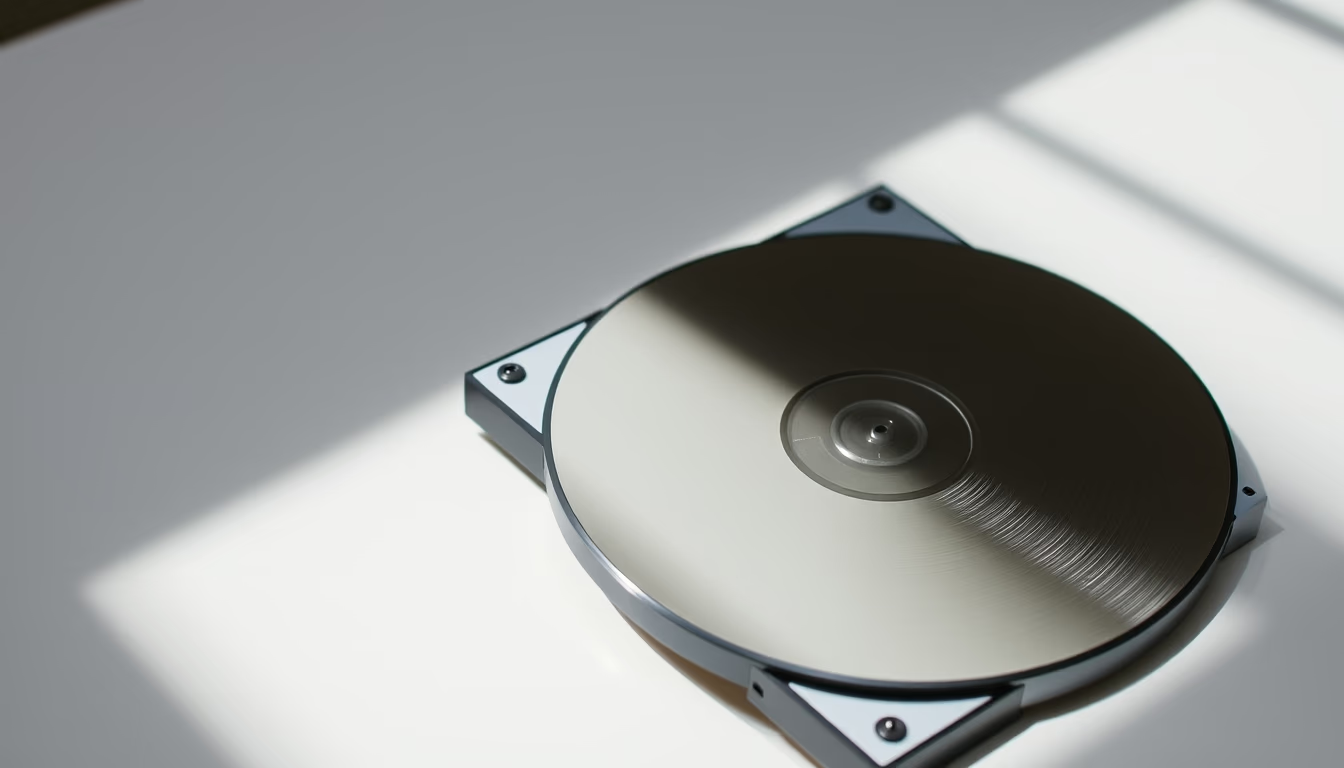
An exposed hard disk platter reveals the precise engineering behind magnetic data storage, essential for computers since the 1950s.
About this subject
The platters of a hard disk drive (HDD) are circular disks made of aluminum or glass coated with a thin layer of magnetic material, typically a cobalt-chromium-platinum alloy. Data is stored as microscopic magnetic domains whose orientation represents bits (0 or 1). The read/write head flies just a few nanometers above the surface, reading and altering these domains as the platter spins at speeds ranging from 4,200 to 15,000 RPM, depending on the model.
The first hard disk, the IBM RAMAC 305 (1956), used fifty 24-inch platters and stored only 5 MB. Since then, areal density (bits per square inch) has grown exponentially, driven by techniques like perpendicular recording and, more recently, heat-assisted magnetic recording (HAMR). Today, a 3.5-inch HDD can store over 20 TB on up to 10 platters. The platter surface is polished to atomic-level smoothness, essential for the head’s stable flight.
Despite the rise of SSDs, HDDs still dominate mass storage due to lower cost per gigabyte. Platter manufacturing is a high-precision process carried out in Class 10 cleanrooms, where dust particles can cause catastrophic failures. Interestingly, glass disks (used since the 1990s) are more shock-resistant and allow smoother surfaces than aluminum ones.
Frequently Asked Questions
What is a hard disk platter?
A platter is a metal or glass disk coated with magnetic material that spins inside the HDD. It stores data in tracks and sectors, read and written by a head that flies above its surface.
How is data stored on platters?
Data is magnetically recorded in tiny regions called domains. Each domain can have a north-south or south-north orientation, representing bits 0 or 1. The drive head changes this orientation to write and detects the magnetic field to read.
How have HDD platters evolved over time?
Since the IBM RAMAC (1956) with 24-inch platters and 5 MB, platters have shrunk to 3.5 or 2.5 inches today. Capacity per platter jumped from a few megabytes to over 2 TB, thanks to perpendicular recording and HAMR technologies.
Direct URL
https://pub-c7d6a6ea828543ac903a74a341ccb2e1.r2.dev/imagens/hdd-platter-exposed-minimalist-composition-p12.avifHow to credit
Include a visible link back to UtilizAí. Copy one of the snippets below:
<a href="https://xn--utiliza-eza.com/en/midia/imagens/hdd-platter-exposed-minimalist-composition-p12">Hdd platter exposed</a> by <a href="https://xn--utiliza-eza.com">UtilizAí</a>, licensed under <a href="https://creativecommons.org/licenses/by/4.0/">CC BY 4.0</a>.
[Hdd platter exposed](https://xn--utiliza-eza.com/en/midia/imagens/hdd-platter-exposed-minimalist-composition-p12) by [UtilizAí](https://xn--utiliza-eza.com), CC BY 4.0
License: CC-BY-4.0