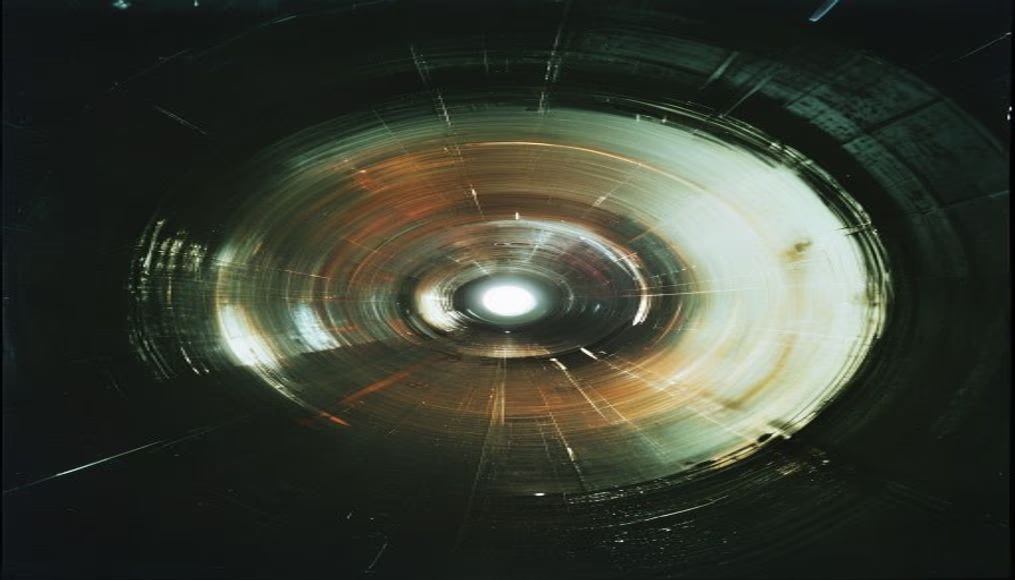
Gravitational lensing visualization
1344×768 · AVIF · CC BY 4.0

Gravitational lensing is a phenomenon predicted by Einstein where gravity from massive objects bends light, magnifying and distorting images of distant galaxies.
About this subject
Gravitational lensing is a consequence of Albert Einstein's Theory of General Relativity, published in 1915. According to the theory, mass distorts spacetime, causing light to follow curved paths when passing near massive objects such as galaxies or galaxy clusters. The first successful test of this prediction occurred during the solar eclipse of 1919, when Arthur Eddington observed the deflection of starlight near the Sun.
In modern astronomy, the effect is divided into strong lensing and weak lensing. In strong lensing, the curvature is so intense that it forms arcs, rings (known as Einstein rings), or multiple images of the same source. A famous example is the galaxy cluster MACS J0416, photographed by the Hubble Space Telescope, where blue arcs reveal distant magnified galaxies. Weak lensing subtly distorts galaxy shapes, allowing mapping of dark matter distribution.
The phenomenon is an essential tool for studying the early universe, as it magnifies objects that would otherwise be invisible due to distance. It also helps measure cluster masses and test cosmological theories. A curiosity: the effect can create multiple images of the same supernova, such as SN Refsdal, whose images appeared months apart, enabling calculation of the universe's expansion rate.
Frequently Asked Questions
What is gravitational lensing?
Gravitational lensing is a phenomenon predicted by General Relativity where the gravity of massive objects, such as galaxies, bends and magnifies light from distant sources, creating distorted or multiple images.
How is gravitational lensing used in astronomy?
Astronomers use gravitational lensing to study distant galaxies that are too faint, map dark matter, measure cluster masses, and even calculate the Hubble constant.
What is the difference between strong and weak lensing?
Strong lensing produces intense curvature, creating arcs or multiple images. Weak lensing causes subtle distortions that can only be detected statistically across many galaxies.
Direct URL
https://pub-c7d6a6ea828543ac903a74a341ccb2e1.r2.dev/imagens/gravitational-lensing-visualization-cinematic-wide-shot-p0.avifHow to credit
Include a visible link back to UtilizAí. Copy one of the snippets below:
<a href="https://xn--utiliza-eza.com/en/midia/imagens/gravitational-lensing-visualization-cinematic-wide-shot-p0">Gravitational lensing visualization</a> by <a href="https://xn--utiliza-eza.com">UtilizAí</a>, licensed under <a href="https://creativecommons.org/licenses/by/4.0/">CC BY 4.0</a>.
[Gravitational lensing visualization](https://xn--utiliza-eza.com/en/midia/imagens/gravitational-lensing-visualization-cinematic-wide-shot-p0) by [UtilizAí](https://xn--utiliza-eza.com), CC BY 4.0
License: CC-BY-4.0