Gpu nvidia rtx
1344×768 · AVIF · CC BY 4.0
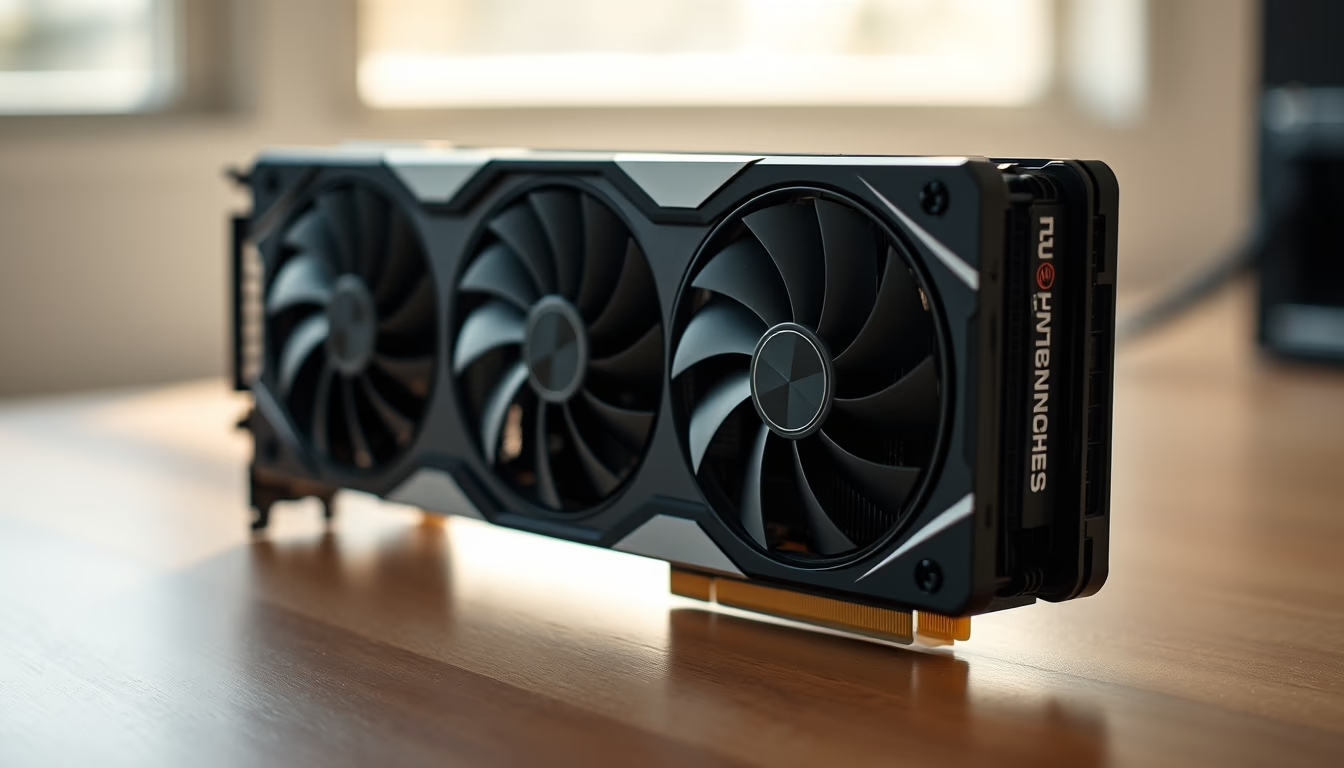
The Nvidia RTX GPU revolutionized graphics processing with real-time ray tracing and AI, since the 20-series launch in 2018.
About this subject
The Nvidia RTX series, launched in 2018 with the Turing architecture, marked a technological leap by incorporating dedicated cores for ray tracing (RT Cores) and artificial intelligence (Tensor Cores). Later generations like Ampere (RTX 30) and Ada Lovelace (RTX 40) refined these features, offering exponentially greater performance. The main differentiator of RTX is the ability to calculate light paths in real time, generating more realistic reflections, shadows, and lighting in games and professional applications. Additionally, DLSS (Deep Learning Super Sampling) uses AI for image upscaling, enabling higher frame rates without significant quality loss.
The impact of RTX GPUs extends beyond gaming. In areas like 3D modeling, architectural rendering, scientific simulations, and video editing, RT Cores accelerate ray tracing tasks, while Tensor Cores boost machine learning workloads. Nvidia also expanded the ecosystem with technologies such as Reflex (latency reduction) and Broadcast (AI-based audio/video filters). Competition from AMD, which responded with the Radeon RX 6000 and 7000 series, kept the market dynamic and spurred innovation.
Interestingly, the RTX 20 series was the first to support Microsoft's DirectX Raytracing (DXR), setting an industry standard. Despite high costs and power consumption (especially on flagship models like the RTX 4090), RTX cards became the benchmark for enthusiasts and professionals. Their success drove the adoption of ray tracing as a standard feature in next-generation consoles (PlayStation 5 and Xbox Series X), which use similar technology. Today, RTX represents the state of the art in computer graphics, with applications ranging from AAA games to artificial intelligence research.
Frequently Asked Questions
What is the difference between an RTX and a GTX GPU?
RTX cards have dedicated RT and Tensor cores for real-time ray tracing and DLSS. GTX cards lack these specialized cores, resulting in lower performance in games that utilize these features.
What is DLSS and how does it work?
DLSS (Deep Learning Super Sampling) is an AI-based upscaling technology that renders games at a lower resolution and uses neural networks to reconstruct the image at a higher resolution, boosting performance without noticeable quality loss.
Is an RTX GPU necessary for gaming?
It is not strictly necessary, but it offers visual advantages in ray tracing-compatible games and can increase performance via DLSS. For games without these features, older or competitor cards may be sufficient.
Direct URL
https://pub-c7d6a6ea828543ac903a74a341ccb2e1.r2.dev/imagens/gpu-nvidia-rtx-documentary-photography-p10.avifHow to credit
Include a visible link back to UtilizAí. Copy one of the snippets below:
<a href="https://xn--utiliza-eza.com/en/midia/imagens/gpu-nvidia-rtx-documentary-photography-p10">Gpu nvidia rtx</a> by <a href="https://xn--utiliza-eza.com">UtilizAí</a>, licensed under <a href="https://creativecommons.org/licenses/by/4.0/">CC BY 4.0</a>.
[Gpu nvidia rtx](https://xn--utiliza-eza.com/en/midia/imagens/gpu-nvidia-rtx-documentary-photography-p10) by [UtilizAí](https://xn--utiliza-eza.com), CC BY 4.0
License: CC-BY-4.0