Gpu nvidia rtx
1344×768 · AVIF · CC BY 4.0
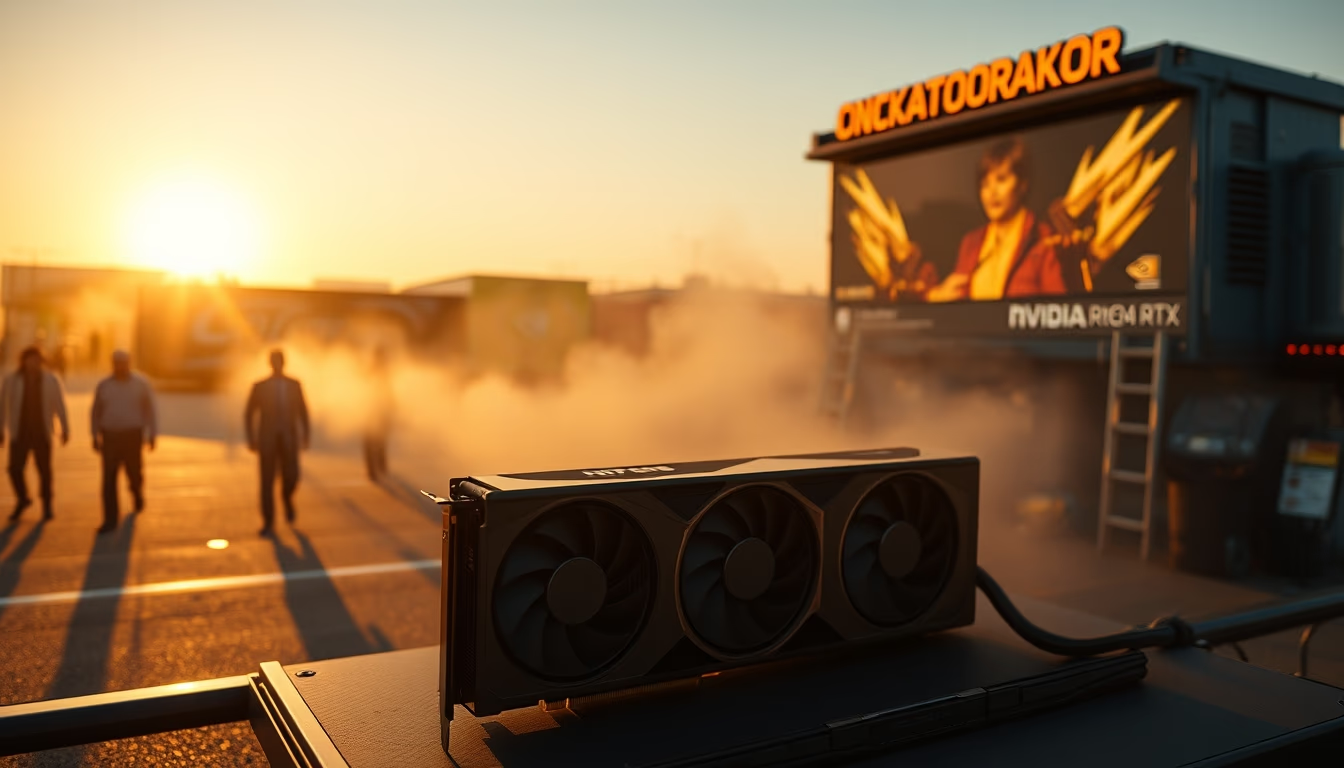
The Nvidia RTX GPU revolutionized the graphics card market with real-time ray tracing and artificial intelligence.
About this subject
The Nvidia RTX is a line of graphics cards launched in 2018, based on the Turing architecture. It introduced dedicated RT cores for real-time ray tracing and Tensor cores for AI acceleration, such as DLSS (Deep Learning Super Sampling). This combination enabled more realistic graphics in games and higher performance in rendering and machine learning tasks. Since then, the series has evolved with the Ampere (RTX 30) and Ada Lovelace (RTX 40) architectures, offering significant improvements in efficiency and computational power.
RTX GPUs are widely used not only in gaming but also in workstations for video editing, 3D modeling, and scientific simulations. Models like the RTX 4090 lead in raw performance, while options like the RTX 3060 offer good value for entry into ray tracing. DLSS technology, which uses AI for resolution upscaling, has become essential for maintaining high frame rates in demanding titles.
Interestingly, Nvidia faced challenges with availability and pricing during the pandemic but maintained its lead in the segment. Competition from AMD, which launched ray tracing cards via RDNA 2 and 3, spurred innovations such as support for HDMI 2.1 and PCIe 4.0. For enthusiasts, RTX represents the state of the art in computer graphics, with applications ranging from AAA games to architecture and design projects.
Frequently Asked Questions
What is ray tracing and why is it important in RTX GPUs?
Ray tracing is a rendering technique that simulates the real behavior of light, producing more realistic reflections, shadows, and lighting. RTX GPUs have dedicated cores to accelerate this process in real time, improving visual quality in games and professional applications.
What is DLSS and how does it work?
DLSS (Deep Learning Super Sampling) is an Nvidia technology that uses artificial intelligence to reconstruct higher resolution images from a lower resolution input. This allows higher performance without significant quality loss, making it essential for games with ray tracing enabled.
What is the difference between the RTX 30 and RTX 40 series?
The RTX 40 series (Ada Lovelace) offers improvements in energy efficiency, more CUDA and RT cores, and DLSS 3 with frame generation. In terms of performance, the RTX 4090 is about 50-70% faster than the RTX 3090, depending on the workload.
Direct URL
https://pub-c7d6a6ea828543ac903a74a341ccb2e1.r2.dev/imagens/gpu-nvidia-rtx-cinematic-wide-shot-p11.avifHow to credit
Include a visible link back to UtilizAí. Copy one of the snippets below:
<a href="https://xn--utiliza-eza.com/en/midia/imagens/gpu-nvidia-rtx-cinematic-wide-shot-p11">Gpu nvidia rtx</a> by <a href="https://xn--utiliza-eza.com">UtilizAí</a>, licensed under <a href="https://creativecommons.org/licenses/by/4.0/">CC BY 4.0</a>.
[Gpu nvidia rtx](https://xn--utiliza-eza.com/en/midia/imagens/gpu-nvidia-rtx-cinematic-wide-shot-p11) by [UtilizAí](https://xn--utiliza-eza.com), CC BY 4.0
License: CC-BY-4.0