Fractal infinite zoom
1344×768 · AVIF · CC BY 4.0
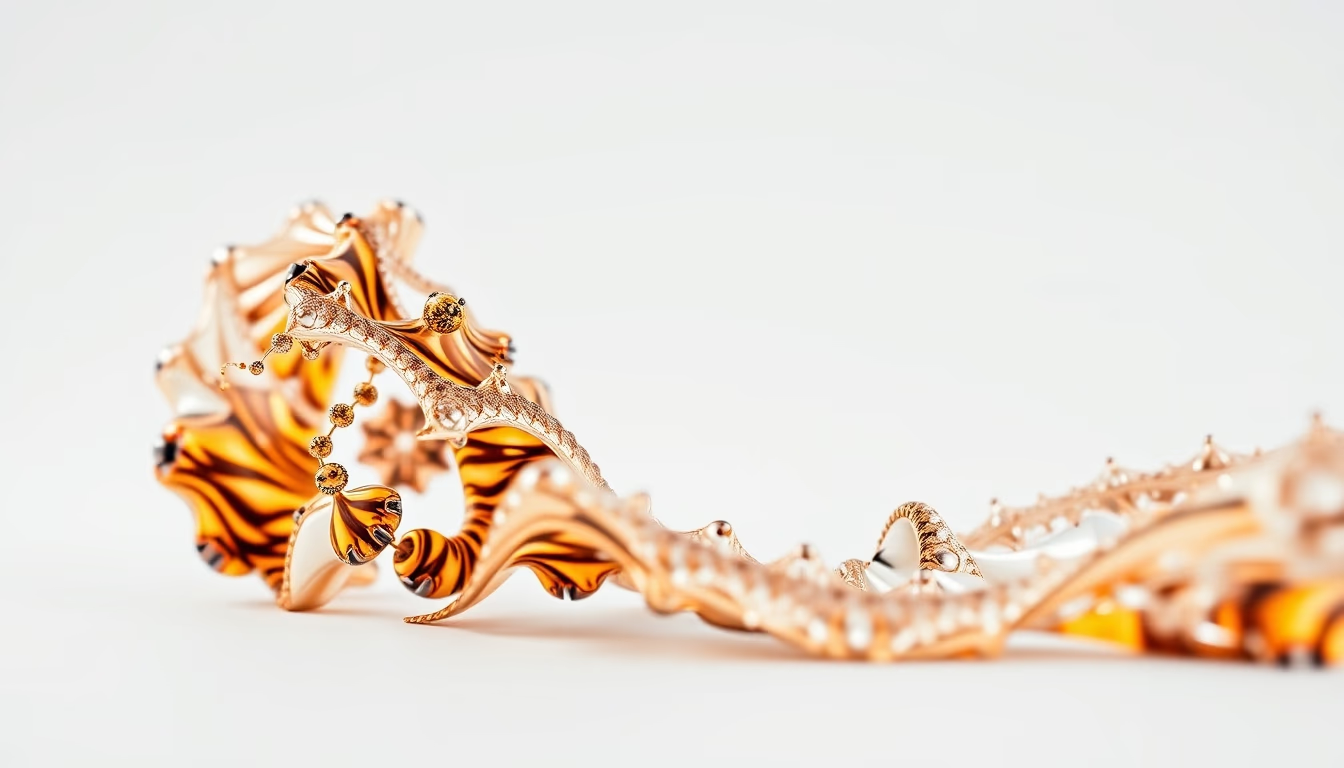
Fractals are complex geometric shapes that repeat across infinite scales, mathematically studied since Mandelbrot and applied in science, art, and technology.
About this subject
Fractals are mathematical objects defined by self-similarity: each smaller part resembles the whole at different scales. This property appears in nature, such as coastlines, clouds, trees, and vascular systems, though often in a statistical sense. The Mandelbrot set, one of the most famous fractals, is generated by a simple iterative equation and displays infinitely complex detail.
The concept was formalized by mathematician Benoit Mandelbrot in the 1970s, but earlier examples include the Koch snowflake (1904) and the Sierpinski triangle (1915). From the 1980s, fractals gained popularity in computer graphics, used to generate realistic terrains, textures, and visual effects. They also have applications in image compression, signal analysis, and modeling natural phenomena.
Infinite zoom is a direct consequence of self-similarity. In fractals like the Mandelbrot set, zooming into a region reveals new structures that repeat the global pattern, enabling an endless visual journey. This property is exploited in digital art, animations, and scientific visualizations. Chaos theory and complexity are closely tied to fractals, which help describe nonlinear dynamic systems.
For 2026, the 'fractal infinite zoom' trend appears in commercial product photography, abstract backgrounds, and modern visual identities. Brands use fractal patterns to convey innovation, depth, and sophistication, especially in technology, fashion, and design campaigns. The hypnotic aesthetic of fractals captures attention and suggests an immersive experience, aligned with contemporary visual demands.
Frequently Asked Questions
What is a fractal?
A fractal is a geometric shape that exhibits self-similarity at different scales, meaning each part resembles the whole. Classic examples include the Mandelbrot set and the Sierpinski triangle.
How does infinite zoom work in fractals?
Infinite zoom works because fractals have detail at every scale. Magnifying a region reveals new structures that repeat the global pattern, allowing continuous exploration without loss of complexity.
Who coined the term 'fractal'?
The term 'fractal' was coined by mathematician Benoit Mandelbrot in 1975, from the Latin 'fractus' (broken). He formalized the study of fractals and demonstrated their application across many fields.
Direct URL
https://pub-c7d6a6ea828543ac903a74a341ccb2e1.r2.dev/imagens/fractal-infinite-zoom-commercial-product-photography-p4.avifHow to credit
Include a visible link back to UtilizAí. Copy one of the snippets below:
<a href="https://xn--utiliza-eza.com/en/midia/imagens/fractal-infinite-zoom-commercial-product-photography-p4">Fractal infinite zoom</a> by <a href="https://xn--utiliza-eza.com">UtilizAí</a>, licensed under <a href="https://creativecommons.org/licenses/by/4.0/">CC BY 4.0</a>.
[Fractal infinite zoom](https://xn--utiliza-eza.com/en/midia/imagens/fractal-infinite-zoom-commercial-product-photography-p4) by [UtilizAí](https://xn--utiliza-eza.com), CC BY 4.0
License: CC-BY-4.0