Fluorite cubes octahedral
1344×768 · AVIF · CC BY 4.0
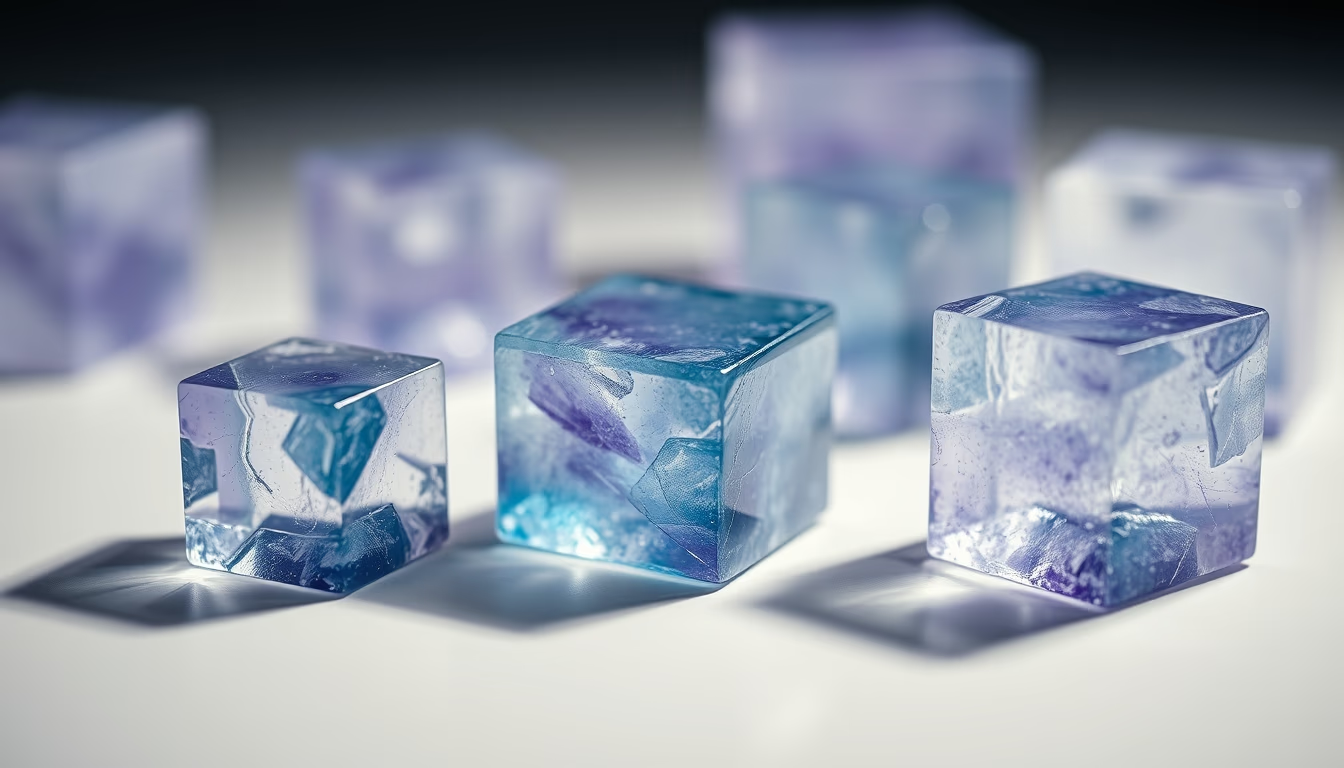
Cubic and octahedral fluorite crystals: geometric forms with a wide color range, used in optics and as collectibles.
About this subject
Fluorite (CaF2) is a calcium fluoride mineral famous for its perfect cubic crystals and wide color palette, ranging from purple and green to blue, yellow, and colorless. While cubic habit is most common, fluorite can also form octahedral crystals, especially in hydrothermal veins. These octahedra are actually the natural growth form of fluorite, but are less common due to the influence of crystallization conditions.
Fluorite occurs as an accessory mineral in many rock types, notably pegmatites and hydrothermal deposits. Notable localities include the Weardale district in England, known for its deep blue crystals, and the mines of Illinois, USA, which produced purple and yellow fluorites. In Brazil, it is found in Minas Gerais, such as in Conselheiro Pena, associated with other species. Fluorite is also mined in China, Mexico, and South Africa.
Industrially, fluorite is essential for producing hydrofluoric acid and as a flux in steelmaking, lowering the melting point of iron ore. In optics, due to its low dispersion, it is used in lenses and windows for spectroscopy and microscopy. For collectors, well‑formed octahedral and cubic crystals are highly prized, especially when they display intense colors and complex twinning.
Fun fact: fluorite exhibits fluorescence under ultraviolet light, the phenomenon that gave rise to the term "fluorescence." Most specimens fluoresce blue or violet, but some varieties emit green or yellow. This makes it a popular mineral in museums and mineral shows.
Frequently Asked Questions
Why does fluorite have so many different colors?
Fluorite's color is caused by chemical impurities (such as rare earth ions and color centers) and defects in the crystal lattice. Different elements and formation conditions produce colors from purple (common) to green, yellow, blue, and colorless.
What is the difference between cubic and octahedral fluorite crystals?
Cubic crystals are the most common form, with square faces. Octahedral crystals have eight triangular faces and are less frequent, but they represent the natural growth habit of fluorite when there is no external interference.
Where can I find fluorite in Brazil?
In Brazil, fluorite occurs mainly in Minas Gerais, such as in Conselheiro Pena, São João del-Rei, and Araçuaí. It is also found in pegmatites in Rio Grande do Norte and Bahia.
Direct URL
https://pub-c7d6a6ea828543ac903a74a341ccb2e1.r2.dev/imagens/fluorite-cubes-octahedral-lo-fi-disposable-camera-p10.avifHow to credit
Include a visible link back to UtilizAí. Copy one of the snippets below:
<a href="https://xn--utiliza-eza.com/en/midia/imagens/fluorite-cubes-octahedral-lo-fi-disposable-camera-p10">Fluorite cubes octahedral</a> by <a href="https://xn--utiliza-eza.com">UtilizAí</a>, licensed under <a href="https://creativecommons.org/licenses/by/4.0/">CC BY 4.0</a>.
[Fluorite cubes octahedral](https://xn--utiliza-eza.com/en/midia/imagens/fluorite-cubes-octahedral-lo-fi-disposable-camera-p10) by [UtilizAí](https://xn--utiliza-eza.com), CC BY 4.0
License: CC-BY-4.0