Fiber optic transceiver
1344×768 · AVIF · CC BY 4.0
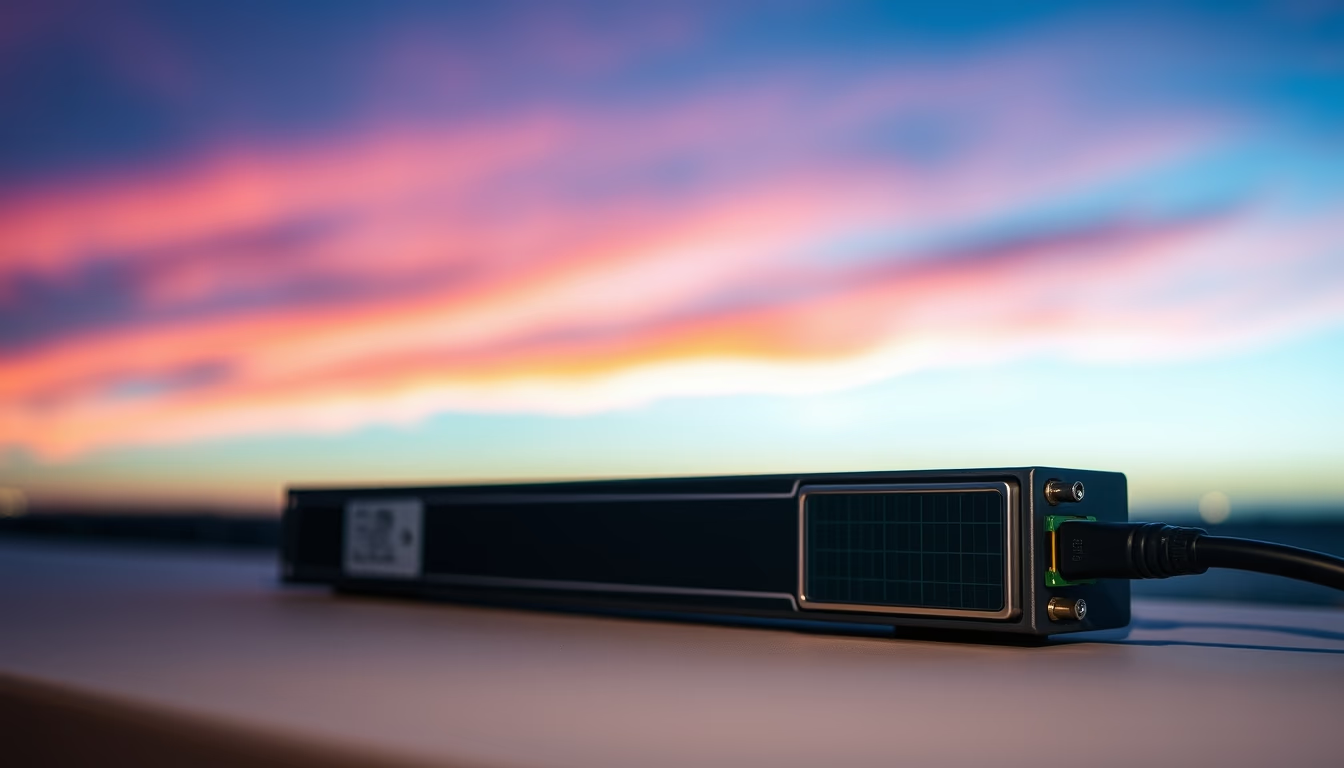
Fiber optic transceivers convert electrical signals to optical and back, essential for high-speed networks in data centers and telecommunications.
About this subject
A fiber optic transceiver is an electronic device that integrates a transmitter and a receiver into a single module, enabling bidirectional communication over fiber optic cables. It is crucial in modern network infrastructures, especially in data centers, internet backbones, and telecommunications networks. Common form factors follow standards like SFP (Small Form-factor Pluggable), SFP+, QSFP, and CFP, each supporting different transmission rates from 1 Gbps to 400 Gbps and beyond.
The basic operation involves converting electrical signals into light pulses emitted by a laser or LED into the fiber, and in the reverse direction, detecting light with a photodetector and converting it back into electrical current. This technology enables long-distance transmission with low signal loss, high bandwidth, and immunity to electromagnetic interference, significantly outperforming copper.
Transceivers are modular and hot-swappable, meaning they can be replaced without powering down the equipment, facilitating upgrades and maintenance in switches, routers, and servers. The choice of transceiver depends on distance (multimode for short distances, single-mode for long distances) and protocol (Ethernet, Fibre Channel, InfiniBand). The growth of 5G, cloud computing, and video streaming has driven demand for higher-capacity transceivers, reducing costs and improving energy efficiency.
Frequently Asked Questions
What is the difference between SFP and SFP+?
SFP (Small Form-factor Pluggable) supports up to 1 Gbps, while SFP+ supports up to 10 Gbps. They share the same physical size, but SFP+ requires faster circuits and is used in 10 Gigabit Ethernet networks.
How to choose between multimode and single-mode fiber for a transceiver?
Multimode fiber is used for short distances (up to ~550 m) with LEDs or VCSELs, being cheaper. Single-mode fiber is for long distances (up to 100+ km) with lasers, offering higher bandwidth, but with higher component cost.
Do optical transceivers consume a lot of power?
Power consumption varies by standard: typical SFP+ consumes about 1 W, while QSFP28 (100 Gbps) can consume up to 3.5 W. Newer generations (400G, 800G) aim for efficiency using technologies like Co-Packaged Optics to reduce power.
Direct URL
https://pub-c7d6a6ea828543ac903a74a341ccb2e1.r2.dev/imagens/fiber-optic-transceiver-long-exposure-p12.avifHow to credit
Include a visible link back to UtilizAí. Copy one of the snippets below:
<a href="https://xn--utiliza-eza.com/en/midia/imagens/fiber-optic-transceiver-long-exposure-p12">Fiber optic transceiver</a> by <a href="https://xn--utiliza-eza.com">UtilizAí</a>, licensed under <a href="https://creativecommons.org/licenses/by/4.0/">CC BY 4.0</a>.
[Fiber optic transceiver](https://xn--utiliza-eza.com/en/midia/imagens/fiber-optic-transceiver-long-exposure-p12) by [UtilizAí](https://xn--utiliza-eza.com), CC BY 4.0
License: CC-BY-4.0