Exoplanet earth-like
1344×768 · AVIF · CC BY 4.0
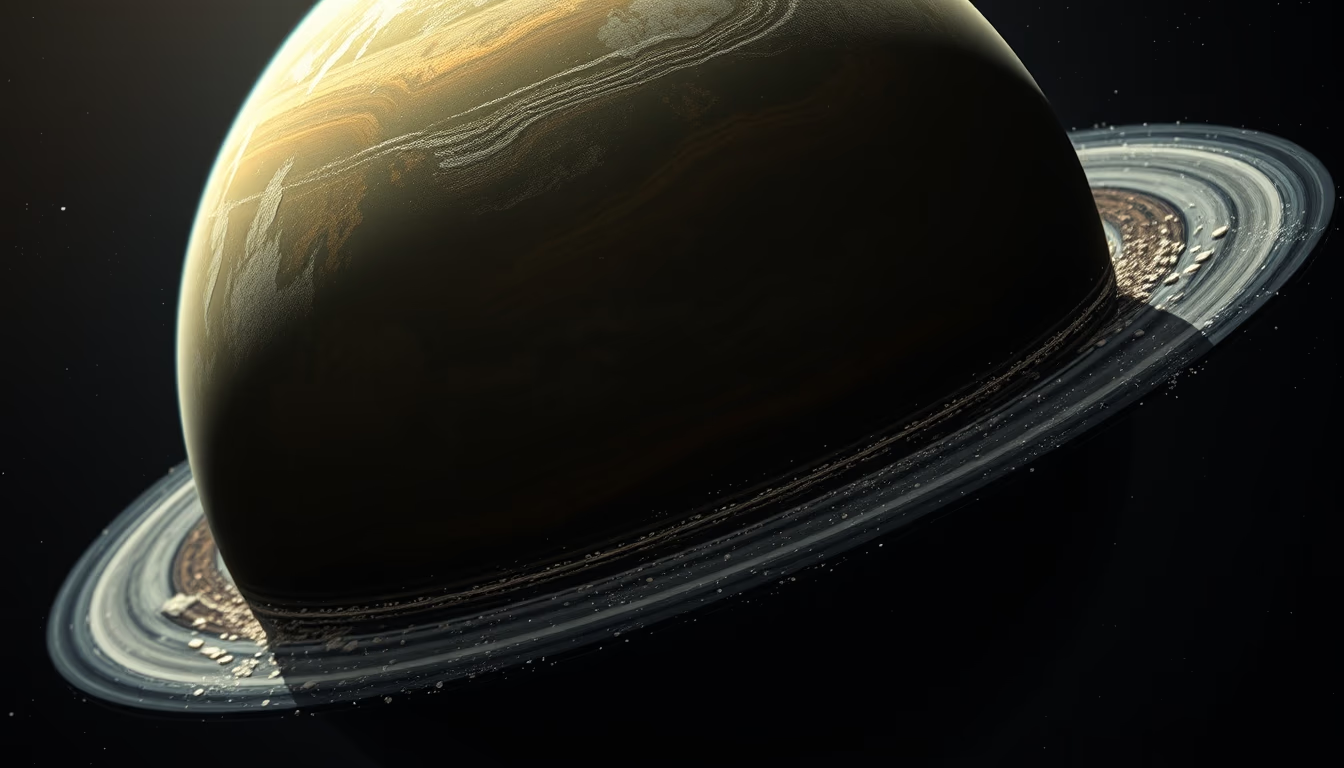
Earth-like exoplanets are prime targets in astrobiology's search for life beyond the Solar System.
About this subject
Earth-like exoplanets, also known as terrestrial planets, are rocky worlds with compositions similar to our own. The first candidate in the habitable zone of its star was Gliese 581c, discovered in 2007, though later analysis suggested it might be too close to its red dwarf star to support liquid water. Since then, missions like NASA's Kepler and TESS have revealed thousands of candidates, with roughly 200 having Earth-like sizes and orbits within the region where liquid water could exist.
Notable examples include Kepler-452b, dubbed 'Earth's cousin,' with a diameter 60% larger and an orbital period of 385 days around a Sun-like star. The TRAPPIST-1 system hosts seven Earth-sized planets, three of which lie in the habitable zone. However, these worlds orbit an ultracool red dwarf, posing challenges such as tidal locking and intense stellar radiation.
Characterizing terrestrial exoplanets relies on transit photometry and spectroscopy. The James Webb Space Telescope has begun analyzing atmospheres of promising candidates, searching for biosignatures like oxygen, methane, and water vapor. Future giant telescopes, such as the Extremely Large Telescope, may directly image these worlds. Discovering an exact Earth twin remains a challenge, but technological advances are steadily bringing this goal within reach.
Frequently Asked Questions
Which exoplanet has the highest chance of harboring life?
Among discovered worlds, TRAPPIST-1e is considered one of the most promising due to its Earth-like size and position in the habitable zone. However, its atmosphere and water presence remain unconfirmed.
How do astronomers detect terrestrial exoplanets?
The primary methods are the transit technique (measuring the star's dimming as the planet passes in front) and radial velocity (detecting stellar wobbles caused by the planet's gravity).
Can we send a probe to an exoplanet?
With current technology, no. The nearest exoplanet, Proxima Centauri b (4.2 light-years away), would take tens of thousands of years with existing probes. Interstellar travel remains a future challenge.
Direct URL
https://pub-c7d6a6ea828543ac903a74a341ccb2e1.r2.dev/imagens/exoplanet-earth-like-documentary-photography-p0.avifHow to credit
Include a visible link back to UtilizAí. Copy one of the snippets below:
<a href="https://xn--utiliza-eza.com/en/midia/imagens/exoplanet-earth-like-documentary-photography-p0">Exoplanet earth-like</a> by <a href="https://xn--utiliza-eza.com">UtilizAí</a>, licensed under <a href="https://creativecommons.org/licenses/by/4.0/">CC BY 4.0</a>.
[Exoplanet earth-like](https://xn--utiliza-eza.com/en/midia/imagens/exoplanet-earth-like-documentary-photography-p0) by [UtilizAí](https://xn--utiliza-eza.com), CC BY 4.0
License: CC-BY-4.0