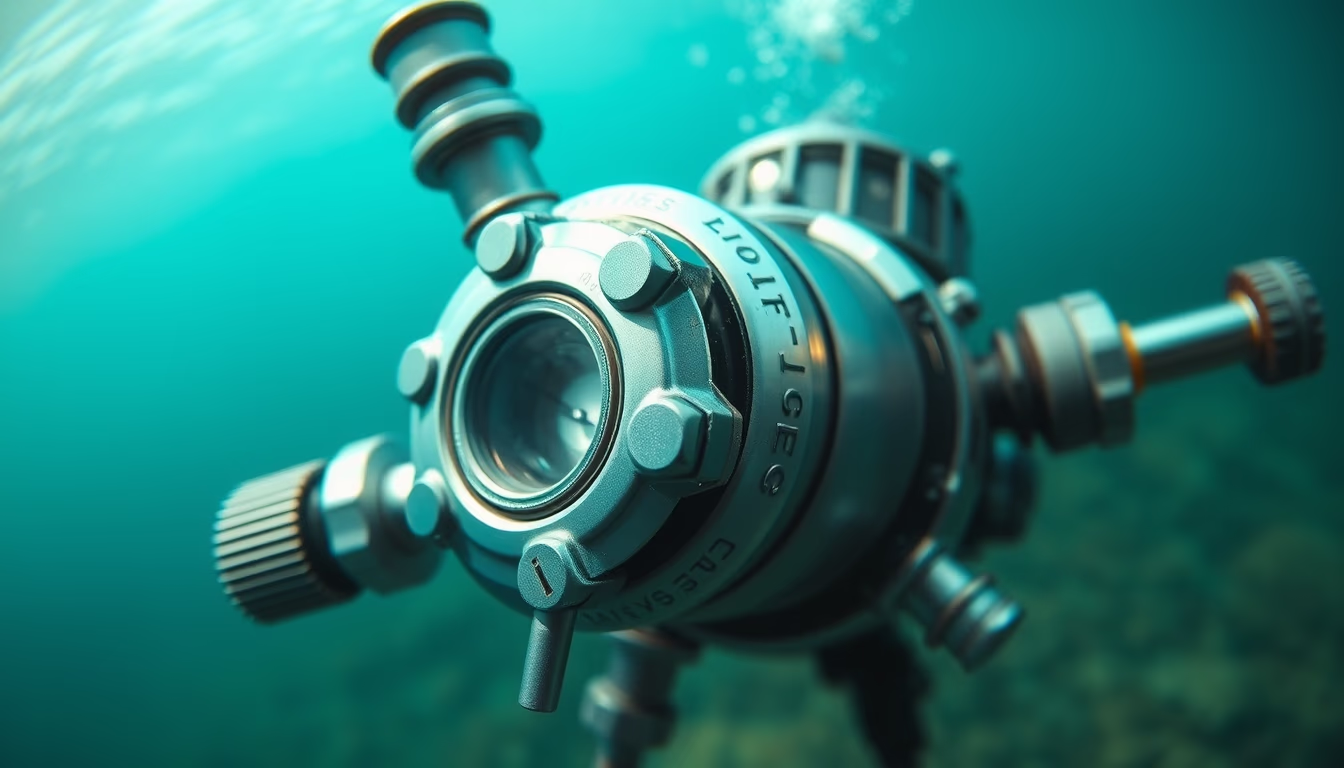
Diving regulator detail
1344×768 · AVIF · CC BY 4.0

The diving regulator is the equipment that reduces the air pressure from the tank to ambient level, enabling underwater breathing.
About this subject
A diving regulator is an essential device for underwater breathing, responsible for reducing the high pressure of compressed air in the tank (about 200 to 300 bar) to ambient pressure, which varies with depth. Invented by Jacques-Yves Cousteau and Émile Gagnan in 1943, the first demand regulator, called Aqua-Lung, revolutionized autonomous diving. The equipment has two main stages: the first stage, attached to the tank, reduces pressure to an intermediate level (about 8 to 10 bar above ambient), and the second stage, at the mouthpiece, delivers air at ambient pressure when the diver inhales.
Important components include the diaphragm, which senses ambient pressure, and springs that adjust the valve opening. Modern regulators feature balanced systems to ensure constant flow at great depths, and materials like chrome-plated brass and titanium to resist corrosion. Regular maintenance is crucial, as failures can lead to suffocation or regulator freezing in cold water due to gas expansion.
Interestingly, diving regulators are also used in other contexts, such as self-contained breathing apparatus for firefighters and high-altitude breathing systems. Evolution includes electronic models that monitor air consumption and depth, integrated with dive computers. Different types of regulators serve various diving modes, recreational, technical, and professional, each with specific performance and safety requirements.
Frequently Asked Questions
How does the first stage of a diving regulator work?
The first stage reduces the tank pressure (200-300 bar) to an intermediate pressure, about 8-10 bar above ambient. It uses a piston or diaphragm and a spring to adjust the valve opening according to depth.
What causes regulator freezing in cold-water dives?
Freezing occurs due to adiabatic expansion of gas passing through the regulator, rapidly cooling the air. In water below 10°C, moisture can freeze in the second stage, locking the valve. Cold-water regulators have designs that minimize this risk.
What is the difference between a balanced and unbalanced regulator?
A balanced regulator maintains constant airflow regardless of tank pressure, while an unbalanced one may cause varying inhalation effort as the tank empties. Balanced models are preferred for deep and technical dives.
Direct URL
https://pub-c7d6a6ea828543ac903a74a341ccb2e1.r2.dev/imagens/diving-regulator-detail-high-fashion-editorial-fresh11.avifHow to credit
Include a visible link back to UtilizAí. Copy one of the snippets below:
<a href="https://xn--utiliza-eza.com/en/midia/imagens/diving-regulator-detail-high-fashion-editorial-fresh11">Diving regulator detail</a> by <a href="https://xn--utiliza-eza.com">UtilizAí</a>, licensed under <a href="https://creativecommons.org/licenses/by/4.0/">CC BY 4.0</a>.
[Diving regulator detail](https://xn--utiliza-eza.com/en/midia/imagens/diving-regulator-detail-high-fashion-editorial-fresh11) by [UtilizAí](https://xn--utiliza-eza.com), CC BY 4.0
License: CC-BY-4.0